Understanding Likelihood and the Probability Scale
Introduction 🎉
Welcome to Make Sense of Everyday Probabilities, your first course in a learning path designed to help you think more clearly about chance, risk, and uncertainty.
Every day, we hear statements like "it will probably rain," "there's a good chance of a delay," or "that's almost impossible." We nod along, but what do these phrases actually mean in concrete terms? In this lesson, you will learn how to take those fuzzy feelings about likelihood and place them on a simple numeric scale. By the end, you will be able to:
- Assign numbers to everyday events using the 0-to-1 probability scale.
- Connect common words like "unlikely" or "almost certain" to approximate numeric ranges.
- Understand why those words can be surprisingly slippery and how that imprecision affects real decisions.
🤔 Thinking About Certainty and Impossibility
Before we introduce any numbers, let's anchor ourselves with two extremes that everyone agrees on. Some things are impossible: a fair coin landing on both heads and tails at the same time simply cannot happen. Other things are certain: if today is Monday, then tomorrow is Tuesday. No debate there.
Most of life, though, falls somewhere in between. Will the bus be on time? Will it rain this afternoon? Will your favorite team win tonight? These outcomes are uncertain, and the whole point of probability is to measure just how uncertain they are. Think of it as placing each event somewhere on a ruler that stretches from "no way" on one end to "guaranteed" on the other.
⚖️ The Probability Scale: 0 to 1
That intuitive ruler has a formal version — a numeric scale from 0 to 1:
- A probability of means the event is impossible or cannot happen.
- A probability of means the event is guaranteed or is certain to happen.
- Everything else sits somewhere in between.
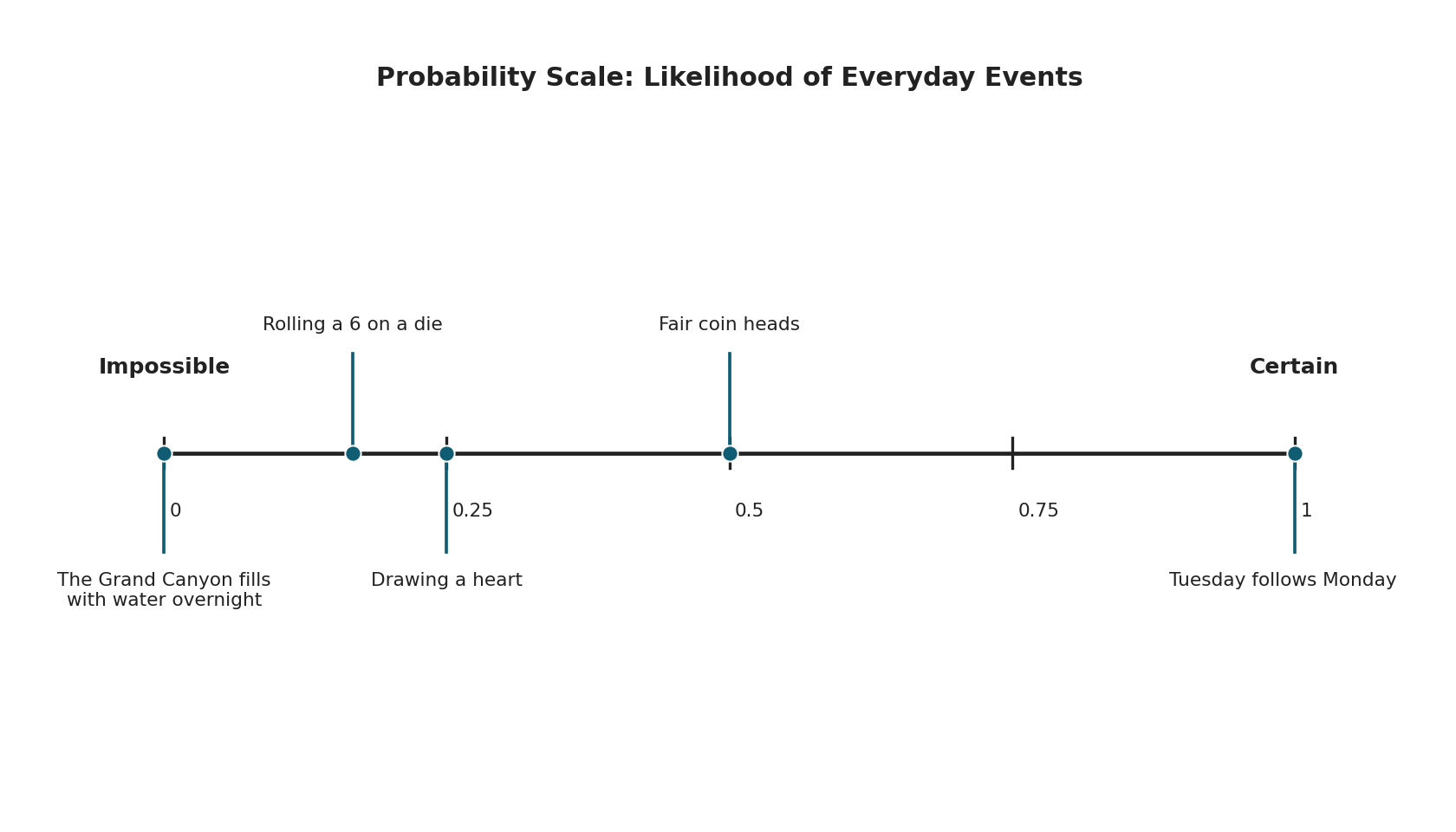
A fair coin landing heads, for example, has a probability of , right in the middle. An event with a probability of is very likely but not guaranteed. An event at is unlikely but not impossible. The closer the number is to , the more likely the event; the closer to , the less likely.
Here are a few familiar events placed on the scale to build your intuition:
| Event | Approximate Probability |
|---|---|
| Tuesday follows Monday | |
| Drawing a heart from a shuffled deck | |
| A fair coin lands heads | |
| Rolling a 6 on a fair die | |
| The Grand Canyon fills with water overnight |
🔢 Connecting Words to Numbers
In everyday conversation, we rarely say "there's a probability of rain." Instead, we use likelihood words. These words are handy, but each one maps to a range on the probability scale rather than a single precise number. Here is a rough guide:
| Likelihood Word | Approximate Range |
|---|---|
| Impossible | |
| Very unlikely | |
| Unlikely | |
| Possible / could go either way | |
| Likely | |
| Very likely | |
| Certain |
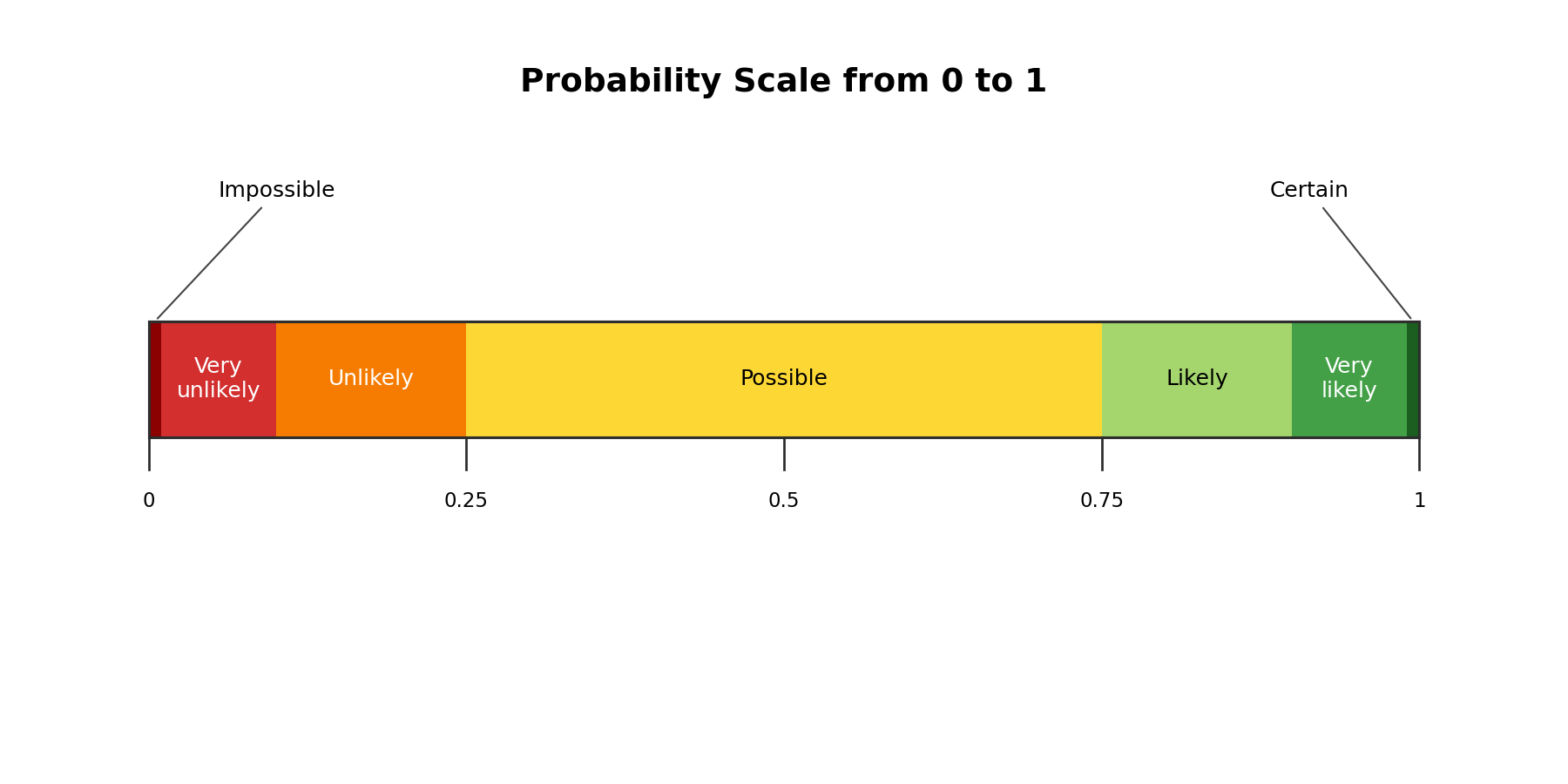
An even chance (sometimes called a "fifty-fifty") sits right at , meaning the event is just as likely to happen as not. When someone says an outcome is "likely," they generally mean somewhere above but below certainty. These ranges are not official rules carved in stone — they are useful approximations that help us translate between the way people naturally talk and the precision of numbers.
🧐 Why Likelihood Words Are Imprecise
Now that we have a map from words to numbers, let's look at why that map is blurrier than it first appears. Imagine two coworkers reading the same project update that says there is "a good chance of a delay." One coworker might read "a good chance" as roughly . The other might interpret it as . Neither person is wrong; the phrase itself is simply vague enough to support both readings.
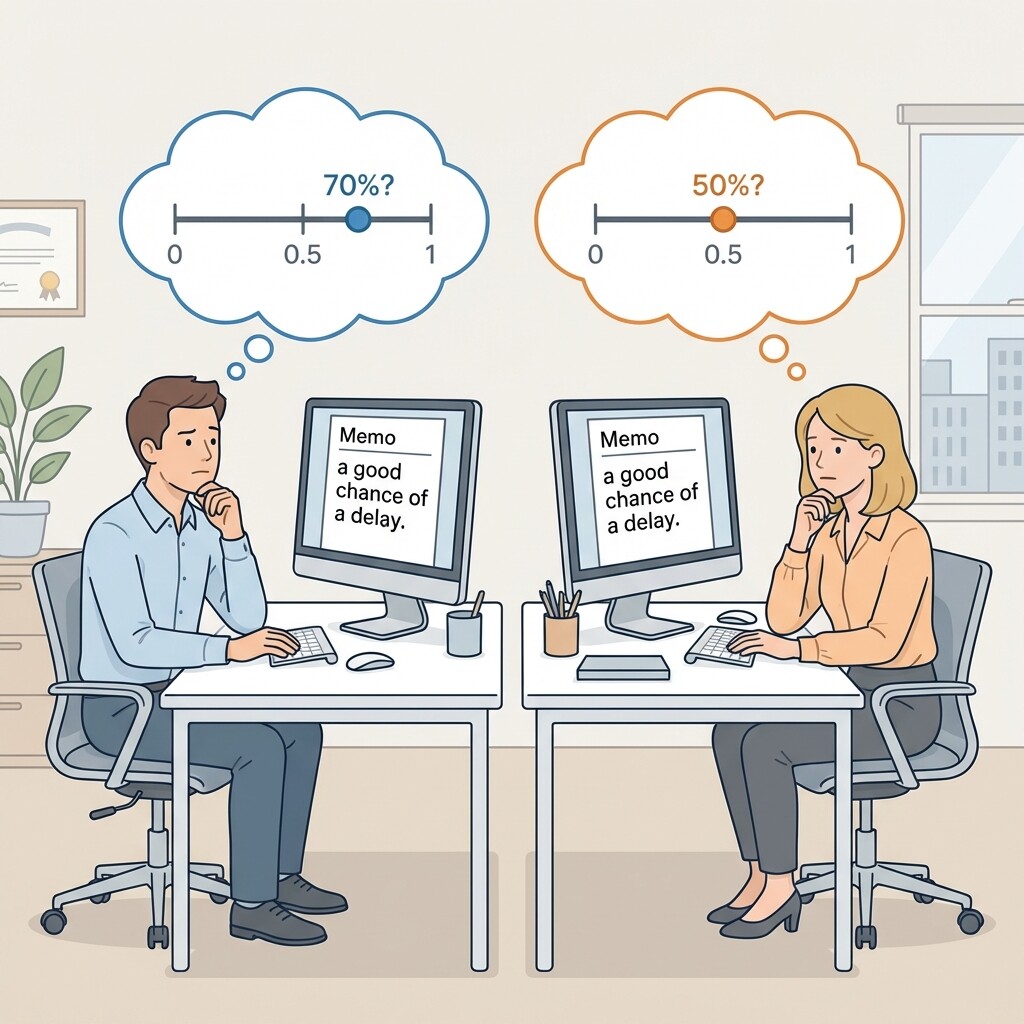
Research in decision science has repeatedly shown that when people are asked to put a number on words like "probable" or "unlikely," their answers vary widely. One person's "unlikely" might be , while another's is . This is not a flaw in anyone's reasoning — it is a natural limitation of qualitative language. Words describe a general region on the scale, not a pinpoint location.
This matters because important decisions in medicine, finance, and logistics can go very differently depending on whether "unlikely" means a 5% chance or a 20% chance. Recognizing this imprecision is the first step toward communicating about uncertainty more clearly, either by choosing words more carefully or by pairing them with actual numbers.
🎯 Placing Events on the Scale Yourself
With the scale, the word-to-number mapping, and a healthy respect for imprecision under your belt, you are ready to try the process yourself. Suppose someone asks: "What is the probability that a randomly chosen person in the U.S. was born in January?" There are 12 months, and January is one of them, so a reasonable starting estimate is:
That sits in the very unlikely zone, which matches our intuition: picking any single month for a random person is a long shot.
Now consider: "What is the probability that a local restaurant is open on a Wednesday evening?" Most restaurants are open midweek, so you might estimate something around to , placing it in the likely to very likely range. You might adjust slightly depending on the type of restaurant or the area, but the scale gives you a structured way to express your judgment.
Whenever you face a new uncertain event, follow these steps:
- Identify what you know about the event — facts, experience, or data.
- Estimate a number between and .
- Match it to a likelihood word to check whether the number feels right.
If the word and the number disagree, revisit your estimate. This back-and-forth between intuition and the scale is exactly how you sharpen your probability thinking over time.
Conclusion and Next Steps
In this lesson, you explored the probability scale from (impossible) to (certain) and practiced placing everyday events along it. You connected common likelihood words such as "unlikely," "even chance," and "almost certain" to approximate numeric ranges. Most importantly, you saw that these words are inherently imprecise — two people can hear the same phrase and picture very different numbers, which is exactly why learning to think in numeric probabilities is so valuable.
Up next, you will put these ideas to work in a set of hands-on practice tasks where you will match words to ranges, assign probabilities to real scenarios, and diagnose why vague language leads to miscommunication. Let's see how sharp your probability instincts already are!
