Building Tiny Rituals
📆 Building Tiny Rituals
The last lesson handled the big shock: a genuine setback, and how to stay honest and hopeful through it. But most days aren't dramatic. They're just full. Back-to-back meetings, three fires before lunch, a calendar with no white space in it. A positivity habit that needs ten quiet minutes will die the first time your day goes wall-to-wall. This lesson tackles the quieter threat: not the crisis, but the ordinary busy Tuesday that slowly erodes the habit.
In this lesson, you will learn to:
- Shrink a ritual and stack it onto a cue you already hit every day
- Choose a reliable cue that survives your worst Tuesday, not your best
- Protect the streak with a Never-Miss-Twice restart rule
🔗 Shrink It, Then Stack It
When a routine keeps collapsing, your instinct as a general manager is probably to recommit harder: block the calendar and promise yourself you'll really do it this time. That almost never works, because the problem was never your discipline. It was the size of the ritual and the fact that it floated free, waiting on spare time you don't have.
The move is called Habit Stacking: take one tiny positivity habit and bolt it onto a routine you already run every day. The formula is simple: "After I [current habit], I will [tiny positivity habit]." For example, "After I pour my morning coffee, I'll name one good thing from yesterday." You're not finding new time; you're borrowing a cue that already fires without fail.

Here's how a coach guides it. Natalie helps Dan, a colleague whose ten-minute gratitude habit keeps dying on packed days, shrink it into something that survives:
- Dan: I keep meaning to do that gratitude habit, but the second meetings pile up, it's gone.
- Natalie: So don't schedule it. Attach it. What's something you do every single day, no matter how slammed?
- Dan: Pour my first coffee, I guess.
- Natalie: Perfect. After you pour it, name one thing that went right. That's the whole ritual.
- Dan: That feels almost too small to count.
- Natalie: Small is exactly why it survives. Ten minutes dies on a busy day. Ten seconds doesn't.
Notice that Natalie never asked Dan for more discipline. She shrank the ritual and borrowed a cue that already happens daily.
⚓ Pick a Cue That Never Misses
Whether a tiny ritual sticks or quietly dies comes down to one choice: the cue you attach it to. That cue is your anchor — an action already wired so deeply into your day that it happens without a decision, like pouring your coffee or sitting down at your desk. When you bolt a new habit onto an anchor, the habit borrows that same automatic momentum instead of waiting on willpower or spare time, so it fires the moment the anchor does.
That is exactly why the choice of anchor matters so much. An unreliable cue depends on a good day showing up, so on a packed day it never fires and the ritual never happens. A reliable cue is something you genuinely do every single day, no matter how the day goes.
| ⚠️ Unreliable Cues (need a good day) | ✅ Reliable Cues (fire daily) |
|---|---|
| "During my afternoon lull" | Pouring your morning coffee |
| "When things quiet down" | Sitting down at your desk |
| "When I find a few spare minutes" | Opening your laptop for the first time |
Choose the anchor that survives your worst Tuesday, not your best one.
Once your cue is solid, the next layer is making the streak visible so the habit builds on itself. A simple streak marker — a checkbox on a sticky note, a tally in your phone, a coin dropped in a jar — turns an invisible habit into something you can watch building. That small visual is oddly motivating: you start to protect the chain rather than break it. Keep the marker as low-effort as the ritual itself, or it becomes one more thing to skip.
🔁 Never Miss Twice
Even a good plan gets broken, and here's where most people quit for good: one miss becomes proof they "can't stick to anything," so they drop the habit entirely. The rule that prevents that spiral is Never Miss Twice. A single skipped rep is just a moment, not a failure. Miss twice in a row, though, and you've quietly started a new, unhelpful habit. So the promise isn't "never miss." It's "never miss twice," which turns a slip into a shrug and a fast restart instead of a collapse.
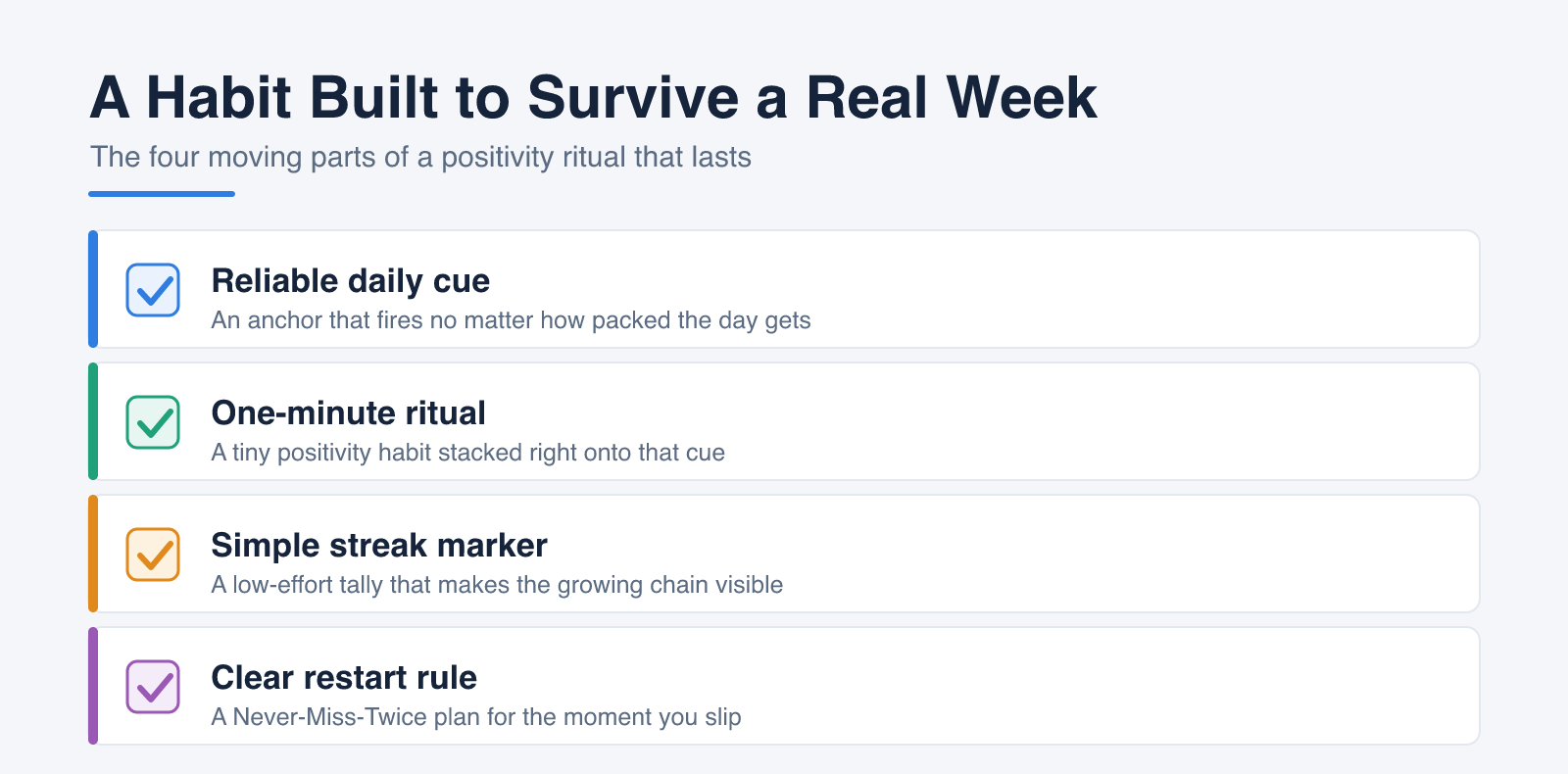
Put it together and you have a seven-day plan with four moving parts:
- A reliable daily cue that fires no matter how packed the day gets
- A one-minute ritual stacked onto it
- A simple streak marker to make the chain visible
- A clear restart rule for the moment you slip
That's a habit built to survive a real week, not an ideal one.
The takeaway is small on purpose: a tiny ritual glued to a cue you already hit, plus a restart rule, beats an ambitious routine that folds on the first busy day. Next, you'll lock in these moving parts with a quick concept check, coach a colleague through shrinking a routine that quit on them, and reflect on the seven-day plan you'll run this week.
