Running Your Playbook
📕 Running Your Playbook
You've built a full kit across this path: catching harsh self-talk, reframing, gratitude and savoring, coaching yourself like a good friend, encouraging others, and a reset for genuine setbacks. A tough day rarely hands you just one of those. It hands you several, back to back, before lunch. This lesson is about knowing which tool to reach for in the moment, and keeping the whole kit in one place you can actually grab when you're stretched thin.
In this lesson, you will learn to:
- Match the right tool to each kind of tough-day trigger
- Assemble a one-page playbook from the pieces you've already built
- Pressure-test the playbook yourself so it holds up before the hard day arrives
🛠️ The Right Tool for the Moment
The hard part isn't the techniques anymore. It's matching the right one to what's actually in front of you. Reach for gratitude when what you needed was a reframe, and it lands hollow. So here's a quick guide you can hold in your head:
| When You Face... | Reach For |
|---|---|
| One specific thought looping ("I always drop follow-ups") | Catch-Check-Choose |
| Your inner critic in the heat of a moment | Self-Talk Swap |
| Something genuinely big going wrong (missed target, blown deadline) | Honest Hope Reset |
| An overlooked win | Savoring |
| A flat, gray stretch with nothing specifically wrong | Gratitude |
| A discouraged teammate | Encouragement |
The move is to name the tool by the shape of the trouble, not by the mood. Here's how that plays out. Chris, a general manager, talks a rough client email through with his colleague Simone:
- Chris: A client email just tore into my proposal and my head's already at "I've blown the whole account."
- Simone: That's one specific thought spiralling. Sounds like a Catch-Check-Choose, not a full reset.
- Chris: Right, catch it, then check what's actually true. The email says "unclear," not "you're fired."
- Simone: Exactly. And later, when you land the fix, don't blow past it. Savor it for ten seconds.
- Chris: So a different tool for a different moment, not one big positivity switch.
Notice that Simone names the tool by the shape of the trouble, not by how bad Chris feels. That's the whole move.
📋 Assembling Your Playbook
Once you can pick the right tool live, the next step is to write it all down in one place. That's your Personal Positivity Playbook: a single page with eight compact sections you can reach for on a hard day.
- Motivation — why this habit is worth the reps
- Triggers — the emails, delays, and pile-ups that reliably knock you sideways
- Daily rituals — the gratitude or savoring you've stacked onto a cue
- Go-to reframes — built on Catch-Check-Choose
- Self-talk lines — for your toughest recurring moments
- Encourage others — using Acknowledge-Appreciate-Advance
- Pressure reset — the Honest Hope Reset for genuine setbacks
- Restart-after-a-slip promise — built on Never Miss Twice
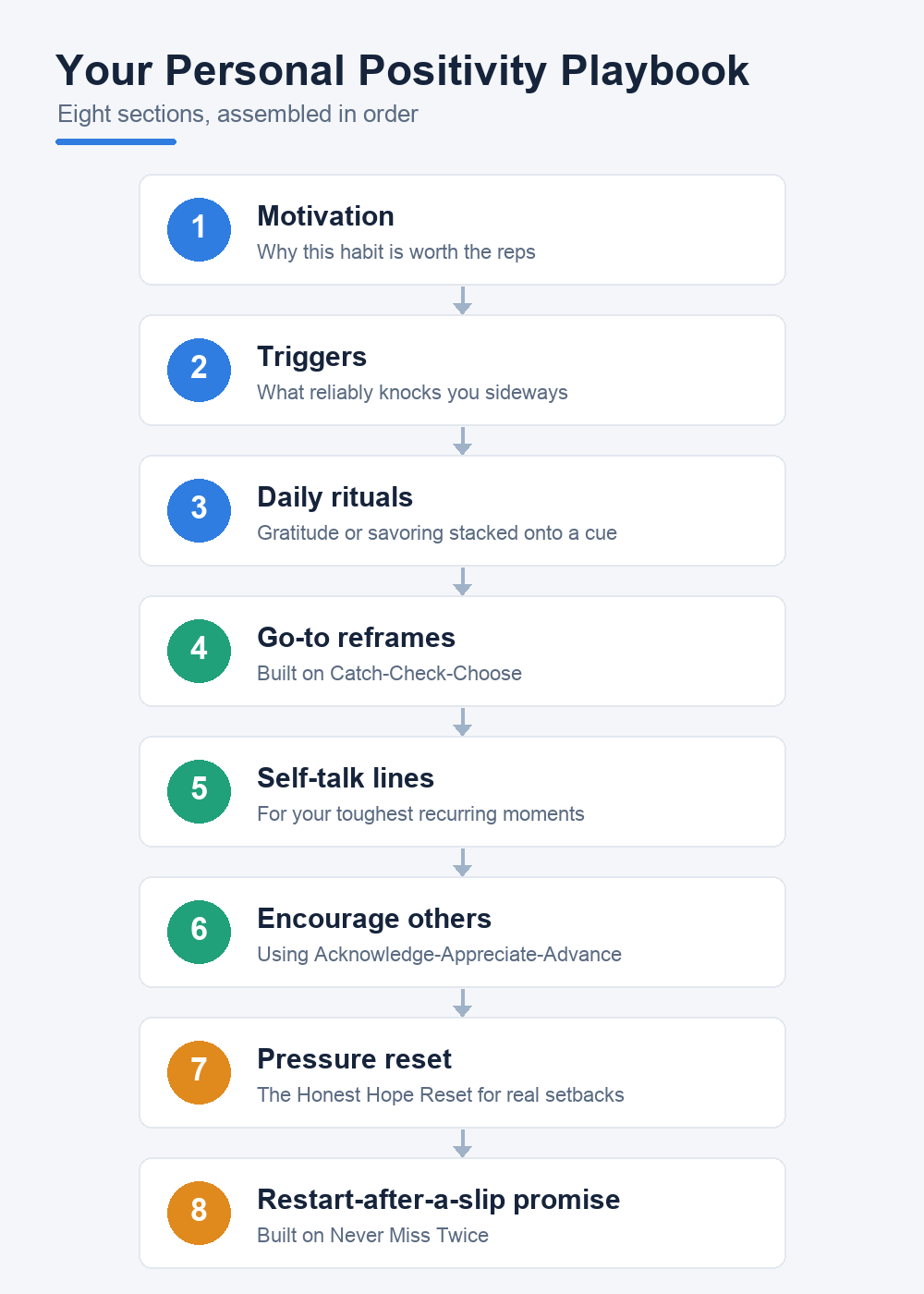
Here's the good news: you're not writing this from scratch. Every section is an artifact you've already built somewhere across this path. You're pulling those pieces forward and slotting each into its matching slot. The playbook is an assembly job, not a blank page.
🌋 Keeping It Alive Under Pressure
A written playbook has one quiet failure mode: it drifts into vague affirmations that read nicely and do nothing. "Stay positive" is not a tool. So the last move is to pressure-test it yourself before a hard day arrives, not during one.
Run a quick two-minute self-check on your own playbook, reading it with a skeptic's eye and giving yourself three jobs:
- Flag every fuzzy line. For each entry, ask "what exactly would I do here?" Rewrite anything that can't survive that question into a specific, honest action — turn "stay calm" into "name the one fact I actually know before I reply."
- Hunt for the gap. Look for a trigger you left out or a restart rule that wouldn't hold on a truly packed day, and patch it now, while you're calm.
- Walk one real tough day in your head. Picture a specific rough morning, then point to the exact slot you'd reach for at each moment — the reframe here, the reset there — so the retrieval is rehearsed, not improvised.
Refuse to let yourself off with empty cheerleading; the goal is an honest critique, not a pep talk. Done as a short rehearsal whenever you sense a rough day coming, this is what keeps positivity something you practice on purpose rather than something you merely hope for.
The one takeaway to carry: a tough day doesn't need more willpower, it needs the right tool at the right moment, kept somewhere you'll actually reach for it. Ahead of you sits a short arc: a quick matching drill to sharpen your tool-to-trigger instincts, a coaching session where you walk a colleague through assembling her own playbook section by section, and the assembly and honest pressure-testing of your own one-page playbook.
