Staying Honest and Hopeful
📣 Welcome to the Course
Welcome to Make Positivity Stick Under Pressure! As a manager, pressure rarely announces itself politely. A target gets missed, a launch slips, a key hire walks, and your team looks to you to read the moment. This whole course is about keeping your optimism honest and useful exactly when it's hardest: under real stress, on busy days, and right after a slip. This first lesson tackles the hardest case, staying honest and hopeful when a genuine setback lands, without pretending everything is fine.
In this lesson, you will learn to:
- Run an Honest Hope Reset to stay grounded and hopeful through a real setback
- Separate confirmed facts from the worst-case doom story your mind spins up
- Land on one controllable next step and capture it on a setback reset card
⚖️ Naming Reality Without the Doom
When something goes genuinely wrong, your mind usually pulls you toward one of two ditches. The first is denial: "It's fine, don't worry about it," which ignores a real problem until it grows. The second is catastrophizing: jumping straight to the worst possible ending, where one bad month becomes proof the whole plan is doomed. Both feel like coping. Neither helps you lead.
The tool that keeps you out of both ditches is the Honest Hope Reset. It has five small moves:
- Name the hard reality — say what actually happened, plainly.
- Separate facts from the worst-case story — sort what you know from what you fear.
- Identify what's in your control — set the rest aside for now.
- Choose one small next step — something you can start today.
- Notice one source of good or support — a person, a strength, or a resource.
Think of it as a way to be honest and hopeful at the same time, rather than picking one and losing the other.
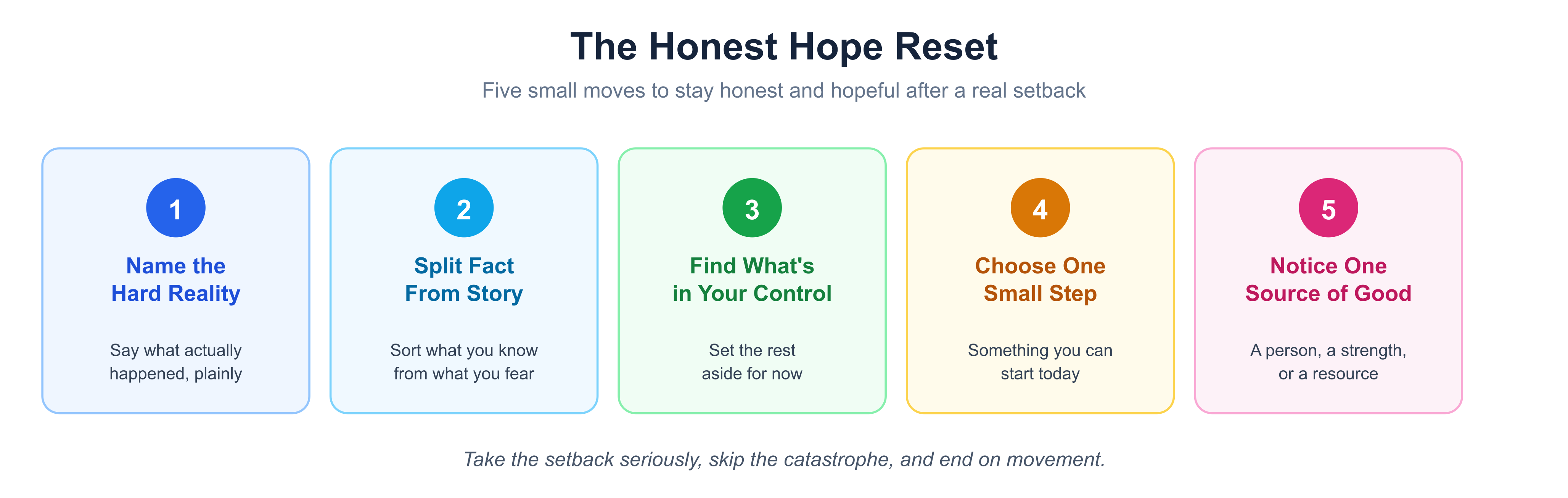
The whole reset hinges on the second move: telling the difference between what you actually know and the story you've wrapped around it. Here's how that sounds when a setback hits. Matt, a team lead, has just seen a missed month, and his manager Meredith walks him through the reset in real time:
- Matt: We came in below plan again. That's it, the whole strategy is getting scrapped.
- Meredith: Hold on. What do we actually know for sure?
- Matt: ...that we're down for the month. One month.
- Meredith: Right. "Down one month" is the fact. "Strategy is getting scrapped" is the story we just added. So what's still in our hands this week?
- Matt: We could pull the three accounts that stalled and call them before Friday.
- Meredith: That's exactly where I'd start. You're not brushing the miss aside, you're just refusing to let it write the whole ending for you.
Notice that Meredith never says "it's fine." She takes the miss seriously and still refuses to let it balloon into a catastrophe. That balance is the entire skill.
🔍 Facts Versus the Doom Story
Under stress, your brain is a fast, sloppy storyteller. It takes one confirmed data point and fills the rest in with fear. The fix is to sort every claim into two buckets: assumed and confirmed.
| ❓ Assumed Story | ✅ Confirmed Facts |
|---|---|
| Predictions and mind-reads riding on top | Point to them on a report or a calendar |
| "Leadership will lose all faith" | "Revenue came in eight percent under target" |
| "We'll be blamed for this" | "The review is tomorrow morning" |
| "This is the beginning of the end" | "Two accounts went quiet" |
The trap is that the assumptions feel just as true as the facts, so they drive your mood and your decisions as if they were real. So when you catch yourself spiraling, ask a plain question out loud: "What do I actually know for sure?" versus "What am I predicting?"
Usually the confirmed pile is smaller and far more manageable than the story suggested. When you actually write out what you can point to, it is often just one or two concrete facts, while the assumed pile is a long tail of predictions your fear stacked on top. The miss is real, and it matters, so name it plainly instead of softening it: a missed quarter can mean lost momentum, an uncomfortable review, and a target you now have to climb back toward, and pretending otherwise only leaves you less prepared. But "we missed by eight percent this quarter" is a bounded, solvable problem, while "the whole plan is doomed" is just fear wearing a suit. Naming the difference shrinks the setback back down to its real size, so your energy goes to the part you can actually act on.
👉 One Controllable Next Step
Once the story is trimmed down to facts, the reset ends on movement. You finish by finding what's controllable, picking one small next step, and noticing one source of good or support, then you write it down. That's your setback reset card: a short, honest note that names the hard reality, splits fact from doom story, points to one steadying source of support, and lands on a single doable action.
The key word is one. Not a five-point recovery plan you'll never start, but one step small enough to take today: message the data owner for a timeline, draft the review with placeholders, or call the three stalled accounts before Friday. A small action you actually complete beats a grand plan that stays on the whiteboard, because momentum is what quiets the doom story for good.
The heart of this lesson is simple: a genuine setback deserves to be taken seriously, but it does not deserve the catastrophe your mind adds for free. Next, you'll sort a mix of claims into confirmed facts and assumed story, coach a spiraling colleague back to a fairer read, and write your own setback reset card so each step feels natural before you need it under pressure.
