Imagine following a straight route across a coordinate plane. The points where the route crosses the axes are useful checkpoints: one tells you the output when the input is zero, and the other tells you when the output becomes zero. These checkpoints are called intercepts.
This is the third of five lessons in Linear Graphs, Slope, and Intercepts. In the first lesson, you identified linear relationships; in the second, you described their constant change with slope. Now you will connect a line’s axis crossings to equations and to situations such as starting costs and balances reaching zero.
You will read intercepts from graphs, calculate them by substitution, and decide whether an intercept makes sense in context. Start with the geometric reason that zero appears in both procedures.
See Intercepts as Axis Crossings
Name Each Intercept Correctly
Read Intercepts from a Graph
Handle Lines with a Missing Intercept
Calculate Intercepts by Setting One Variable to Zero
Be a part of our community of 1M+ users who develop and demonstrate their skills on CodeSignal
An axis is a collection of points that share one coordinate. Every point on the x-axis has a vertical coordinate of 0, and every point on the y-axis has a horizontal coordinate of 0.
x-axis:y-axis:y=0x=0
Setting one coordinate to zero is not an arbitrary algebra trick; it places the point on the selected axis. Once you know which coordinate must be zero, the remaining coordinate tells you exactly where on that axis the line crosses.
An x-intercept is where a graph meets the x-axis. A y-intercept is where a graph meets the y-axis.
Intercept
Axis it lies on
Coordinate forced to zero
Ordered-pair pattern
x-intercept
x-axis
y=0
(a,0)
y-intercept
y-axis
x=0
(0,b)
The name comes from the axis the graph meets—not from the coordinate you set to zero. This is why an x-intercept has the form (a,0), while a y-intercept has the form (0,b).
For a function y=f(x), an x-intercept is an input a for which the output is zero, while the y-intercept is the output when the input is zero:
An intercept can have a positive, negative, fractional, or zero coordinate. The essential feature is that the correct coordinate equals zero.
Once the names are clear, you can find intercepts visually by locating where the line crosses each axis. Use the axis labels carefully, especially when one grid square represents more than one unit.
Find where the line meets the horizontal axis.
Read the corresponding x-coordinate and write the point as (x,0).
Find where the line meets the vertical axis.
Read the corresponding y-coordinate and write the point as (0,y).
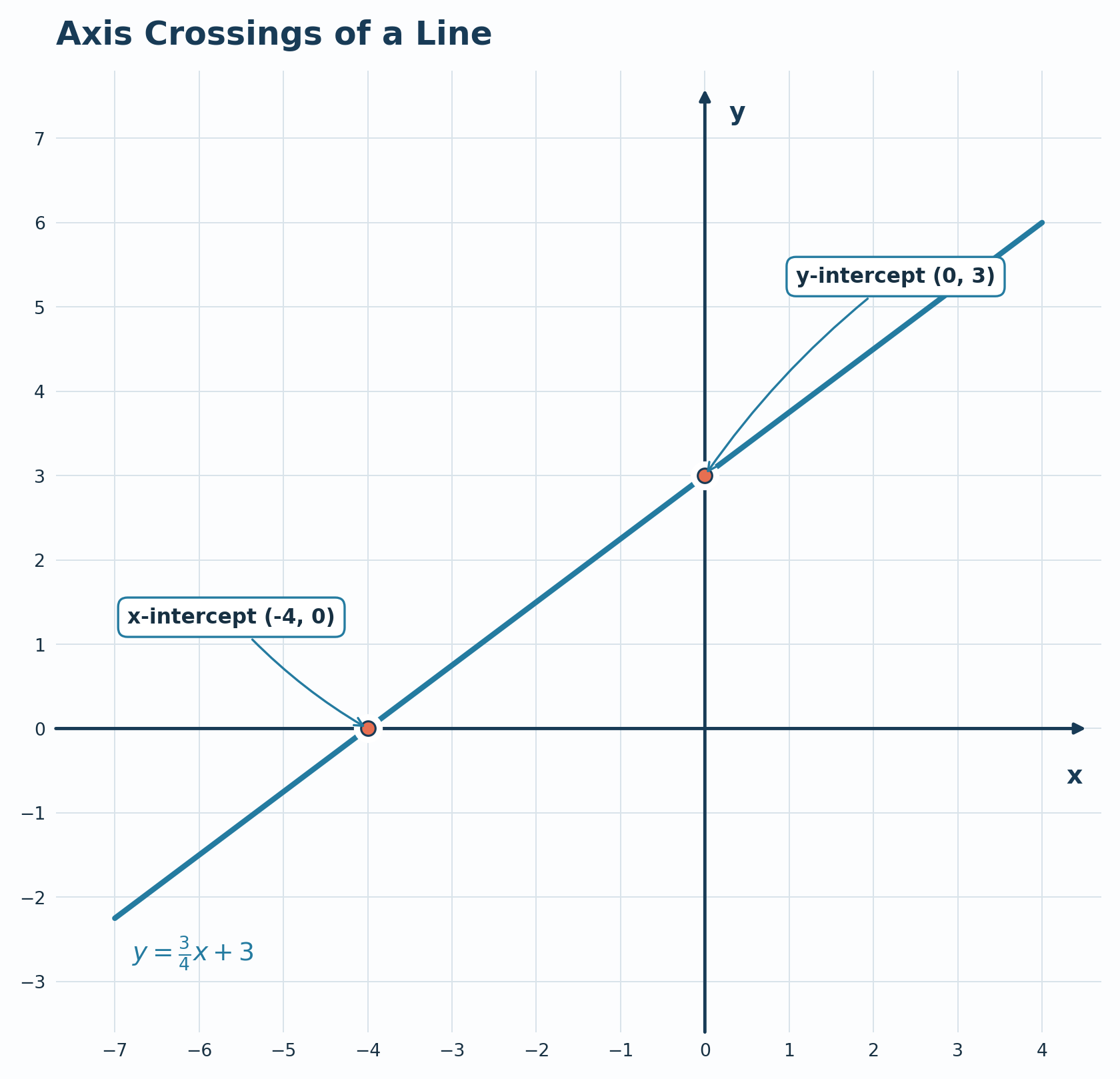
Suppose a line crosses the x-axis at −4 and the y-axis at 3. Its intercepts are:
x-intercept=(−4,0),y-intercept=(0,3)
The negative x-coordinate means the x-intercept is to the left of the y-axis. If the line crosses at the origin, the point (0,0) is both an x-intercept and a y-intercept.
For a complete line that is neither horizontal nor vertical, one crossing with each axis is typical. However, a line can be parallel to one axis and never meet it.
Equation
Shape
Intercepts
y=5
Horizontal
y-intercept (0,5) only; no x-intercept
x=−2
Vertical
x-intercept (−2,0) only; no y-intercept
y=2x
Nonhorizontal line through the origin
Both intercepts are (0,0)
A vertical line such as x=−2 can have an x-intercept even though it is not a function of x. Therefore, check the line’s shape instead of assuming that every line can be written as y=mx+b.
The coordinate axes themselves are special cases. If the equation is y=0, the graph is the entire x-axis, so every point (a,0) is an x-intercept and (0,0) is its y-intercept. If the equation is x=0, every point (0,b) is a y-intercept and (0,0) is its x-intercept.
When a line is described by an equation, the axis definitions tell you exactly which substitution to make.
Desired intercept
Set this equal to zero
Solve for
Write the point as
x-intercept
y=0
x
(x,0)
y-intercept
x=0
y
(0,y)
Consider the equation y=2x−6. To find the x-intercept, set y=0 and solve for x:
02xx=2x−6=6=3⟹x-intercept=(3,0)
To find the y-intercept, set x=0 and solve for y:
y=2(0)−6=−6⟹y-intercept=(0,−6)
The zero coordinate confirms that each answer is written on the correct axis. This same method works whether the equation is written in slope-intercept form, standard form, or another equivalent form.
The slope-intercept form from the previous lesson is y=mx+b. When m=0, its intercepts can be found efficiently:
y-interceptx-intercept=(0,b)=(−mb,0)(m=0)
The first result comes from setting x=0, which leaves y=b. The second comes from setting y=0 and solving 0=mx+b for x.
If b=0 and m=0, the line passes through the origin, so both intercepts are (0,0). If m=0 and b=0, the graph is horizontal and has only a y-intercept. When m=b=0, the equation is y=0, which is the special axis case described earlier.
Not every linear equation is solved for y. For an equation such as 3x+2y=12, you can still find each intercept by substituting zero directly.
For the x-intercept, set y=0:
3x+2(0)=12⟹3x=12⟹x=4
Therefore, the x-intercept is (4,0).
For the y-intercept, set x=0:
3(0)+2y=12⟹2y=12⟹y=6
Therefore, the y-intercept is (0,6). Substitution is often quicker than rearranging the entire equation when the only goal is to find axis crossings.
Finding a coordinate is only the first step; the context explains what that coordinate represents. When the input measures time since an event began, x=0 often marks the starting moment, so the y-intercept can represent an initial value.
Suppose the total cost of a subscription is modeled by:
C(m)=12+5m
Here, m is the number of months since signing up, and C(m) is the total cost in dollars. At the starting moment,
C(0)=12
The y-intercept is (0,12), meaning the subscription begins with a total cost of 12 dollars. The first coordinate represents 0 months, and the second represents the starting cost.
Do not automatically call every y-intercept an initial value. If the input value of zero does not represent the beginning of the situation, the safest interpretation is simply that the output equals the y-intercept when the input is zero.
The x-intercept answers a different question: When does the output become zero? In a real situation, that moment might represent a balance being paid off, remaining distance reaching zero, or inventory running out.
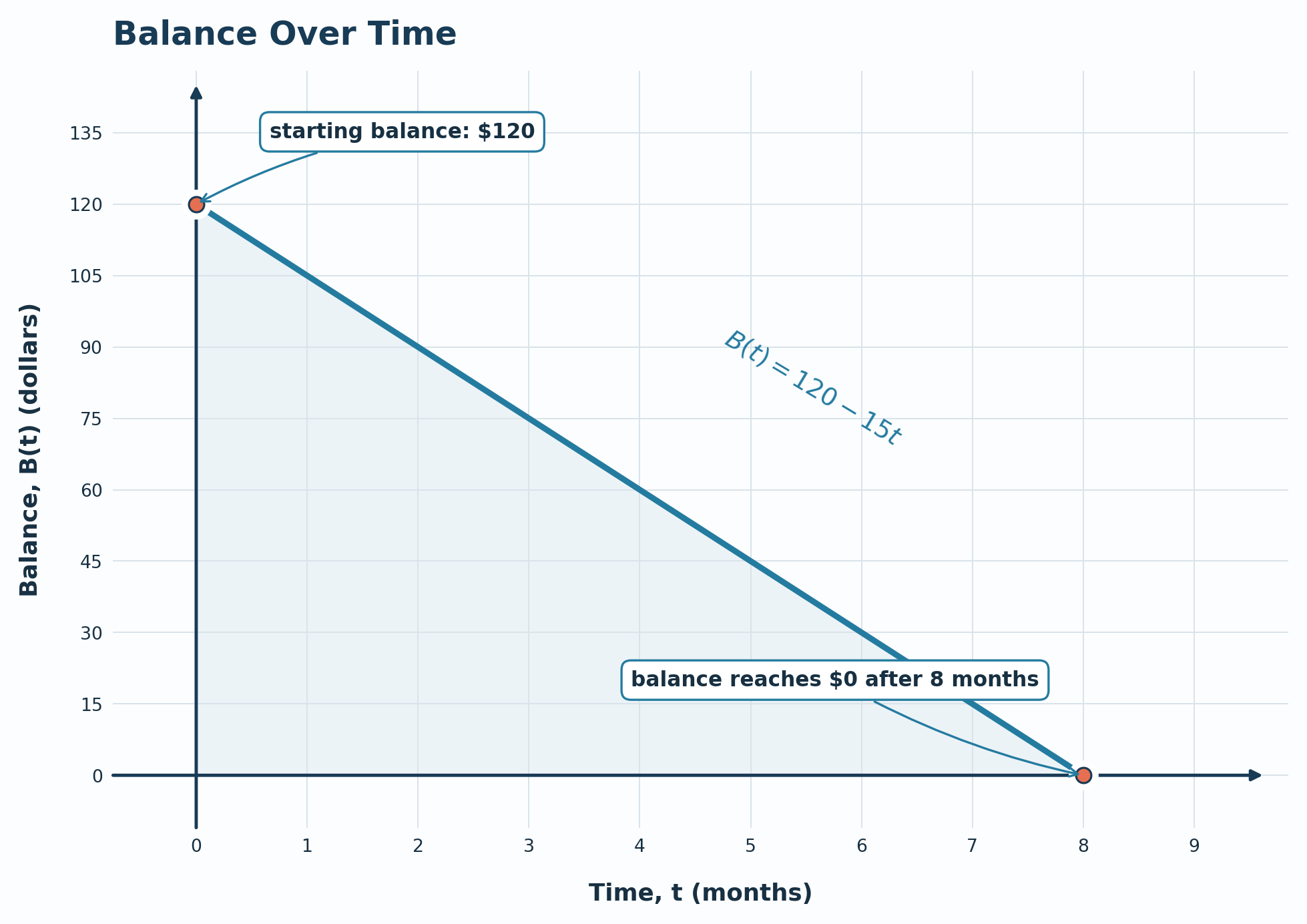
Suppose a balance is modeled by:
B(t)=120−15t
Here, t is the number of months, and B(t) is the balance in dollars. Set the balance equal to zero:
0=120−15t⟹15t=120⟹t=8
The x-intercept is (8,0). It means the balance reaches 0 dollars after 8 months: the first coordinate gives the time of the event, and the second confirms that the balance is zero.
If the model is intended to describe the balance only until it is paid off, then t=8 is the meaningful endpoint. The same algebraic idea applies to any quantity whose value reaching zero marks an important event.
A line can have a mathematically valid intercept that does not describe a meaningful event in context. The domain is the set of allowed input values, so an intercept outside that set should not be interpreted as a real-world outcome.
Return to the subscription model C(m)=12+5m. Setting the cost equal to zero gives:
0=12+5m⟹m=−512=−2.4
The extended line has an x-intercept at (−2.4,0), but negative months do not make sense if m measures time since signing up. Before interpreting an intercept, check:
whether the input value is allowed in the situation;
whether an output of zero represents a real event;
whether the coordinates have the correct units; and
whether the intercept is outside the visible graph only because the viewing window is limited.
Separating mathematical existence from contextual meaning helps you avoid giving an algebraically correct but unrealistic explanation.
Common error
Better approach
Setting x=0 to find the x-intercept
Set y=0 because the x-intercept lies on the x-axis.
Setting y=0 to find the y-intercept
Set x=0 because the y-intercept lies on the y-axis.
Writing an x-intercept as (0,a)
Write it as (a,0).
Assuming every line has both intercepts
Check for horizontal, vertical, or axis lines.
Treating a negative or fractional coordinate as an error
Read its location and check whether the context allows it.
Calling every y-intercept an initial value
Confirm that input zero represents the beginning.
Treating every x-intercept as a meaningful event
Check the domain, units, and meaning of an output of zero.
Reporting only a coordinate value
Give the full ordered pair and explain its meaning when needed.
A quick coordinate check catches many mistakes: the second coordinate of an x-intercept must be zero, and the first coordinate of a y-intercept must be zero.
Use this routine when working from a graph, an equation, or a real-world model:
Identify the input and output quantities, including their units and allowed domain.
For the x-intercept, set the output y equal to zero, solve for x, and write the full point as (x,0).
For the y-intercept, set the input x equal to zero, solve for y, and write the full point as (0,y).
Check the graph’s axis scale or substitute the result back into the equation.
Interpret the intercept only after confirming that its input and output make sense in context.
This routine connects the algebraic substitution to the geometric location. The zero is not just a calculation step; it is what places the point on an axis.
An x-intercept lies on the x-axis, so its y-coordinate is zero; a y-intercept lies on the y-axis, so its x-coordinate is zero. Setting the appropriate variable to zero connects the algebraic solution to the point on the graph. In context, the y-intercept may be an initial value and the x-intercept may mark a zero-output event, but the domain and units determine whether that interpretation is valid.
The practice section that follows starts with seeded graphs: you will locate crossings, enter their coordinates, calculate intercepts from equations, and explain an intercept in a subscription, balance, or distance context. Keep checking the zero coordinate, units, and domain so your answer is both mathematically correct and meaningful.