Collaborate Through Diverse Perspectives
Value Different Perspectives to Spark New Ideas ✨
Teams are stronger when everyone brings their own way of thinking. People have different backgrounds, experiences, and ideas—and that’s a good thing! When you work with people who see things differently, your team can come up with creative solutions that you might not think of on your own.
For example, someone who’s used to working with limited resources might spot ways to save time or money that others miss. Another teammate who’s felt like an outsider before might notice if your project accidentally leaves people out. Someone who’s worked in a totally different field could suggest a new approach that seems unusual at first, but ends up being just what your team needs. These different ways of seeing things aren’t just helpful—they’re what help your team avoid mistakes and come up with great ideas.
You can value different perspectives by:
- Asking everyone what they think, even if their idea is different.
- Noticing when someone brings up something new and saying, “That’s an interesting point. Tell us more!”
- Remembering that everyone’s background and experience can help the team.
🗣️ Invite Everyone to Share Their Ideas
It’s important to make sure everyone feels comfortable sharing their thoughts. Sometimes, people might be quiet because they’re worried their idea is too different or won’t be understood. You can help by inviting everyone to speak up and showing that all ideas are welcome.
If you notice someone hasn’t spoken yet, you might say, “Samir, what do you think?” Or, if someone shares a new idea, you can respond, “Thanks for bringing that up! Has anyone else seen something like this before?”
Here’s a simple team conversation:
- Milo: I’m not sure if this will work, but what if we try a different way to organize our files?
- Nova: That’s a good idea, Milo. Can you show us what you mean?
- Milo: Sure! I used this system at my last job, and it saved us a lot of time.
- Jake: I like that you brought in your past experience. Maybe we can test it out for a week and see how it goes?
In this conversation, Milo shares a new idea based on past experience, and the team responds with interest and support, suggesting they try out the new system together. This shows how welcoming different perspectives can lead to helpful changes for the whole team.
By inviting and encouraging everyone to share, you help your team find new solutions and make sure no good idea gets left out. You can also make sure everyone is included by going around the group and asking each person for their thoughts. Another helpful approach is to use sticky notes or a shared document so everyone can write down their ideas before the discussion starts. No matter what, remember to thank people for sharing, even if their idea is different from yours.
Combine Different Ideas for Better Solutions 🧩
The best solutions often come from mixing different ideas together. Instead of picking just one person’s idea, see if you can combine the best parts from everyone. One helpful way to do this is by using the SCAMPER technique, which is a set of questions that help you look at ideas in new ways. SCAMPER stands for Substitute, Combine, Adapt, Modify, Put to another use, Eliminate, and Reverse. You can use these prompts to help your team build on each other’s suggestions and create something even better.
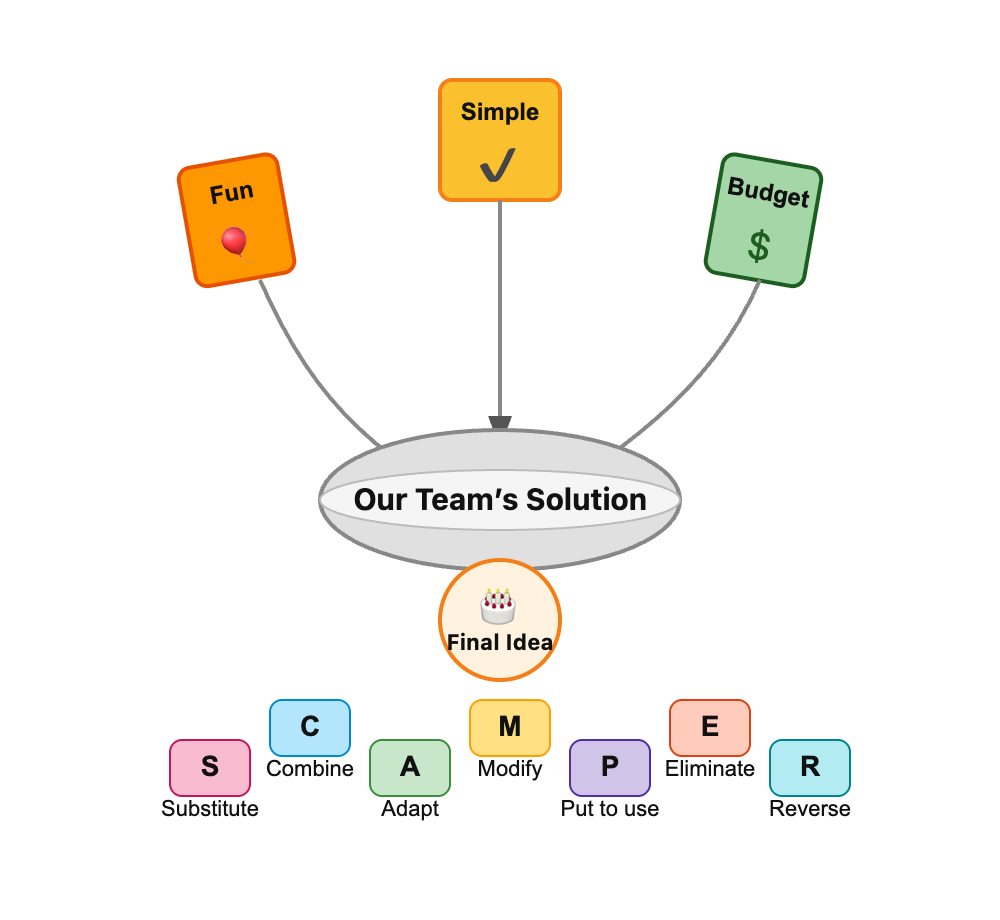
Let’s say your team is planning an event. One person wants to keep it simple, another wants to make it fun with games, and someone else is worried about the budget. Instead of choosing just one idea, you might use SCAMPER to guide your thinking. You could Combine ideas by saying, “What if we have a simple event, but add one or two fun games that don’t cost much?” Or you could Modify the plan by making the games shorter or easier to set up. This way, you’re using everyone’s input and the SCAMPER questions to make a plan that works for the whole team.
You can use the SCAMPER technique by:
- Asking, “How can we combine these ideas?” or “What could we change or adapt to make this work for everyone?”
- Looking for ways to solve problems by mixing, modifying, or rethinking suggestions.
- Checking in with the team to see if the new plan feels right to everyone.
When you bring together different perspectives, invite everyone to share, and combine ideas, your team will be more creative and find better solutions. Next, you’ll get to practice these skills by working through real-life team scenarios and seeing how different viewpoints can help your team succeed.
