Making Safe Fast Calls
Making Safe Fast Calls ⏱️
Last lesson gave you a way to state confidence you can defend when you have time to build a range. But what happens when the clock is running: a system outage during peak hours, a key supplier missing a delivery, a customer escalation about to go public, and someone is demanding a call in the next ten minutes? The reflex is to treat speed and rigor as opposites, to assume that deciding fast means deciding blind. This lesson challenges that assumption. The real question worth sitting with: is the pressure you feel an actual deadline, or just discomfort with looking uncertain?
In this lesson, you will learn to:
- Tell a genuine decision deadline from manufactured pressure to look certain
- Run the Safe Fast Check to make a fast call safe and reversible
- Document a provisional call so a stopgap does not quietly harden into policy
Is It a Real Deadline, or Just Pressure to Look Certain? 🚦
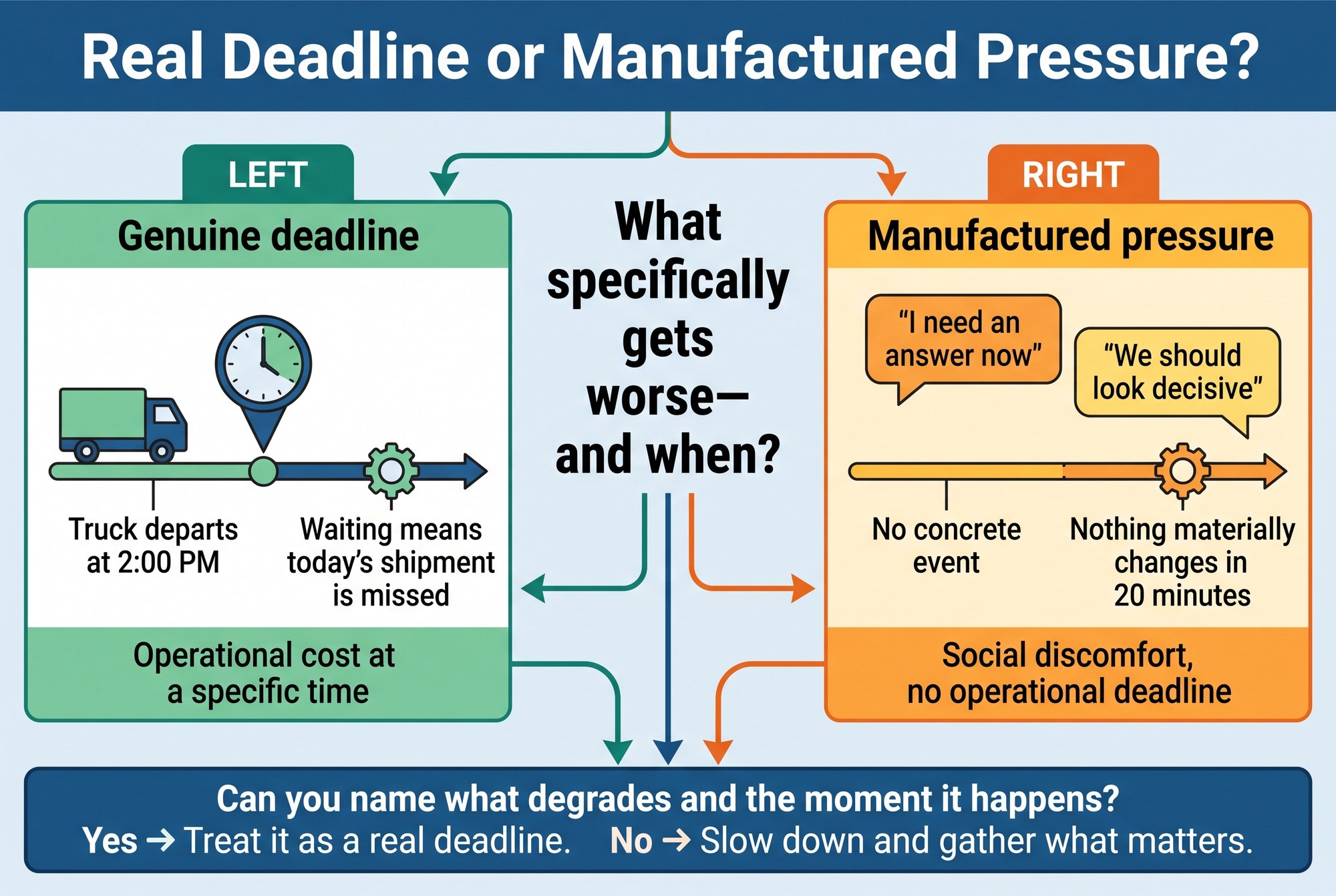
Start by questioning the urgency itself rather than the decision. Before you weigh options, work out whether the clock is genuinely running. That demand is the thing to question: before you accept it, work out whether a real operational cost is forcing the timing or whether someone is simply uncomfortable sitting with an open question. So when someone says "I need an answer now," ask what concretely gets worse if you take another twenty minutes. A genuine decision deadline has a real operational cost to waiting: a truck leaves the dock, a shift starts uncovered, a promotional window closes, a customer walks. You can name the thing and the time it bites.
Mere pressure has no such cost. It is social, not operational. Someone in the room wants to feel resolved, or you want to look decisive, or a loud voice has confused volume with time-sensitivity. The test is blunt: if you cannot name the specific thing that degrades at a specific moment, the deadline is manufactured. And here is the uncomfortable part for most managers: a surprising share of "decide right now" moments are the manufactured kind wearing an operational disguise. Sorting the two is the first move, because it tells you whether you're actually short on time or just short on comfort.
Running the Safe Fast Check ✅
When the deadline is real, you still don't have to gamble. The Safe Fast Check is a two-minute routine, not a two-hour deliberation, and it keeps a fast call from becoming a blind one. Run these five steps:
- Define the immediate objective in one sentence.
- Scan for a catastrophic downside — the kind you cannot walk back.
- Seek one disconfirming signal, a single fact that would prove your instinct wrong.
- Check your bias: are you anchoring on the first report you heard, or reacting to the most vivid disruption rather than the most important one?
- Choose the safest reversible action, and set an escalation trigger and a review time.
For example, a warehouse system flags a possibly miscounted pallet minutes before a truck departs. The objective is to ship on time without sending the wrong goods; the catastrophic downside is a customer receiving the wrong order; the disconfirming signal is a thirty-second manual recount; and the safe, reversible action is to load the verified pallets now and hold the disputed one for the next truck, with a review once the count is reconciled.
What makes the whole routine work is reversibility. When you choose an action you can undo and pair it with a set review time, you get speed and safety at once, because a wrong call costs you minutes instead of the quarter.
Here is how the Safe Fast Check sounds in a live crisis, when a store's payment system fails mid-shift and Chris, the store lead, brings it to Dan, the manager on duty:
- Chris: The payment vendor is down across all registers. Do we switch to the backup processor now or wait for their fix?
- Dan: What breaks if we take ten minutes?
- Chris: Nothing catastrophic. We can run cash. But queues build fast.
- Dan: So the objective is keep checkout moving without locking us into something we can't undo. Is switching to backup reversible once they're up?
- Chris: Yes, it's a same-day toggle.
- Dan: Then flip to backup, offer cash to anyone who prefers it, and we review at the top of the hour. If the vendor isn't back by then, escalate to regional.
Notice Dan never gathered everything. He named the objective, confirmed the action was reversible, and set a review time. That's the whole discipline.
Documenting the Provisional Call 📝
The fast call isn't finished the moment you make it. Because you decided under pressure and on partial information, you owe a short record — and the point is not paperwork. A quick record protects you from the two predictable ways a good fast call goes wrong later:
- The stopgap that hardens into policy. A temporary fix quietly becomes permanent because no one ever revisited it.
- The sound call that looks reckless in hindsight. A perfectly reasonable decision seems careless later because no one wrote down the reasoning while it was fresh.
So capture four things while the decision is still warm:
- The response you chose, and why it was the safest reversible option.
- The guardrails that constrain it.
- The escalation triggers—the conditions that mean it's time to raise the alarm.
- What you'll verify once the pressure lifts.
For the payment-vendor call, that record is one line each: the response was switch to the backup processor and keep cash open; the guardrail was only until the vendor is back; the escalation trigger was not restored by the top of the hour, so call regional; and the item to verify was did any transactions fail to reconcile across the two processors? That last piece matters most, because naming what's still provisional versus what's settled keeps your team from treating a five-minute call as the final answer.
Speed and rigor are not enemies because a reversible action plus a review time lets you have both. Taking a moment for this check is always faster than recovering from a wrong call. In the practice activities after this lesson, you will distinguish real deadlines from manufactured pressure, run the Safe Fast Check against the clock, and document a provisional call while asking yourself whose discomfort you are actually managing when pressed for an immediate answer.
