Deciding When People Disagree
Deciding When People Disagree 🤝
Here is an uncomfortable question to open with: when your leadership team reaches quick consensus on a hard call, is that a sign the decision is sound, or a sign that nobody is thinking independently anymore? Most managers treat agreement as reassurance. This lesson asks you to treat it as a data point that could cut either way, and to build the habit that tells you which.
In this lesson, you will learn to:
- Recognize when fast agreement is a warning sign of shared bias, seniority, or a consensus cascade
- Run the Independent-Judgment-First Protocol to gather independent reads before discussion
- Document a group decision so its strongest dissent is on the record
When Agreement Is the Warning Sign 🚩
You probably believe that a room lining up behind a decision is evidence the decision is right. Under genuine uncertainty, that belief is often backwards. If the answer were obvious, you would not need a group at all. So why would a group facing real uncertainty produce clean, fast agreement?
Three forces quietly manufacture that agreement, and none of them has anything to do with whether the decision is actually right:
- Shared bias. Your team is not a set of independent judges. They read the same deck, share the same targets, and sit in the same culture, so when they converge they may just be making the same error together. For example, everyone has stared at the same optimistic forecast for a month, so they all under-weight the identical downside risk at the same time.
- Seniority. The moment the most senior or most confident voice states a position, everyone else's private question quietly shifts from "what do I actually think?" to "how do I avoid being the visible outlier?" For example, the VP says "we ship," and the two people who had real reservations suddenly reframe them as small clarifying questions.
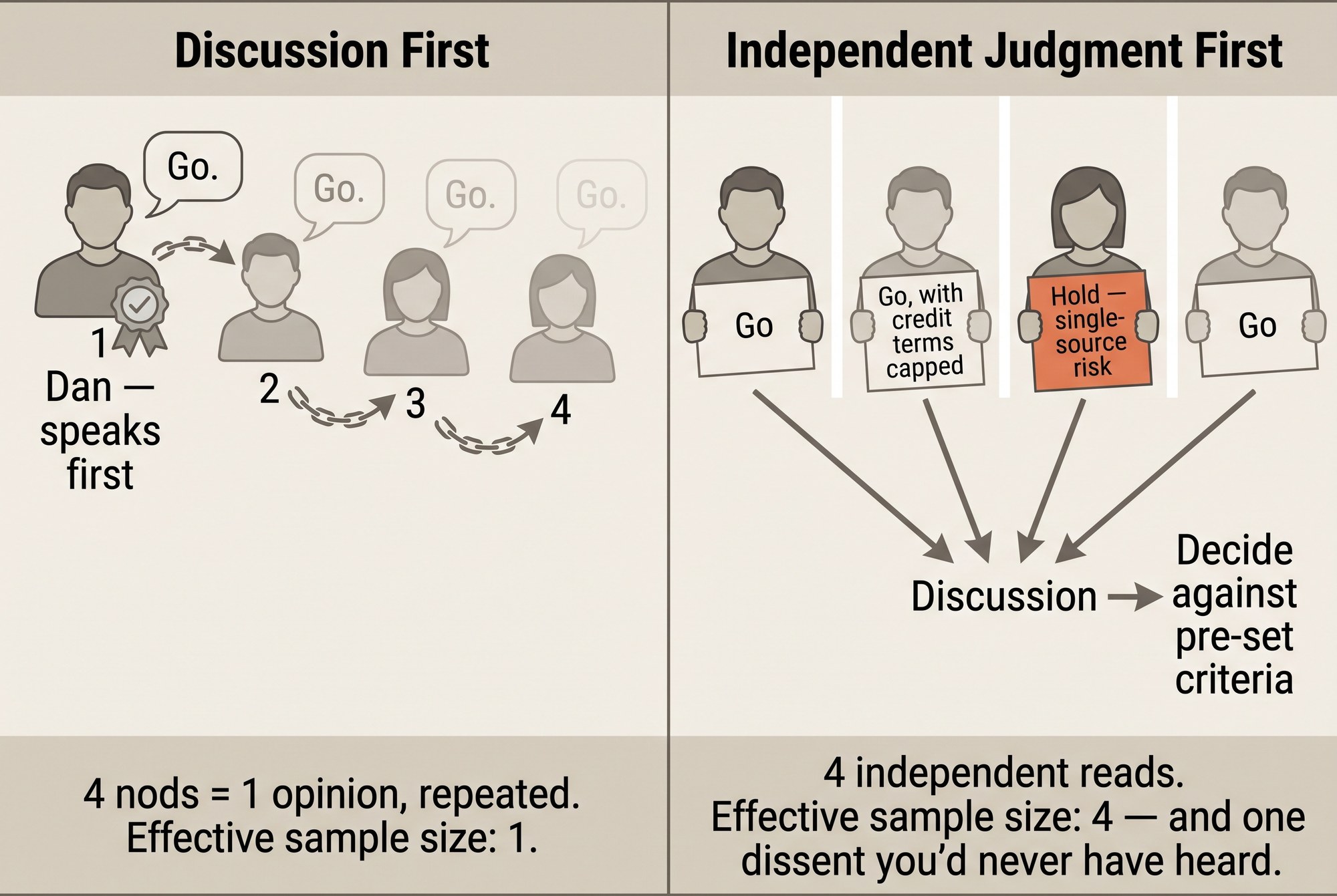
- Premature consensus, or a cascade. The first strong opinion anchors the room, each following person updates toward it, and by the fourth nod you have what looks like four confirmations but is really one opinion echoed four times. For example, Dan says "Go," the next person nods, and by the fourth, disagreeing would mean standing alone against an apparently settled room.
Carry one provocation out of this. A unanimous room under real uncertainty should make you more suspicious, not less, because genuine uncertainty ought to produce genuine disagreement. When the disagreement is nowhere to be found, the honest question is not whether you got lucky — it is where the disagreement went.
Watch all three forces surface in one short exchange. Natalie hears that Jake's room agreed fast, and she treats that speed exactly as this lesson suggests, as a reason to look harder rather than relax.
- Jake: Everyone seems aligned on the new distributor. Can I take that as a yes?
- Natalie: Before you do, did anyone write down their view before Dan made his case?
- Jake: No. Dan spoke first and the room fell in behind him.
- Natalie: Then you don't have four opinions, you have one opinion repeated four times. Ask each person for the single strongest reason this could fail, on paper, before you close it.
- Jake: And if the dissent turns out to be weak?
- Natalie: Then you decide, with confidence. But you decide against the criteria, not against how sure Dan sounded.
Notice Natalie is not anti-consensus. She is separating how confident Dan sounded from whether the evidence actually supports the call, and refusing to count an echo as independent confirmation.
Independent Judgment Before Discussion 🗳️
Natalie's instinct points straight at the fix. If open discussion is where cascades take hold, the remedy has to be structural rather than motivational, because you cannot un-hear the senior voice once it has spoken. The answer is to change when people speak, not how hard they try to stay objective.
The Independent-Judgment-First Protocol puts the sequence right:
- Gather independent reads privately first. Before any group discussion, have each participant write down their view and the single strongest reason it could fail.
- Surface the strongest dissent on the record. Bring the most credible objection into the open instead of letting it dissolve into the group's momentum.
- Separate seniority and confidence from evidence. Judge each read on what actually supports it, not on who wrote it or how sure they sounded.
- Decide against your pre-set criteria, not the loudest voice in the room.
For example, before a go/no-go on a new distributor you email each of the five leads and ask for a one-line call plus the strongest reason it could fail, on paper, before the meeting. Four write "go" (one adds "only with credit terms capped"); the CFO writes "hold — single-source risk." You walk in already holding a real dissent you would otherwise never have heard, and you weigh it against the criteria you set in advance.
The pivotal move is the first one. Ask for views in a live meeting and you get a cascade; collect them in writing before anyone talks and you get independent samples, and disagreement you would otherwise never have surfaced.
Documenting the Dissent, Not Burying It 📄
A decision that survived independent scrutiny is worth almost nothing if the record makes it look like a rubber stamp. When you write up a group call, do the opposite of what feels natural. Put the disagreement on the page. A strong write-up captures five things:
- the option you chose
- the independent reads you gathered before discussion
- the strongest dissenting view, in its most credible form
- why that option still holds — on the evidence and your criteria — despite the dissent
- what would trigger a revisit
A reviewer who sees dissent named and answered trusts the call far more than one who sees suspicious unanimity.
This is also the checkpoint where you add your dissent mechanism to your Personal Decision Playbook: exactly how you elicit independent views and how you record disagreement, so it becomes a default rather than a good intention.
Under real uncertainty, the absence of disagreement is not proof you are right, it is usually proof you have not looked. Next you'll test whether you can spot a cascade in a set of group behaviors, then face a skeptical VP live who assumes any quick consensus is a warning sign, and finally document a decision so its dissent is on the record. So sit with this before you get there: the last time your team agreed fast on something hard, whose independent judgment did you actually hear, and whose did you only assume?
