Building Your Playbook
Building Your Playbook 📘
Good decision-making isn't about using every available reasoning tool. The real skill is diagnosing the decision in front of you, choosing the right approach, and defending why it fits. A skeptic across the table doesn't care how many frameworks you know. They want to see that you examined the right risks, assumptions, evidence, and alternatives. This lesson is about turning those elements into a practical method you can stand behind.
By the end of this lesson, you will be able to:
- Match each reasoning tool to the decision in front of you instead of running every tool
- Defend a high-stakes decision by naming your own assumptions, dissent, and safeguards first
- Assemble a Personal Decision Playbook and write a decision brief you can stand behind
Matching Each Tool to the Decision in Front of You 🧰
The rookie mistake at this stage is running every tool on every call. So ask yourself first: which problem is actually in front of me? Each tool answers a different one.
When you need to discover how a plan could quietly fail, reach for the pre-mortem. When you're comparing options and want the choice driven by criteria rather than the most polished pitch, use a weighted decision matrix with criteria fixed before you look. When you're attached to a forecast and suspect you're seeing only the supporting evidence, run a disconfirmation scan. When a past call comes up for review and the outcome is tempting you to rewrite the reasoning, the decision journal keeps you honest. When the clock is genuinely against you, the Safe Fast Check lets you move fast without moving blind. And before any of these, the Decision Mode Matrix tells you how much deliberation the stakes and reversibility even warrant.
The skill isn't memorizing all five. It's diagnosing the situation and reaching for the one that fits, then stopping. Over-tooling a reversible, low-stakes call burns the very attention you'll need for the irreversible one.
Defending a High-Stakes Decision Under Scrutiny 🛡️
Now the harder test. A skeptical sponsor won't accept "trust me." They'll hunt for the assumption you didn't examine and the downside you didn't guard. So the move that wins is counterintuitive: name your own weak points before they do.
In the exchange below, Ryan is a general manager recommending a full commit to a $4M regional expansion, and Jessica is his executive sponsor — a VP who probes every recommendation for the gap the presenter missed. Watch how he gets ahead of her:
- Jessica: You're recommending the full commit. What's the strongest case against it?
- Ryan: The regional demand data is only two quarters old, so my 65% confidence rests on it holding. If that's seasonal noise, the case weakens fast.
- Jessica: So why not defer?
- Ryan: Because the downside is capped. We've structured it as a staged rollout with a kill trigger if week-eight conversion drops below 8%. Deferring costs us the window with no upside.
- Jessica: And who disagreed?
- Ryan: My ops lead. She'd defer. I weighed it, but the reversible structure answers her main risk, so I'm holding the call.
Notice that Ryan surfaces the shaky assumption, the confidence range, the dissent, and the safeguard before Jessica can extract them. Scrutiny ends up confirming his reasoning instead of exposing gaps. That's defending by disclosure, and behind it sits the toolkit: the Decision Mode Matrix right-sized the effort, the pre-mortem produced the kill trigger, and a disconfirmation scan surfaced the seasonal-noise risk before it became a surprise.
Architecting Your Playbook 🏗️
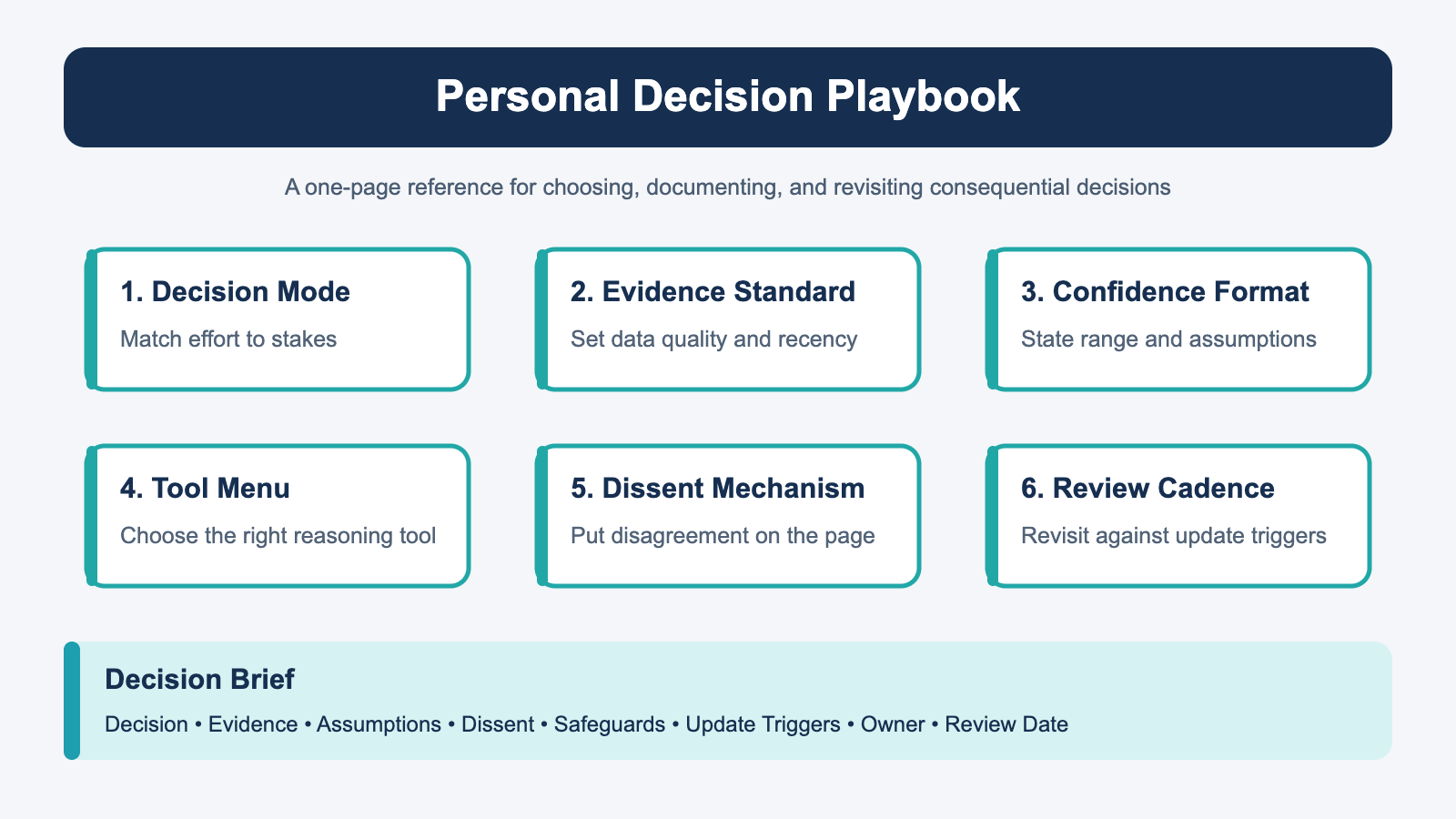
Everything you've built now compresses into one page. Your Personal Decision Playbook is a labeled reference, not an essay — each row is one thing you decide once so you don't re-litigate it on every call:
| Playbook component | What it captures |
|---|---|
| Decision-mode selector | How much deliberation the stakes and reversibility warrant |
| Slow-down triggers | The signals that tell you to stop and think before you commit |
| Bias scan | The biases you check for, each paired with its counter-check |
| Tool menu | Which reasoning tool fits which kind of problem |
| Evidence standard | The minimum quality and recency of data you require before you commit, so a call never rests on stale or thin numbers |
| Confidence format | How you state confidence — an explicit range or probability, not a vibe |
| Dissent mechanism | How you surface and weigh the strongest opposing view |
| Decision-journal fields | What you record at the moment of deciding |
| Review cadence | The schedule of checkpoints at which you revisit the decision against its update triggers, so a provisional call gets reexamined instead of quietly hardening into a permanent one |
It exists so your next consequential call is repeatable rather than lucky.
The Decision Brief is the artifact that shows the playbook working on a single decision. It walks a reviewer through the call in a fixed order:
- the decision and the recommended option
- the context and the alternatives you weighed
- the strongest evidence and the critical assumptions
- your calibrated confidence
- the main trade-offs and the strongest dissent
- the key safeguards and objective update triggers
- the owner and the review date
A reviewer reads it and sees a system at work, not conviction dressed up as analysis.
The one takeaway: a defensible decision isn't the one you feel surest about, it's the one where you've already named the right tool, the assumptions, the dissent, and what would change your mind before anyone asks. Three practices close this out: a quick pattern-match of tool to situation, a live defense against a relentless VP, and the capstone writing where you distill your playbook and apply it end-to-end to a real $4M call. So sit with this before you start: when that call lands on your desk, will the skeptic find a single gap you didn't already name?
