Welcome back to Inside the Parabola: a, b, and c! You have reached the second lesson of the course, and the coefficient we have been postponing is finally taking the stage. So far a told us which way the curve opens and how narrow it is, and c told us how high the whole picture sits.
The coefficient b helps determine the axis of symmetry and vertex location. When b changes while a and c are fixed, the vertex generally moves both horizontally and vertically while the y-intercept stays fixed. By the end of this lesson, you will be able to locate the axis of symmetry and the vertex of any quadratic in standard form, decide whether that vertex is a high point or a low point, and predict where it travels when b changes on its own.
The Balance Point of a Parabola
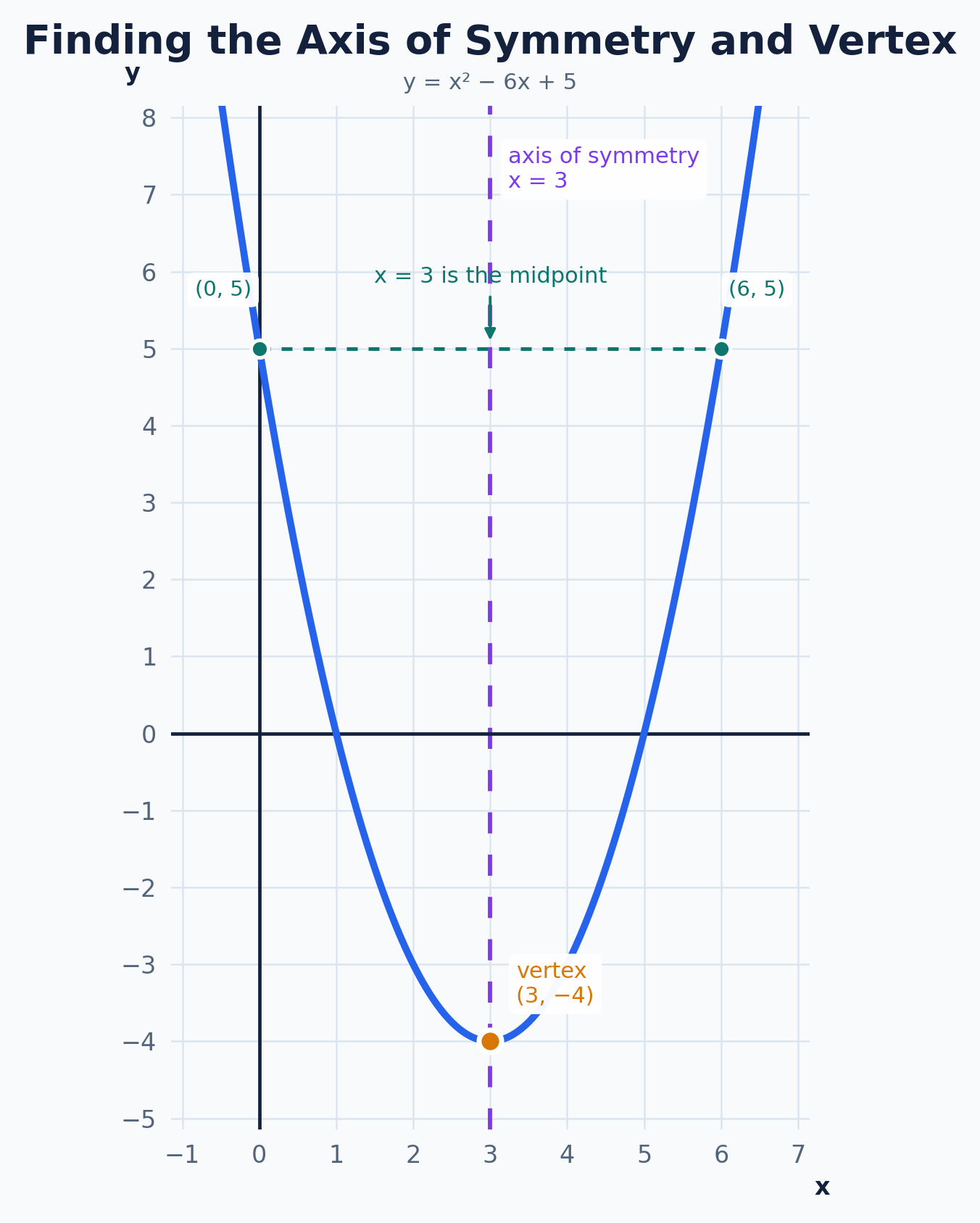
Every parabola is symmetric. Fold it along one particular vertical line and the two halves land exactly on top of each other. That line is the axis of symmetry, and the single point where the curve crosses it is the vertex — the place where the parabola stops turning one way and starts turning the other.
As we saw in the previous lesson, when b=0 that line is simply x=0 and the vertex sits at (0,c). Adding a bx term breaks that convenience: the curve keeps its exact shape and its symmetry, but the balance point slides sideways, so the axis becomes some line x=something that we have to compute. Happily, that computation takes one short formula.
Where the Formula Comes From
Rather than memorizing the formula, let us watch it appear. Ask a simple question: which inputs produce the same height as the y-intercept, meaning y=c?
ax2+bx+c=c⇒ax2+bx=0⇒x(ax+b)=0
The two solutions are x=0 and x=−ab. Those two points sit at the same height on the curve, so symmetry forces the axis to run exactly halfway between them, and the midpoint of 0 and −ab is
x=−2ab
That one line is the engine of this lesson. Notice which letters appear in it: only a and b. The constant c has no say in the horizontal position, which fits perfectly with what we already know — c moves graphs straight up and down, never sideways.
Join the 1M+ learners on CodeSignal
Be a part of our community of 1M+ users who develop and demonstrate their skills on CodeSignal
The formula gives us the x-coordinate of the vertex. To get the matching y-coordinate, we feed that value back into the function, so the full procedure is two steps:
Compute x=−2ab. This is the axis of symmetry, reported as the equation of a line.
Substitute that x into the original equation to get y. The vertex is the ordered pair (x,y).
Let us run it on y=x2−6x+5, where a=1, b=−6, and c=5:
x=−2(1)−6=26=3,y=(3)2−6(3)+5=9−18+5=−4
The axis of symmetry is the line x=3, and the vertex is the point (3,−4). Keep the reporting straight: an axis is an equation, a vertex is a pair of numbers.
Almost every mistake with this formula is a sign error, not a thinking error, so it pays to slow down at the substitution. The safest habit is to write −2ab with b copied in exactly as it appears in the equation, minus sign and all, and simplify only afterward. Two worked cases show the patterns to expect:
y=−2x2+8x−1: here a=−2 and b=8, so x=−2(−2)8=−−48=2, and y=−2(4)+8(2)−1=7. The vertex is (2,7).
y=2x2+3x+1: here a=2 and b=3, so x=−43, and y=2(169)−49+1=89−818+88=−81. The vertex is (−43,−81).
Two lessons stand out here. First, a negative a lands in the denominator, so two negatives can quietly produce a positive axis, exactly as in the first case. Second, fractional answers are perfectly normal and are not a signal that something went wrong; a fractional a behaves the same way, since dividing by a fraction just means multiplying by its reciprocal. For y=43x2+x−2, we get 2a=23 and x=−1÷23=−32.
Once the vertex is in hand, the sign of a tells us what kind of point it is, using the very same opening-direction rule from the previous lesson:
Sign of a
Parabola opens
Vertex is a
Meaning of the vertex y
a>0
Upward
Minimum
Smallest output the function ever reaches
a<0
Downward
Maximum
Largest output the function ever reaches
So the vertex (3,−4) of y=x2−6x+5 is a minimum, because a=1>0: the function never dips below −4. The vertex (2,7) of y=−2x2+8x−1 is a maximum, because a=−2<0: the function never climbs above 7. Note that b has no vote in this decision — it moves the vertex, but only a decides what the vertex means.
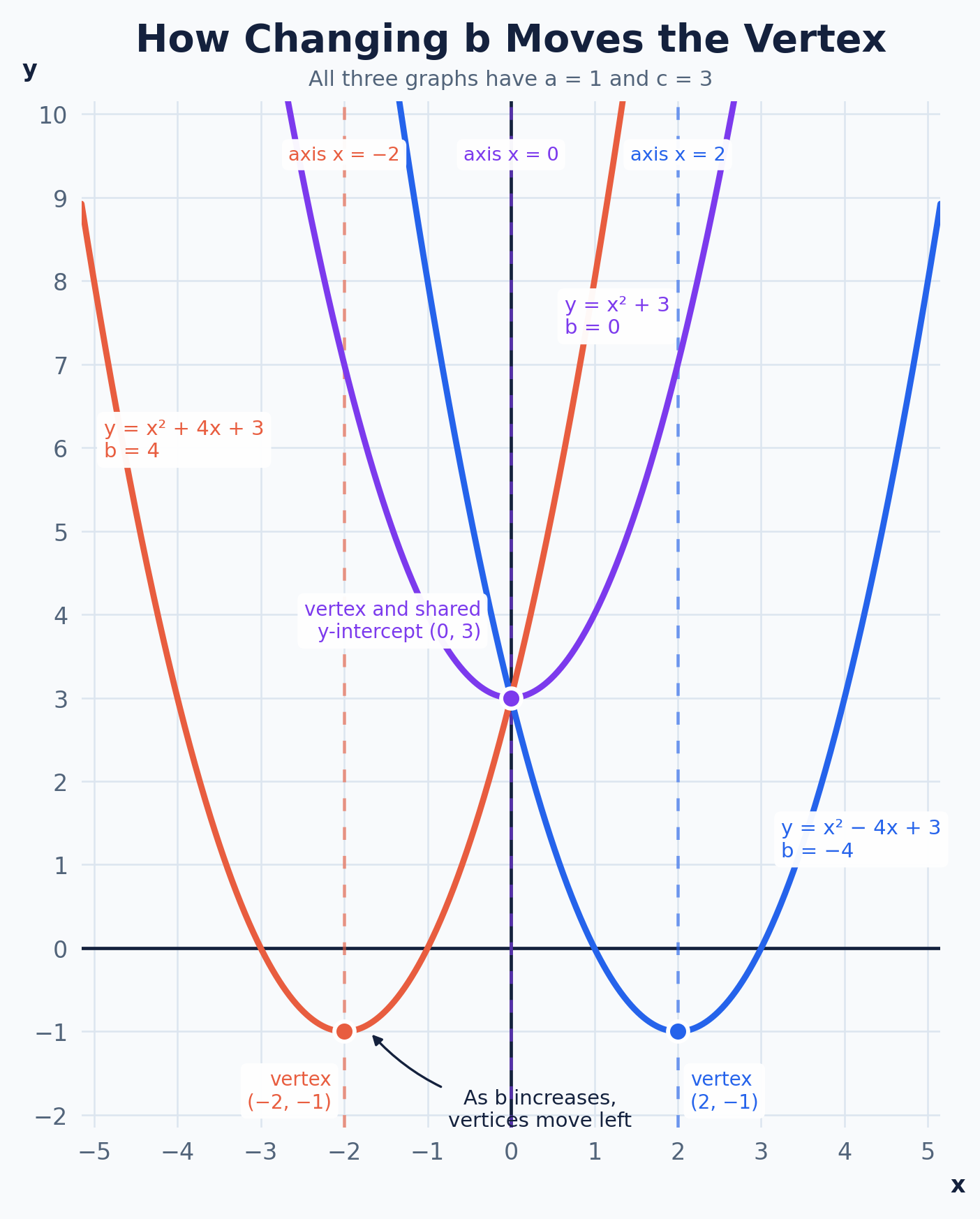
Now let us isolate b and watch it work. Keep a=1 and c=3 fixed, and compare three members of the family y=x2+bx+3:
Equation
b
Axis x=−2ab
Vertex
y-intercept
y=x2−4x+3
−4
x=2
(2,−1)
(0,3)
y=x2+3
0
x=0
(0,3)
(0,3)
y=x2+4x+3
4
x=−2
(−2,−1)
(0,3)
Reading down the table, the horizontal rule is clean: because of the minus sign in −2ab, increasing b slides the vertex left when a>0 and right when a<0. The height follows a different pattern. For this upward parabola the vertex is highest at b=0 and sinks lower the further b travels from zero in either direction, which is why b=4 and b=−4 give the same vertex height of −1.
Meanwhile, two features refuse to budge. The y-intercept stays locked at (0,3), since substituting x=0 erases the bx term, and the opening direction and width stay locked to a. In short, b steers the parabola diagonally across the plane while leaving its shape and its crossing point on the y-axis untouched.
Suppose a ball is thrown upward from a 1.5-meter-high platform, and its height in meters after t seconds is modeled by
h(t)=−5t2+20t+1.5
Here a=−5 and b=20, so the axis of symmetry is t=−2(−5)20=2, and h(2)=−5(4)+20(2)+1.5=21.5. The vertex is (2,21.5), and since a<0 it is a maximum: the ball reaches its greatest height of 21.5 meters, 2 seconds after release.
Each coordinate carries its own meaning, and saying both out loud is a good habit: the first says when the peak happens, the second says how high it is. Now throw the ball harder, which increases the launch speed and therefore b alone. Because a<0, the vertex slides right and up, so the peak arrives later and reaches higher — while c=1.5 still records the platform height at t=0 and a=−5 still reflects gravity bending the arc downward.
You now have a complete toolkit for standard form. The axis of symmetry is x=−2ab, the vertex comes from substituting that value back into the equation, and the sign of a labels the result as a maximum or a minimum. Changing b alone steers the vertex sideways and up or down, while the y-intercept (0,c), the opening direction, and the width all stay exactly where they were.
The formula itself is short, but the sign handling is where careful work pays off, so keep copying b in with its own sign and simplifying afterward. In the practice exercises ahead, you will walk through a substitution one piece at a time, compute axes and vertices for a range of coefficients including negative and fractional ones, nudge b around to see what moves, and send a ball of your own into the air.