This is the third and final lesson of Inside the Parabola: a, b, and c, and it is the one where the vertex stops hiding. Everything so far has been written in standard form, y=ax2+bx+c, where the turning point had to be excavated with x=−2ab and a substitution before we could say anything about it.
There is another way to write the very same curve, one that puts the vertex right on the surface where anyone can read it. It is called vertex form, and we will travel it in both directions: from an equation to a full description of the graph, and from a graph back to its equation.
A Familiar Shape in New Clothes
Think back to the earlier work on shifting graphs. We began with the parent parabola y=x2, whose turning point sits at the origin, and we saw that adding k on the outside lifts the graph up while subtracting h on the inside slides it right. Vertex form is nothing more than those two moves written together, with a scaling factor in front:
y=a(x−h)2+k
Read it as a set of instructions: take the basic parabola, stretch or flip it by a, then slide it h units horizontally and k units vertically. Wherever the turning point lands after those moves is the vertex — and the numbers in the formula spell out that landing spot for us.
Reading the Vertex
Here is the cleanest fact in this whole course: for y=a(x−h)2+k, the vertex is the point (h,k) and the axis of symmetry is the line x=h. No formula, no substitution, just reading.
Why does it work? The squared piece (x−h)2 is never negative, and it equals zero only when x=h. At that one input the equation collapses to y=k, so the curve reaches its extreme value k exactly there. Everywhere else the squared term contributes something, pushing y above k when a>0 or below k when a<0.
The one trap is the sign of h, because the form has a minus built into it. The value of h is whatever makes the parentheses read as "x minus something," so a plus sign inside means h is negative:
Equation
Rewrite as (x−h)
h
k
Vertex
y=(x−4)2+1
(x−4)
4
1
(4,1)
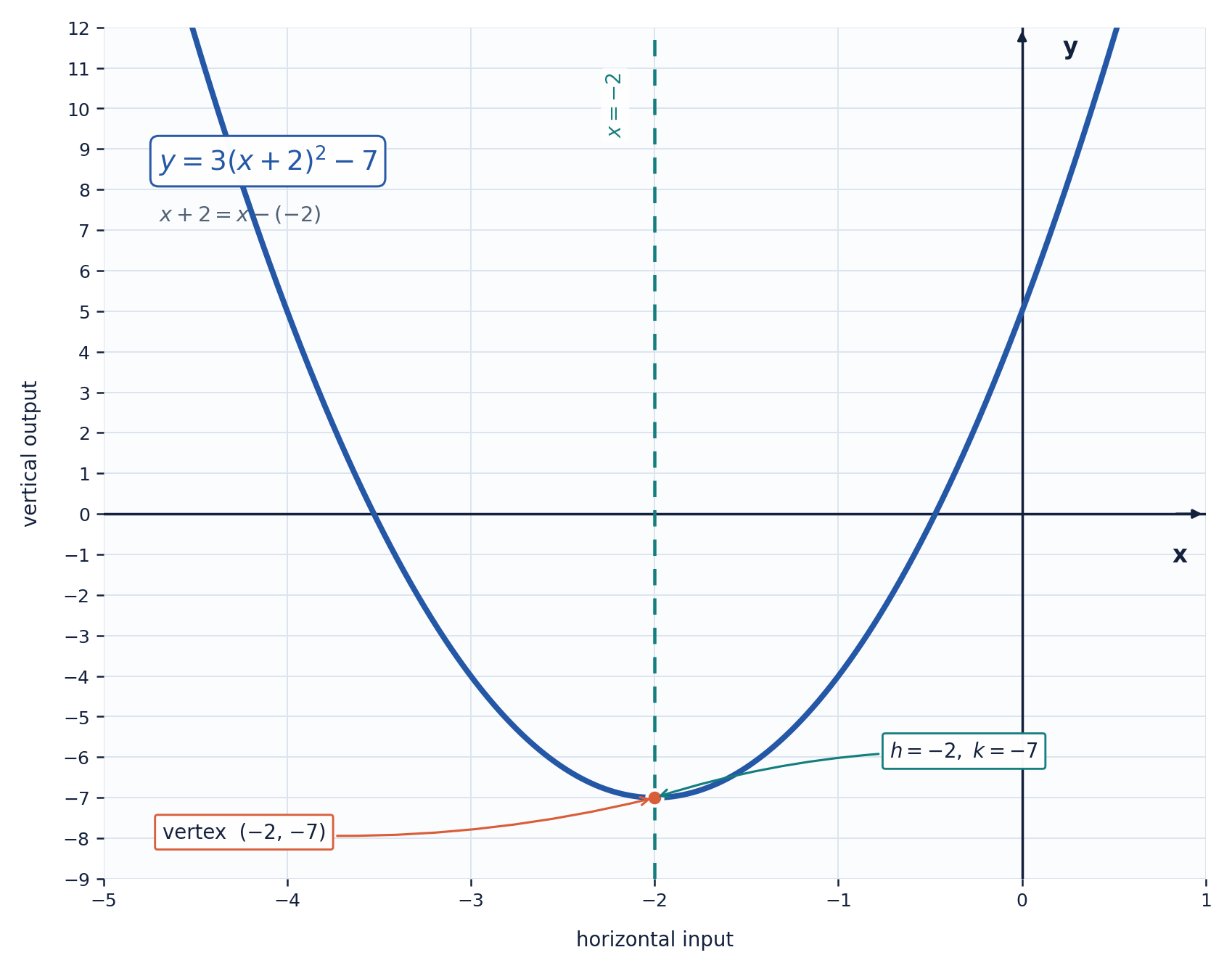
y=3(x+2)2−7
(x−(−2))
−2
−7
(−2,−7)
y=−21(x+5)2+6
(x−(−5))
−5
6
(−5,6)
y=2x2−3
(x−0)
0
−3
(0,−3)
Notice that k needs no flipping at all. It sits outside the parentheses and is added, so we copy it across exactly as written, sign and all. The graph below shows the second row in action: the plus sign in (x+2) places the vertex to the left of the y-axis.
Join the 1M+ learners on CodeSignal
Be a part of our community of 1M+ users who develop and demonstrate their skills on CodeSignal
The coefficient a plays exactly the same role here as it did in standard form, so there is nothing new to memorize. As you may recall from the first lesson, the sign of a decides the opening direction and the size of ∣a∣ decides how narrow the curve is:
a>0: opens upward, and the vertex is a minimum.
a<0: opens downward, and the vertex is a maximum.
∣a∣>1: narrower than y=x2; 0<∣a∣<1: wider than y=x2.
That means a single expression like y=−21(x+5)2+6 answers three questions at once. The vertex is (−5,6), the parabola opens downward because a is negative, and it is wider than the parent parabola because ∣a∣=21 is less than 1. Since the opening is downward, that vertex is a maximum: the function never rises above 6.
It is worth confirming that vertex form is not some separate creature living apart from what we already know. Expanding y=2(x−3)2+1 gives
y=2(x2−6x+9)+1=2x2−12x+19
Now apply last lesson's tool to that result: x=−2(2)−12=3, and substituting back gives y=1. The vertex is (3,1), precisely the pair we could read off the original at a glance. Same parabola, same vertex, two presentations — vertex form simply does the arithmetic in advance, while standard form makes the y-intercept easy instead.
Now let us reverse the direction of travel. Suppose we are handed a picture of a parabola and asked for its equation. Three pieces of information are enough, and they arrive in a natural order:
Read the vertex(h,k) from the turning point on the graph.
Take the sign of a from the opening direction: positive if it opens upward, negative if it opens downward.
Find the size of a by substituting one other known point on the curve into y=a(x−h)2+k and solving.
Steps 1 and 2 are pure observation, no pencil required. Step 3 is the only place algebra shows up, and it is a single equation with a single unknown, which is about as friendly as algebra gets.
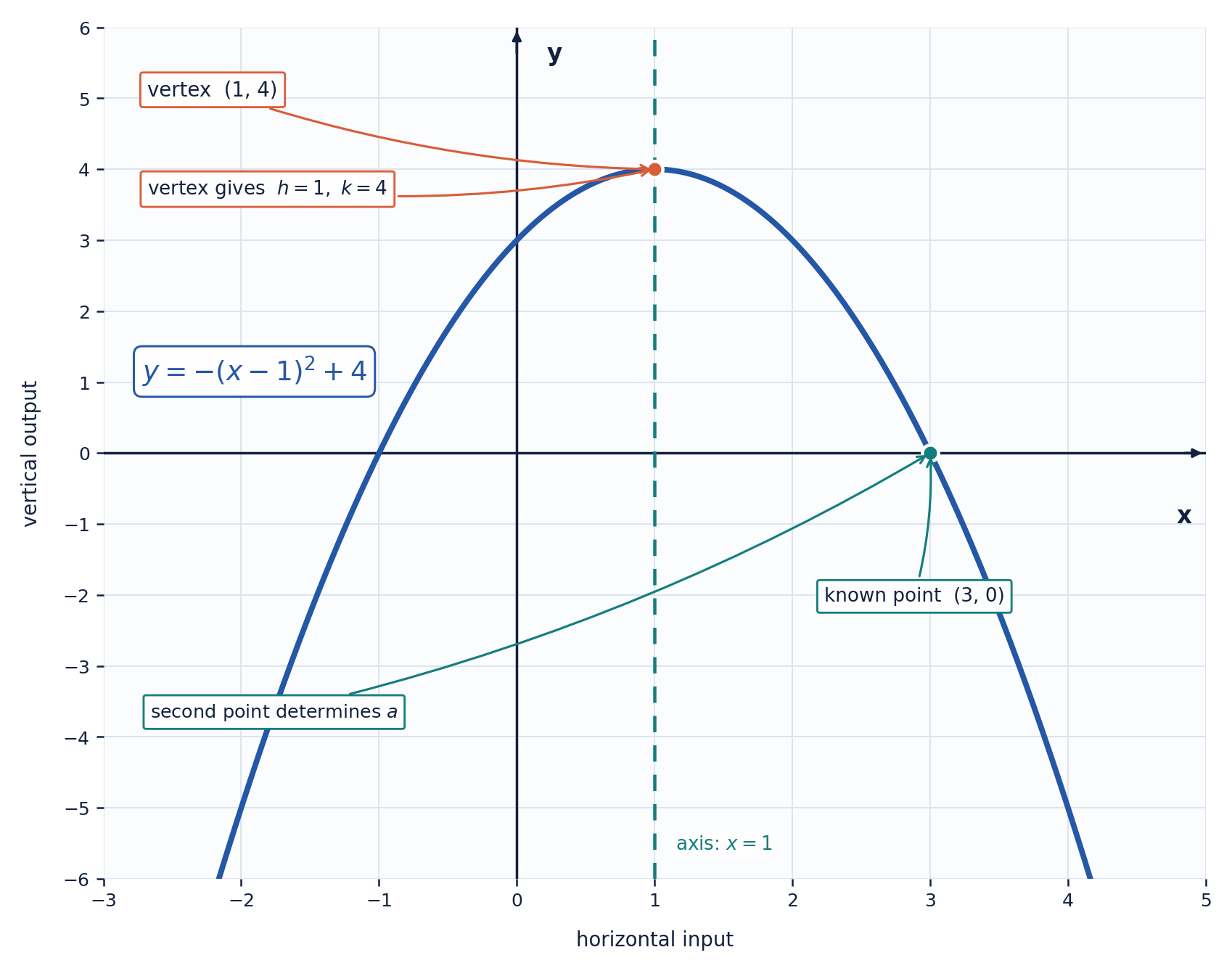
Suppose a parabola has its vertex at (1,4) and also passes through (3,0). The vertex fixes h=1 and k=4, so the equation so far is y=a(x−1)2+4. Substituting the second point, with x=3 and y=0, gives
0=a(3−1)2+4⇒0=4a+4⇒a=−1
The finished equation is y=−(x−1)2+4. Rearranged once and for all, the same three moves are captured by a=(x−h)2y−k, though substituting first and solving second keeps the sign handling more visible.
The negative result is a built-in sanity check: the extra point sits below the vertex, so the curve must open downward, and indeed a came out negative. Whenever the sign from the algebra disagrees with the picture, a substitution slipped somewhere — most often on the sign of h.
Picture a stone bridge whose arch peaks 16 meters above the road at a point 20 meters from the left support, with both supports meeting the road at height 0. Measuring x in meters from the left support, the peak hands us the vertex directly: h=20 and k=16, so y=a(x−20)2+16. The left support sits at (0,0), and that is our second point:
0=a(0−20)2+16⇒400a=−16⇒a=−0.04
The arch is modeled by y=−0.04(x−20)2+16. Every constant now carries a physical meaning: h=20 says the high point stands 20 meters from the left support, k=16 says the arch clears the road by 16 meters at that point, and the negative a says the curve bends downward from the peak, which is exactly what an arch must do. The small size of ∣a∣=0.04 tells us it is a broad, gentle sweep rather than a sharp spike — and by symmetry, the right support must stand at x=40.
Vertex form works in both directions. Forward, y=a(x−h)2+k hands us the vertex (h,k), the axis x=h, the opening direction from the sign of a, and the width from ∣a∣, with the only caution being that a plus sign inside the parentheses means a negativeh. Backward, we read (h,k) off the turning point, take the sign of a from the opening, and pin down its size with one substitution of a second point.
That completes the tour of the parabola: a shapes it, c places it vertically in standard form, b helps determine its axis of symmetry and vertex location, and vertex form gathers all of those results into one readable statement. In the practice ahead you will name vertices, match equations to their turning points, solve for a step by step, tune constants until your curve lands on a target, and finally build an arch of your own from the ground up.