Navigating Identity and Power
Belonging Without the Burden
The previous unit ended with a talent decision delivered cleanly. This one starts upstream of that conversation, in the moments most managers don't see: the small comment in a meeting, the credit that drifts the wrong way, the quiet withdrawal that gets read as "less engaged lately." Identity-charged patterns rarely arrive as incidents. They arrive as drift. Your job this unit is to spot the drift, run a real conversation about it, and change the system that produced it without putting the change on the shoulders of the person it hurt.
Reading Microaggressions as a Cumulative Signal
A microaggression is a brief, often unintentional verbal or behavioral slight that communicates a derogatory or exclusionary message based on a person's identity. The trap is the word "micro." Any single one looks survivable, and most are. The mechanism that matters is cumulative: the same person absorbing the same kind of hit, across months, from a rotating cast of sources. The fortieth "you're so articulate" lands nothing like the first.
As a manager, you won't usually see the incident. You'll see the downstream signal. Someone who used to volunteer stops volunteering. Someone who used to push back goes quiet. Someone skips the team social they used to organize. Recency bias will tell you they're "going through something" or "less invested this quarter." The bias-interruption move is to ask whether you're watching one person's mood or watching a pattern of withdrawal that maps to identity in your room. Is the person being re-explained consistently the same demographic profile? Does the credit-drift go in one direction? Is the "you're so articulate" comment always landing on the same people?
You're not diagnosing motive. You're noticing pattern. Motive is unknowable and often beside the point; impact is observable and is the thing you manage.
Running an Inclusion Check-In Without Burdening the Person
When you've noticed drift, you don't wait for them to bring it up. You bring it up, gently, using the Inclusion Check-In: Ask about experience, Listen for patterns, Validate impact, Name your role or power, Co-create an adjustment, Follow up.
The first three steps look easy and aren't. Ask about experience means a real, open question, not "is everything okay?" which has one socially acceptable answer. Listen for patterns means letting silence sit long enough that something true can surface; if you fill the air, you'll get the surface answer. Validate impact means receiving what they say without minimizing it ("that's a lot to carry, and it makes sense you'd pull back") and without performing shock at it, which makes them manage your reaction instead of their own.
- Chris: It's nothing huge. But in the last few reviews, when I make a point, Ryan rephrases it thirty seconds later and the room picks up his version. It's happened enough that I've stopped bothering.
- Nova: Yeah. That's a real pattern, and it makes sense you'd stop putting energy into it. I've seen pieces of it and didn't name it. That's on me to fix in how I run the room, not on you to fight harder in the moment.
- Chris: I appreciate that. I just don't want to be the guy who made it a thing.
- Nova: You won't be. The change I'm making is a meeting norm for everyone, not a callout. I'll tell you what I'm putting in place before next Tuesday, and we'll check back in two weeks on whether it landed.
Notice what Nova didn't do. She didn't apologize three times, didn't ask Chris to confront the peer, didn't promise to "have a word." She named her own power (you run the room), took the ownership where it belongs, and offered a system change, not a personal mission.
Changing the System, Not Recruiting a Spokesperson
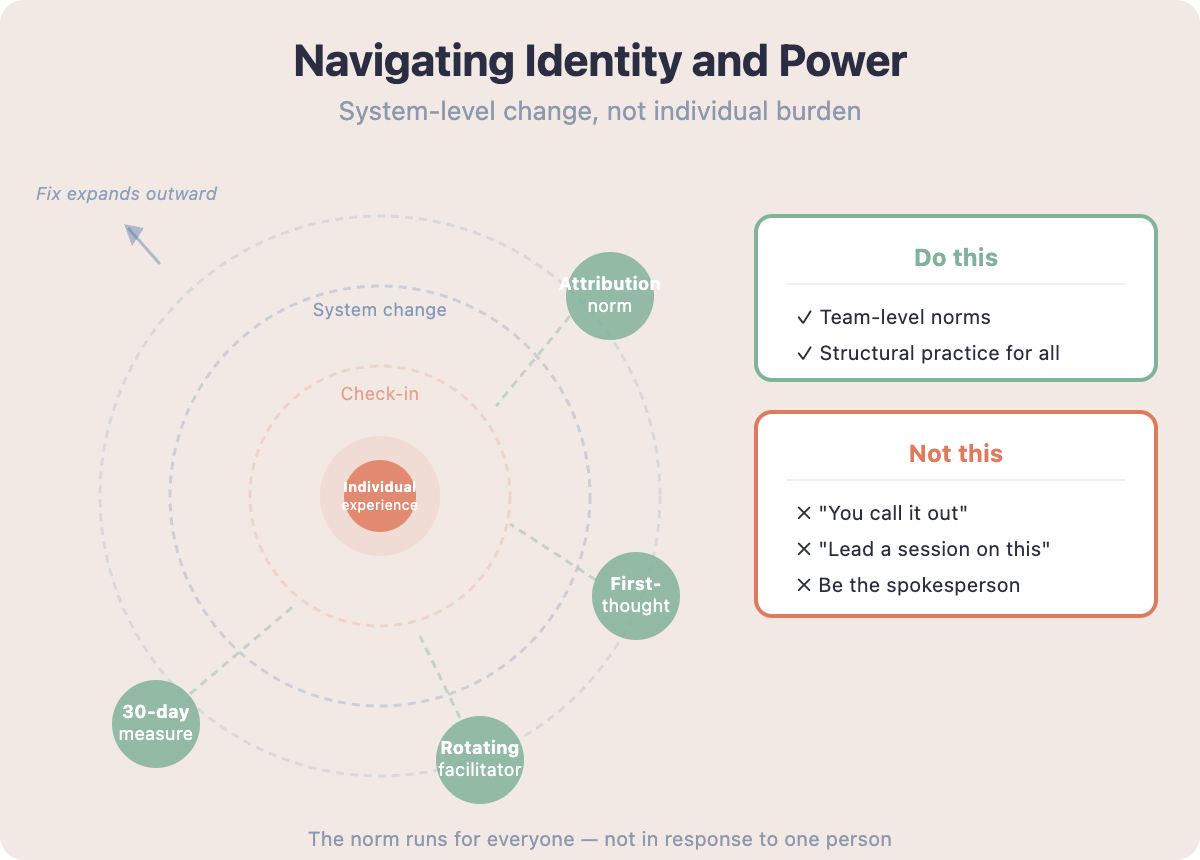 The most common failure mode after a check-in like this is to hand the affected person the solution: "Would you be willing to call it out when it happens?" or "Maybe you could lead a session on this." That rebuilds the burden you just acknowledged. The fix has to be a team-level structural change that runs for everyone.
Concrete adjustments work. An attribution norm where building on someone's idea requires naming them ("building on what Chris said") catches credit-drift in the moment. A first-thought round at the top of decisions captures original contributors before the loudest voice consolidates the framing. A rotating facilitator role distributes who controls airtime so it doesn't sit permanently with the same two people. Pick one. Introduce it as a meeting practice, not a response to a complaint. Measure it in 30 days by looking at the same airtime and credit signals you used to spot the drift.
The takeaway is sharp: identity-charged patterns are managed at the system level, not at the level of the person carrying them. Three practices sit ahead of you. First, a quick pattern-spotting check to make sure you can recognize a microaggression and trace its cumulative shape. Then a live Inclusion Check-In with someone who's been pulling back, where the test is whether you can hold steady, name your power, and end without making them the test case. Finally, you'll write the team-level adjustment a skip-level could actually borrow.
