Fixing Your Bias to Create Team Psychological Safety
Fixing Your Bias to Create Team Psychological Safety
Last unit, you learned to name the biases driving your calls and audit your own patterns. The follow-on question is harder: even if your decisions get cleaner, will your team actually use the room you've made? Will people speak up, push back, surface the half-formed idea, name the concern about the launch date? That's not a decision-quality problem anymore, it's a safety problem. This unit gives you the model for diagnosing where your team is on psychological safety, the message that resets the norms, and the live move when someone tells you they held back.
The Four Stages of Psychological Safety
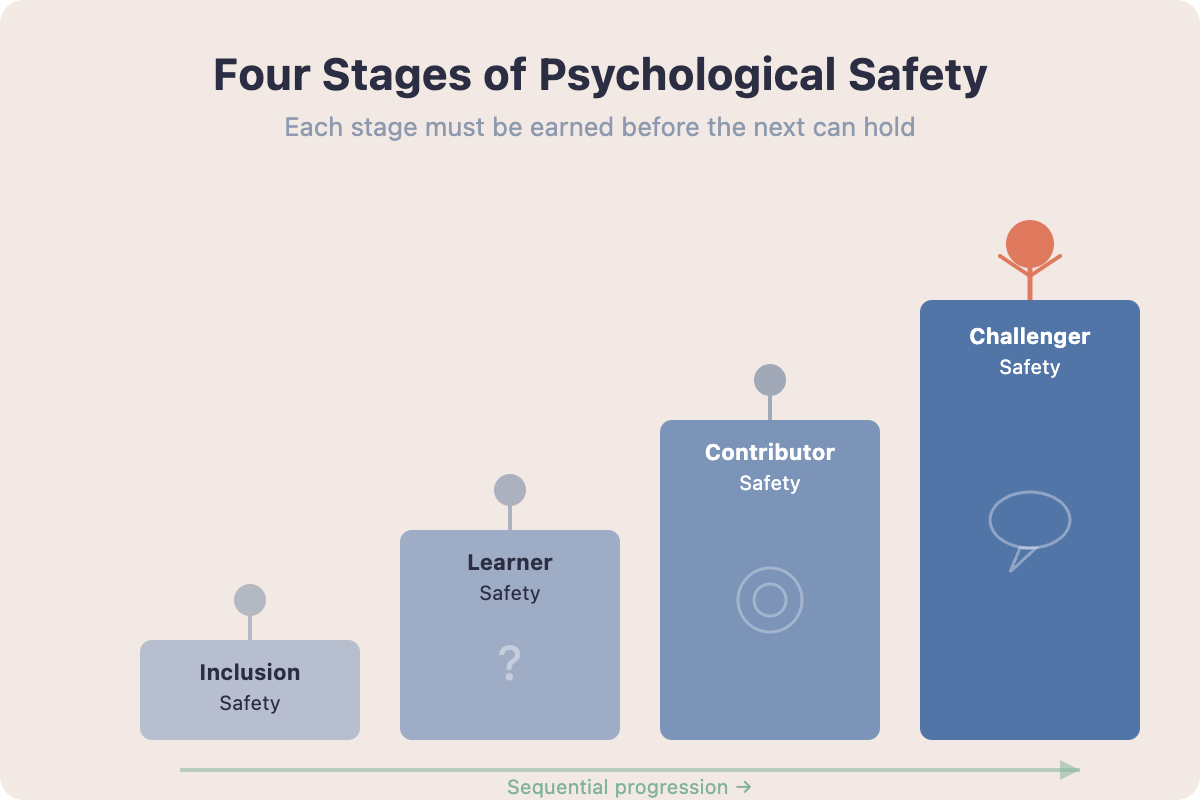 Timothy Clark's Four Stages of Psychological Safety is the most usable diagnostic in this space because it tells you which floor of the building is missing, not just whether the building is shaky. The stages are sequential, and each one has to be earned before the next can hold.
Inclusion Safety is the floor: do people feel accepted for who they are? On a team, this is whether the new hire feels like a member, not a guest. Learner Safety is next: can people ask questions, admit they don't know, try and fail without it costing them? This is the engineer who'll say "I don't understand the model" in a meeting instead of nodding and Googling later.
Contributor Safety is third: can people use their skills and make a real contribution without permission for every move? This is where good ICs either get unleashed or get managed into compliance. Challenger Safety sits at the top: can people disagree with the status quo, including with you, without retaliation? This is the hardest one to build and the first one to collapse under pressure.
The diagnostic move is to watch your meetings through this lens. If a junior IC won't ask a clarifying question, you have a Learner Safety problem. If a senior IC won't push back on your launch call, that's Challenger Safety. The fix changes depending on the stage. You can't norm your way to Challenger Safety if Inclusion Safety is broken: people need to feel like they belong before they'll risk telling you you're wrong.
Resetting the Norms So Dissent and Follow-Through Show Up
Most psychological safety problems on functioning teams aren't about Inclusion or Learner Safety, they're about Contributor and Challenger Safety quietly eroding. The signs are familiar: two voices dominating, decisions getting nodded through, action items dissolving by Friday. You can see hesitation on faces in the moment and convince yourself the silence is consent. It isn't.
The reset is structural, not motivational. A message that says "let's be better about speaking up" changes nothing. A message that names what you've observed, takes your share of responsibility for letting the pattern build, and installs three or four concrete norms is what actually shifts the next meeting. The norms do the work. A round-robin opening so everyone speaks before anyone speaks twice builds Contributor Safety. An explicit "what would change your mind?" prompt before locking a decision builds Challenger Safety. A two-minute action-item recap with named owners and dates closes the follow-through gap.
The tone matters as much as the norms. Direct and coach-like beats apologetic. If you single out the dominant voices, you've created a new problem. If you're so soft nothing concrete changes, the quieter ICs will read it as theater and you'll have spent your one reset for the quarter on nothing.
Responding When Someone Says They Held Back
The first real test of your reset isn't the next meeting, it's the moment one of your reports books fifteen minutes to tell you they disagreed with a call you made and didn't say anything. How you respond in that conversation either builds Challenger Safety or collapses it for the next six months.
- Milo: This is probably nothing, but, in last week's meeting, when you locked the launch date, I actually thought we were going to compromise the data validation step. I didn't say anything.
- Nova: I'm glad you're telling me now. Before I react, walk me through the specific concern, what part of validation gets squeezed?
- Milo: The QA window goes from five days to two. We've caught real issues in days three and four before.
- Nova: That's substantive. I want to think about whether the date holds. Separately, what would have made it easier to raise this in the room last week?
- Milo: Honestly, you'd already framed it as decided when you opened the topic.
- Nova: That's on me. Next meeting I'll flag decisions as open until we've done a "what would change your mind?" round. And I owe you an answer on the date by Thursday.
Notice the moves. Nova thanked him for raising it now without making him feel guilty for raising it now. She engaged the substance instead of skipping past it to "great communication, glad you brought it up." She was honest that the decision might or might not change, she didn't promise a reversal as a reward for speaking. And she named a specific behavior change in the next meeting that he can verify.
The two failure modes to avoid are over-apologizing (which makes him feel he caused you pain and shouldn't do it again) and brushing past it (which tells him the reset was performative). The takeaway for this unit is sharp: psychological safety is built stage by stage and tested move by move, and Challenger Safety lives or dies in the first thirty seconds of conversations exactly like that one.
Three practices sit ahead. First, a quick pattern-spotting check to make sure you can tell which of Clark's four stages is being built or violated in everyday team moments. Then you'll draft the team-wide message that actually resets the meeting norms, something you could send tonight. Finally, the live conversation, where a direct report has worked up the nerve to tell you they disagreed and didn't say so, and your next sentence decides whether they ever do it again.
