Ask Questions and Confirm Understanding
Ask Questions to Understand Other People’s Experiences 🗣️
When you want to solve a problem, it’s important to make sure you really understand what other people are going through—not just what you think is happening. Sometimes, we guess what the problem is, but the people who deal with it every day might see it differently. The best way to learn is to ask them about their experiences. Often, what you notice at first is just the tip of the iceberg—there’s a lot more hidden below the surface.
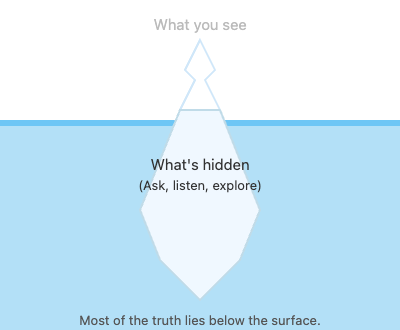
For example, if you notice that a process at work seems slow, you might think it’s because people aren’t working fast enough. But if you ask someone who does the job every day, they might tell you that the tools they use are outdated or that they have to wait for information from someone else. By asking, “Can you walk me through what a typical day looks like for you?” or “What’s the hardest part of this process?” you can discover details you wouldn’t have known on your own.
When you talk to people, listen carefully and repeat back what you heard to make sure you got it right. For example, you might say, “So, if I understand, the biggest problem is waiting for updates, not the actual work itself?” This gives the other person a chance to correct you or add more details. The goal is to see the problem from their point of view, not just your own.
❓Use Open-Ended Questions to Learn More
It’s easy to ask questions that just confirm what you already think, but that doesn’t help you learn anything new. Instead, try to ask questions that let people share their real thoughts and experiences. These are called open-ended questions because they can’t be answered with just “yes” or “no.”
For example, instead of asking, “Don’t you think this way is better?” try asking, “How do you feel about this idea?” or “What has your experience been with this?” If someone gives a short answer, you can follow up with, “Can you tell me more about that?” or “What else should I know?” This shows you are really interested in their perspective.
Here’s a simple example:
- Nova: I think we should try a new way of organizing our group project. What do you think?
- Ryan: I’m open to it, but I’m not sure how it would work with my schedule.
- Nova: That’s helpful to know. Can you tell me what would make it easier for you?
- Ryan: If we could do most of our planning after school instead of before, that would work better for me.
This kind of open conversation helps everyone share their needs and find solutions that work for the whole group.
By asking open-ended questions and listening carefully, you can learn things you didn’t expect. Sometimes, you might even find out that your first idea wasn’t the best one, and that’s okay! The goal is to learn, not just to prove you’re right.
Be Ready to Change Your Mind When You Learn Something New 🔄
Sometimes, when you ask questions and listen to others, you’ll hear something that doesn’t match what you thought before. This is a good thing—it means you’re learning! When you get new information, it’s important to update your understanding instead of ignoring it.
One way to do this is to use the “Reflect and Adjust” method:
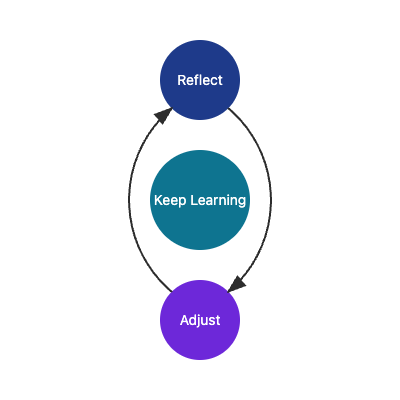
- Reflect: Ask yourself, “Does this new information fit with what I believed before?”
- Adjust: If it doesn’t, update your thinking or plans to include what you’ve learned.
For example, you might think that everyone prefers working in the morning, but after talking to your group, you find out that some people do their best work in the afternoon. Instead of sticking to your first idea, you can say, “I used to think mornings were best, but now I see that afternoons work better for some people. Let’s try to find a schedule that fits both.”
If you hear two different opinions, try to figure out why. Maybe people have different needs, or maybe they are talking about different situations. You can ask, “What makes this work for you?” or “Are there times when this doesn’t work as well?” This helps you understand the bigger picture.
By using the Reflect and Adjust method, you’ll keep learning and make better choices as you go.
When you ask good questions, listen carefully, and use the Reflect and Adjust method, you can understand problems from different points of view and make better decisions for everyone involved. Next, you’ll get to practice these skills in real-life scenarios. You’ll try asking open-ended questions, listening for hidden details, and using what you learn to adjust your plans.
