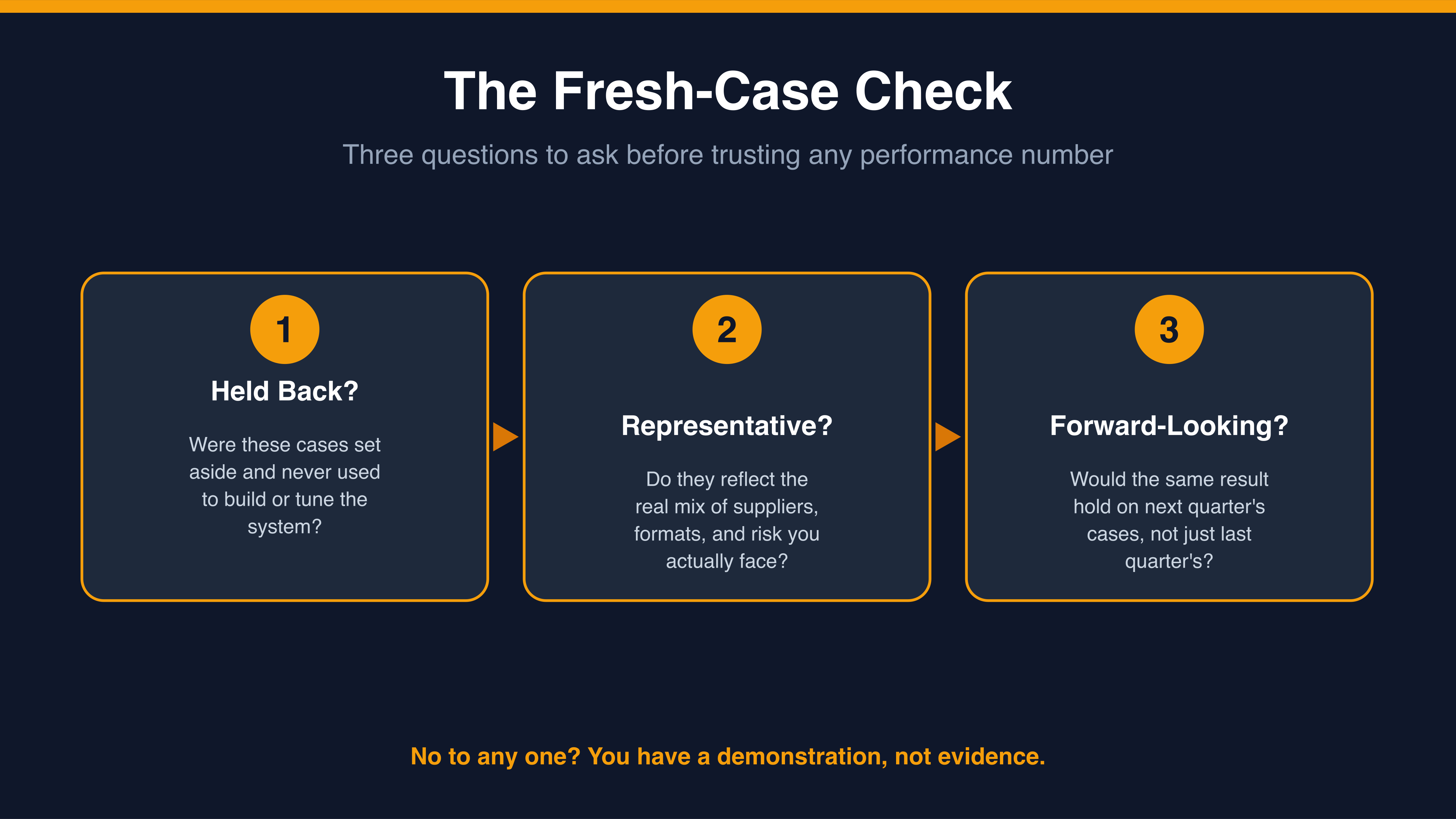
Evaluating Unseen Case Performance
Testing Performance on Relevant Unseen Cases 🧪
Last time you checked whether a system's examples covered the cases you actually face. Now assume coverage looks reasonable and someone hands you a number: ninety-four percent accurate, and here's the demo to prove it. Your next job is narrower again. Not "what did it study?" but "what were these results measured on?" Because a number is only as good as the cases behind it, and most numbers you'll be shown come from cases the system already knows by heart.
This lesson gives you a repeatable way to question any performance number by checking what cases it was actually measured on, and to specify an evaluation set that would count as real evidence.
In this lesson, you will learn to:
- Recognize why a demo's high score on familiar cases is not evidence of real-world performance
- Apply the Fresh-Case Check's three questions to test any performance claim before trusting it
- Recommend an evaluation set built from unseen suppliers, formats, risk levels, and time periods
Results on Studied Cases Are Not Evidence ⚠️
Here's the trap in plain terms. When a system is built, someone feeds it examples and tunes it until it handles those examples well. If you then measure it on those same examples, you learn nothing except that the tuning worked. It's the difference between a student who studied the exam paper and a student who studied the subject. Both score highly. Only one of them can handle Monday's real work.
This happens constantly and usually without anyone intending it. A vendor builds a demo from the invoices you sent them last quarter, tunes on those invoices, then walks you through those same invoices in the meeting. Your team recognizes the supplier names and finds that reassuring. The recognition is exactly the problem.
The following exchange is between Victoria, who was impressed by a vendor's invoice-processing demo, and Milo, who is helping her check what the demo actually proves.
- Victoria: The demo was convincing. Thirty invoices, it got twenty-eight right, I checked the totals myself.
- Milo: Where did those twenty come from?
- Victoria: Our own file. Last quarter's, from our biggest suppliers.
- Milo: And did the vendor have that file while they were building the tool?
- Victoria: Yes, we sent it over in June so they could set it up.
- Milo: Then twenty-eight out of thirty tells us it handles those thirty invoices. It's a working demonstration, not evidence about the invoices arriving next Tuesday.
Notice what Milo did not do. He didn't call the demo dishonest or accuse anyone of rigging it. He asked one factual question about where the test cases came from, and that question alone changed what the number meant. That's the move, and it works because it's neutral.