Balancing Misses and False Alarms
Weighing Missed Cases, False Alarms, and Harm ⚖️
This lesson is about the business judgment call hiding behind a single accuracy number: choosing how to balance missed cases against false alarms.
In this lesson, you will learn to:
- Distinguish a missed case from a false alarm in plain operational language everyone in the room can act on.
- Cost each type of mistake in workload, money, and trust to see why they can't be traded off like-for-like.
- Apply the Two-Mistake Trade-off Review to recommend and document an alert threshold your team can actually work with.
In the last unit you learned to refuse evidence drawn from cases the system already studied. Now comes the number itself. Someone puts a slide in front of you that says the screening tool is "94% accurate," and the room relaxes. Don't. That single figure hides two completely different mistakes with completely different consequences, and choosing between them is a business decision, not a technical one. It belongs to you.
It helps to carry a short set of questions into any of these reviews: does the evidence use unseen relevant cases, does the system catch the cases that matter, how many false alarms does it create, and which resulting business harm are you willing to accept? The first question you covered already. This unit is about the last three.
Naming the Two Mistakes in Plain Operational Terms 🏷️
Any screening system, on any single case, does one of four things. It flags something that genuinely mattered, which is the win. It stays quiet on something that genuinely didn't matter, which is also a win and the reason you bought the thing. Or it gets it wrong in one of two directions: it lets a case through that should have been looked at, or it raises an alert on a case that turns out to be nothing.
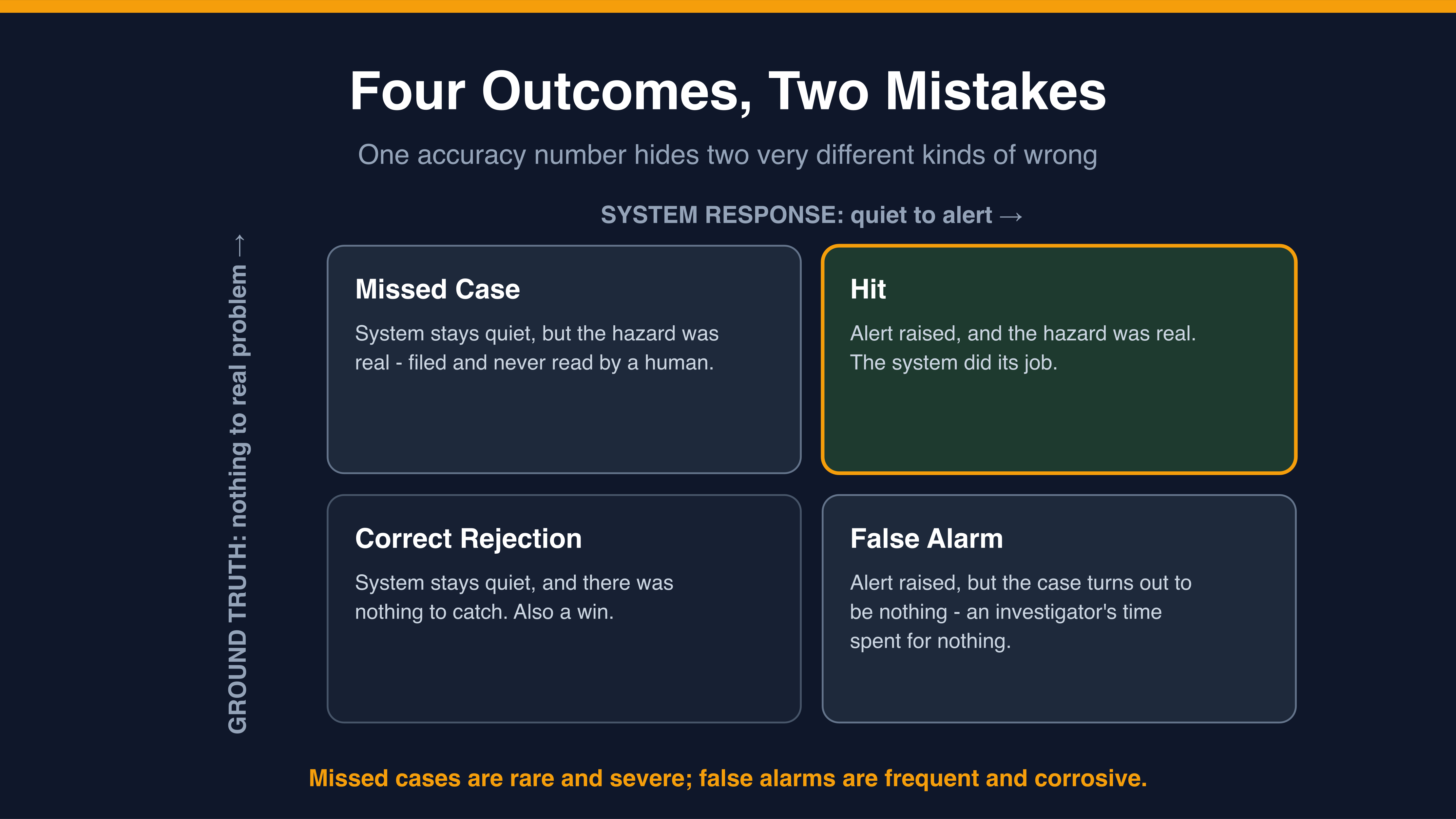
Your first job in the room is to make people say those two mistakes out loud in operational language, not statistical language. A missed case is not "a false negative." It is "a hazard report that was screened out, filed, and never read by a human being." A false alarm is not "a precision problem." It is "an investigator spending ninety minutes on a report that was fine all along." The moment those sentences exist in plain words, everyone in the meeting can reason about them, including the people who will actually live with the outcome.
The coaching move is a single question, and you can ask it verbatim: When this system is wrong, which way is it usually wrong — does it stay quiet when it shouldn't, or does it shout when it doesn't need to? A good data partner will answer immediately. If the answer is a shrug, you have learned something important about how well the system has been evaluated.
Here's how that exchange plays out between Milo, a data scientist eager to ship the model, and Natalie, the product manager who has to answer for its real-world consequences:
- Milo: The model came back at 94% on the held-out set. I think we're good to launch.
- Natalie: Ninety-four percent of what, though? Break the six percent apart for me. How much of it is cases we let through, and how much is alerts that turn out to be nothing?
- Milo: Roughly a fifth is cases we let through. The rest are alerts that get closed with no action.
- Natalie: So out of a hundred mistakes, about twenty are the kind that could actually hurt someone, and eighty just cost review time. Say it that way tomorrow and the room will make a much better decision.
- Milo: Honestly, nobody's asked me to split it before.
Notice that Natalie didn't dispute the number. She just refused to let one number stand in for two very different kinds of harm.
