Assessing Training Data Coverage
Assessing Training Data for Intended Use 🎯
Last time you sorted out which question your data can answer at all. Now assume the answer was yes: the outcome was recorded, and a system has been built. The next question you own is narrower and, in practice, more dangerous to skip. Not "can this work?" but "can this work here, on the cases my part of the business actually sees?"
This lesson shows you how to judge whether a system's training data actually covers the regions, time periods, case types, and populations where you plan to use it.
In this lesson, you will learn to:
- Assess whether a system's training examples cover the regions, populations, and case types you intend to serve
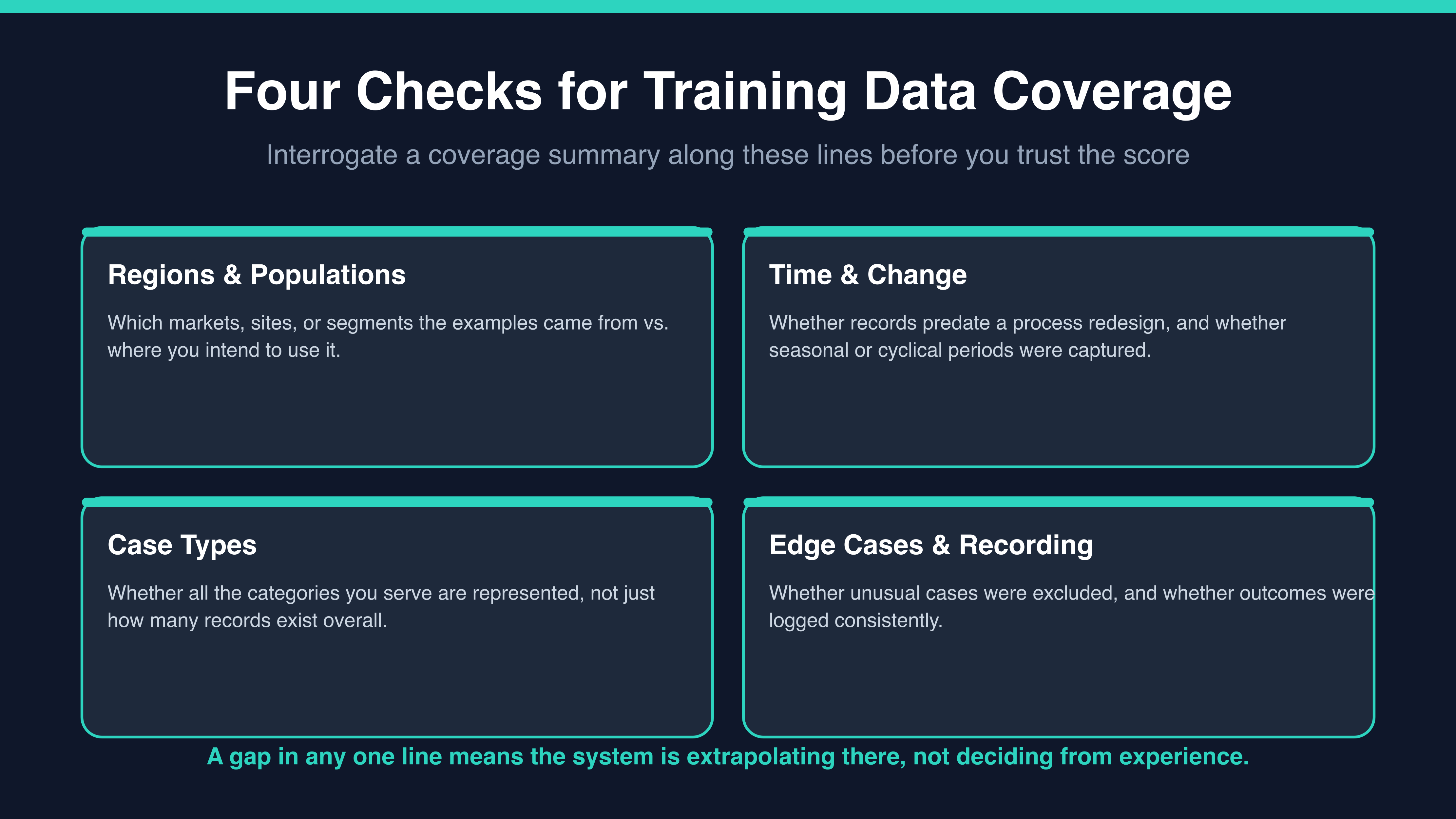
- Read a plain-English coverage summary along four lines: regions and populations, time and seasonality, case types, and how outcomes were recorded
- Recommend which coverage gaps must close before wider approval, what use remains defensible now, and what evidence would justify expanding scope
The Examples a System Studied Set the Edge of What It Can Handle 🧭
Here's the mental model to carry into every one of these conversations. A learned system is only ever a summary of the examples it was shown. It has no general knowledge of hiring, or invoices, or customers. It has patterns pulled from a specific pile of past cases, and outside that pile it is guessing with confidence it hasn't earned.
That last part is what catches leaders out. A system doesn't go quiet or flag uncertainty when it meets something unfamiliar. It produces an answer that looks exactly like its good answers. So the boundary is invisible from the output. The only place you can see it is in the description of what the system studied, which is why your job is to ask for that description before rollout, not after.
Think of it like a manager who has spent eleven years hiring software engineers in one country. Ask them to assess an engineering candidate and they're excellent. Ask them to assess a field sales candidate in a market they've never worked in, and they'll still have an opinion, delivered with the same confidence. Nothing about their manner tells you they've left their experience behind.
The following exchange is between Simone, a talent-acquisition leader excited about early pilot results, and Milo, the data partner who presses on exactly what population those results actually cover.
- Simone: The pilot results are strong. Ninety-one percent agreement with our recruiters. I'd like to take this to all regions next month.
- Milo: Agreement on which candidates, though? Which regions were in the examples it studied?
- Simone: It learned from our whole history of screening decisions.
- Milo: Our history, or one division's history? Because if every example came from engineering roles in one market, ninety-one percent tells you it does well on engineering roles in that market. It says nothing yet about a sales role in a region it's never seen.
- Simone: But it would still give us a score for that candidate.
- Milo: It would. That's the risk, not the reassurance.
Notice Milo never questioned the ninety-one percent. He questioned what population that number was measured over. That's the move.