Choose Measurements for Real Situations
Introduction 🎉
Welcome to Choose Measurements for Real Situations! You have reached the fourth and final lesson in this course, which means all the building blocks are in place and it is time to bring everything together.
Over the past three lessons, you learned what perimeter, area, and volume physically represent, how to count the right kind of units for each one, and how to attach correct real-world labels with the proper exponent. Now comes the practical payoff: when you face an everyday task, how do you decide which measurement to use? Textbooks spell it out for you, but a trip to the hardware store does not come with instructions saying "find the area."
In this lesson, you will learn to:
- Read real situations to identify the physical action involved.
- Choose the correct measurement (perimeter, area, or volume) for an everyday task.
- Back up your measurement choice with a clear reason.
🧠 Thinking Like a Problem-Solver
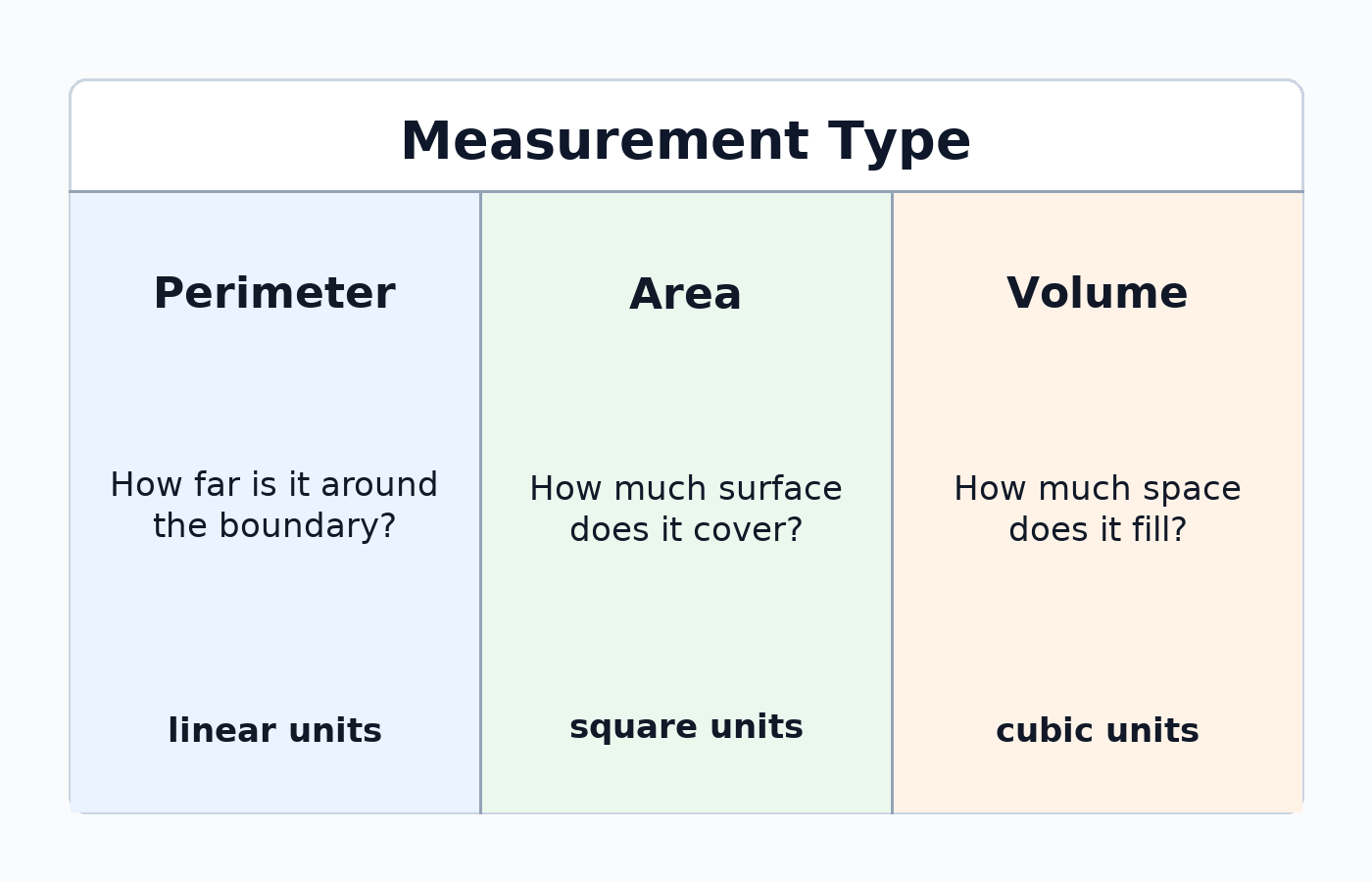
Every geometric measurement answers one of three questions: How far around?, How much surface?, or How much space inside? You already know these map to perimeter, area, and volume. The new skill is recognizing which question a real-world task is secretly asking.
Think of it this way. The task always involves some material or action — buying ribbon, spreading paint, pouring concrete. That material interacts with an object in a specific physical way: it lines an edge, coats a surface, or fills an interior. Once you identify that interaction, the measurement practically names itself.
- A material that runs along an edge → you are measuring a boundary → perimeter.
- A material that covers or coats a surface → you are measuring surface coverage → area.
- A material that fills or packs a space → you are measuring enclosed space → volume.
This three-way check is the single most useful habit you can build, and every example in the rest of this lesson uses it.
🧐 Ask What You Are Really Measuring
The fastest path to the right measurement is a single question: What am I physically doing with the object? Let's test this with three familiar tasks.
| Everyday Task | What You Are Doing | Measurement |
|---|---|---|
| Installing a fence around a yard | Running material along the property edge | Perimeter |
| Painting a bedroom ceiling | Covering a flat surface with paint | Area |
| Filling a kiddie pool with water | Filling an enclosed space | Volume |
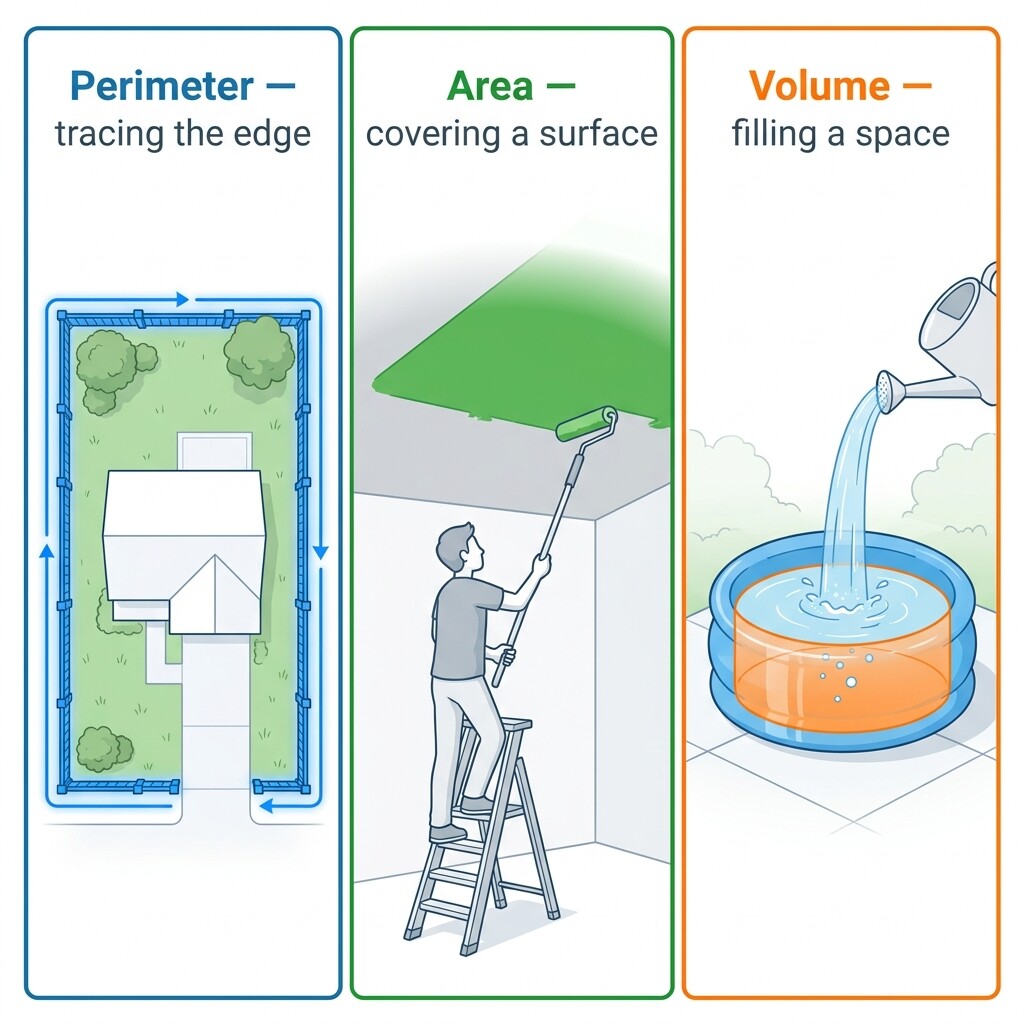
Notice that the object itself does not decide the measurement. The action does. A swimming pool could involve perimeter (placing tiles around the rim), area (covering the pool floor with a liner), or volume (filling it with water).
🚶 Walking Through Real Scenarios
Let's practice the decision process step by step with three common situations.
Scenario 1 — Framing a painting. A homeowner wants to put a wooden frame around a rectangular painting. The frame follows the outer edge of the painting, so you are measuring a boundary length. That means perimeter, reported in linear units like inches or centimeters.
Scenario 2 — Carpeting a living room. Carpet covers the floor from wall to wall. The floor is a flat surface, so you need to know how much surface the carpet must cover. The correct measurement is area, reported in square units like or .
Scenario 3 — Filling a fish tank with water. Water fills the inside space of the tank. This asks how much space the tank holds, so the correct measurement is volume, reported in cubic units like or .
In every case, the reasoning follows the same pattern: identify the action, connect it to boundary, surface, or space, and then name the measurement with its matching unit type.
👀 Spotting Common Mix-ups
Some situations sound tricky because the wording can point you in the wrong direction. Here are two mix-ups that come up often:
- "How much wallpaper do I need?" It is tempting to think about the perimeter of the room because wallpaper goes around the walls. But wallpaper covers wall surfaces, so the correct measurement is area. Perimeter would only tell you the total length along the base of the walls — it says nothing about how tall the paper needs to be.
- "How much mulch should I buy for the garden?" Mulch might seem flat once it is spread, but it fills a layer of space with a certain depth. Because it has length, width, and thickness, we are filling a three-dimensional space. The correct measurement is volume.
The key to avoiding these traps is to focus on what the material actually does. If it covers a surface (like paint or carpet), think area. If it fills a space with some depth (like soil, water, or mulch), think volume. If it runs along an edge (like a fence or a ribbon), think perimeter.
✅ A Three-Step Decision Checklist
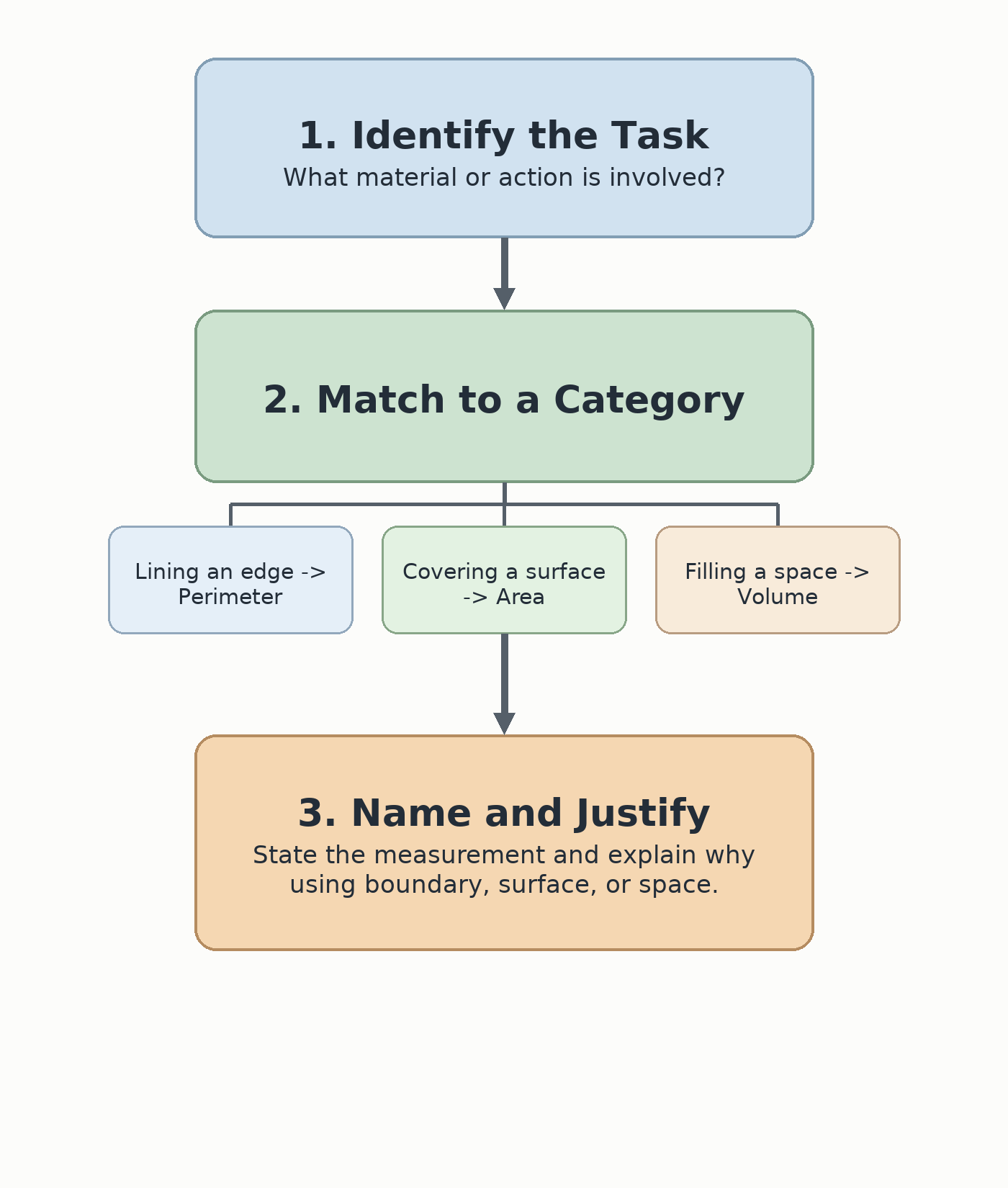
Whenever you encounter a new situation, run through these three steps:
- Identify the task. What material or action is involved? (e.g., buying ribbon, spreading fertilizer, pouring concrete)
- Match it to a category. Is the material lining an edge, covering a surface, or filling a space?
- Name and justify. State the measurement (perimeter, area, or volume) and explain why it fits, using the language of boundary, surface, or space.
Step 3 is just as important as the other two. Being able to say why shows real understanding and helps catch mistakes before they become expensive. For example: "I need the area of the ceiling because paint covers a flat surface, and area measures surface coverage in square units."
Conclusion and Next Steps
In this lesson, you learned to read everyday situations and choose whether perimeter, area, or volume is the right measurement by focusing on what you are physically doing: tracing a boundary, covering a surface, or filling a space. You also practiced spotting common mix-ups where the wording can be misleading. Combined with the unit-labeling skills from previous lessons, you now have a complete toolkit for identifying, computing, and communicating geometric measurements.
Up next, you will put this decision-making skill to the test with a set of hands-on practice exercises. You will sort scenarios, catch mismatched measurements, and explain your reasoning in your own words. Time to show what you have learned — let's jump in!
