Welcome back to Finding the Lowest Common Multiple! You have reached lesson four of five in this course, and that is a great place to be. So far, we have built a solid toolkit: first we explored common multiples by listing, then we found the LCM from those lists, and most recently we learned how to compute the LCM efficiently using prime factorisation. Today, we shift our focus from how to calculate the LCM to when and why we need it. In this lesson, we will learn to recognise real-world problems that call for the LCM and practise solving them from start to finish.
Why the LCM Keeps Showing Up
Think about everyday situations where two or more things repeat on their own fixed schedule. City buses leave a station at regular intervals. Maintenance tasks recur every set number of days. Grocery items come in fixed pack sizes that rarely match. In all of these cases, a natural question arises: "When will these cycles line up?" or "What is the smallest quantity that works for both?"
These questions sound different on the surface, but they share the same mathematical core. Finding the answer means finding the smallest number that is a multiple of each cycle length or group size involved — and that is exactly what the LCM gives us.
Spotting an LCM Problem
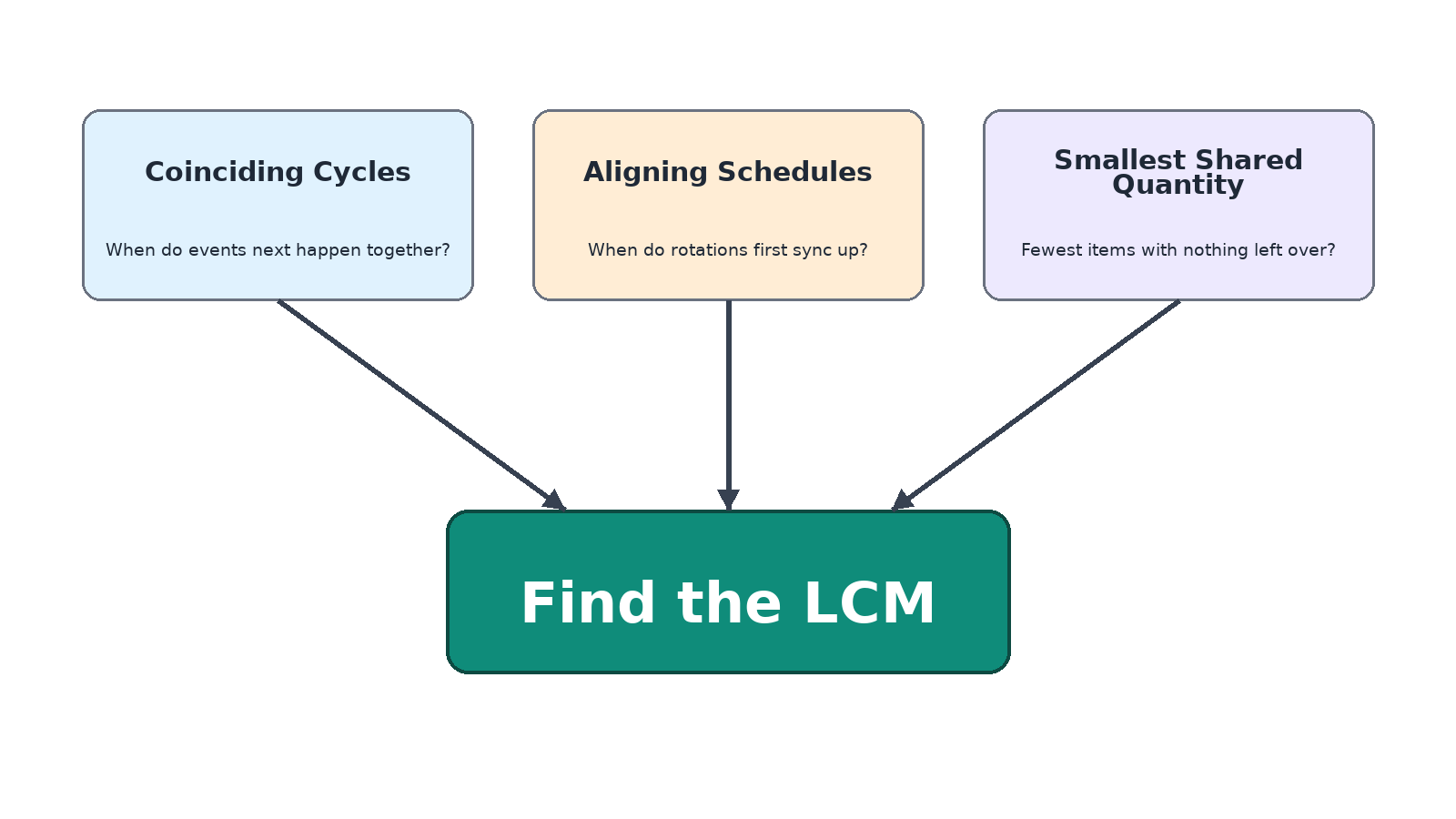
Before we calculate anything, the most important skill is learning to recognise when the LCM is the right tool. Here are three common patterns to watch for:
Coinciding cycles — Two or more repeating events with different intervals, and we want to know when they next happen at the same time. Example: "Alarm A rings every 15 minutes and Alarm B rings every 20 minutes. When do both ring together?"
Aligning schedules — Different schedules or rotations need to sync up. Example: "One worker has a day off every 6 days, another every 8 days. When do they first share a day off?"
Smallest shared quantity — Items come in groups of different sizes, and we need the smallest total where nothing is left over. Example: "Bread rolls come in packs of 6, burger patties in packs of 8. What is the fewest of each item so that rolls and patties match exactly?"
In every case, the key signal is that we are looking for the smallest number that satisfies all the given group sizes or intervals at once.
Join the 1M+ learners on CodeSignal
Be a part of our community of 1M+ users who develop and demonstrate their skills on CodeSignal
Worked Example: When Do Both Buses Leave Together?
Worked Example: Matching Pack Sizes
Worked Example: Repeating Maintenance Tasks
Choosing the Right Method
Conclusion and Next Steps
In this lesson, we moved from computing the LCM to applying it. We learned to spot three common LCM problem patterns — coinciding cycles, aligning schedules, and matching group sizes — and practised a consistent three-step approach: recognise the problem type, calculate the LCM, and interpret the result in context. These steps turn abstract arithmetic into practical answers like clock times, calendar days, and pack counts.
Up next, you will put these skills into action with a set of practice tasks. You will start by identifying which word problems call for the LCM, then work through guided solutions, and finish by solving and explaining full problems on your own — jump in and see how naturally the reasoning flows!
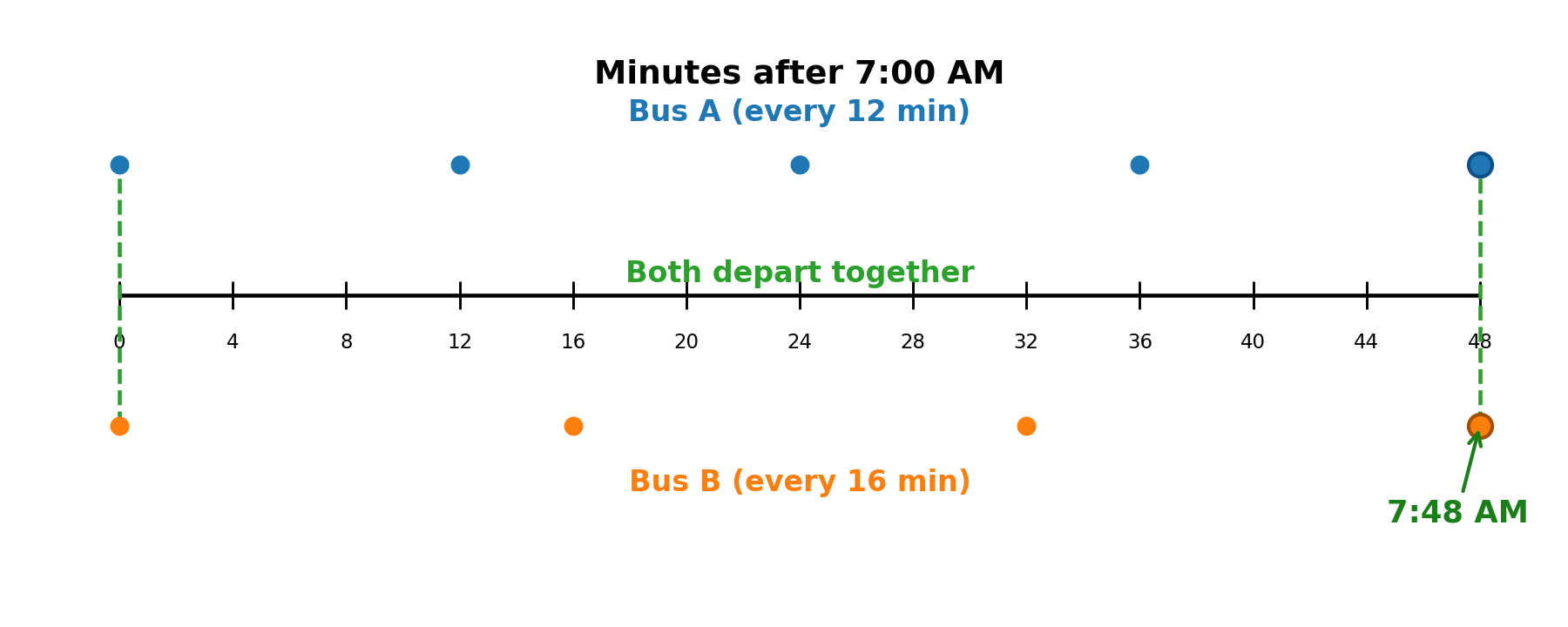
Suppose Bus Route A departs from a station every 12 minutes and Bus Route B departs every 16 minutes. Both buses leave the station together at 7:00 AM. We want to find the next time they depart together.
Step 1 — Recognise the problem type. Two events repeat at fixed intervals (12 and 16 minutes), and we need the first moment they coincide again. This is a coinciding-cycles problem, so we need LCM(12,16).
Step 2 — Find the LCM. We can use prime factorisation, as we learned in the previous lesson:
12=22×3,16=24
Take every prime at its highest power: 24 and 31.
LCM(12,16)=24×3=16×3=48
Step 3 — Interpret the result. The buses next depart together after 48 minutes. Since they both left at 7:00 AM, the next shared departure is at 7:48 AM.
Notice that the final step matters just as much as the calculation. In a word problem, the LCM is rarely the last word — we usually need to translate the number back into the context, whether that is a clock time, a calendar day, or a quantity.
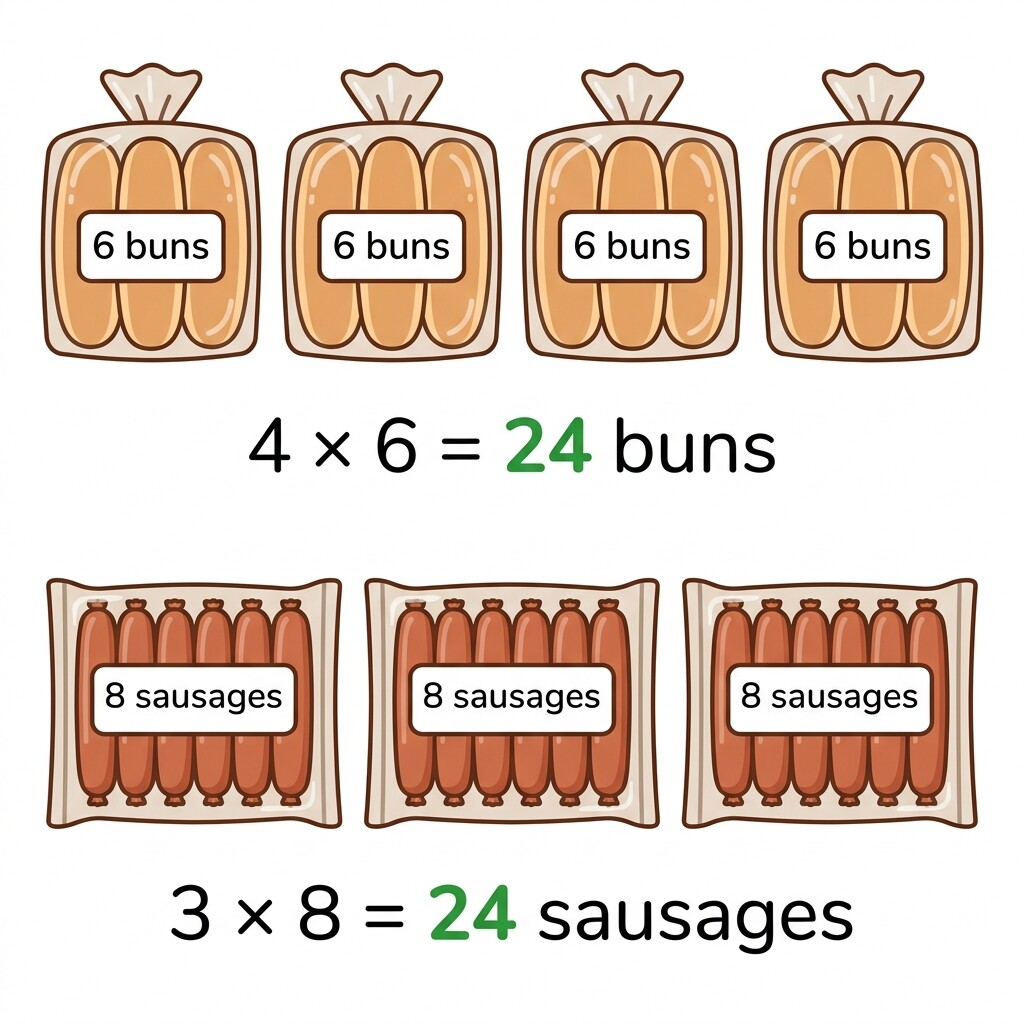
Hot-dog buns come in packs of 6 and sausages come in packs of 8. You are planning a cookout and want every bun to have a sausage, with nothing left over. What is the smallest number of each item you should buy, and how many packs is that?
Step 1 — Recognise the problem type. We need the smallest total that is a multiple of both 6 and 8. This is a smallest-shared-quantity problem, so we need LCM(6,8).
Step 2 — Find the LCM.
6=2×3,8=23LCM(6,8)=23×3=24
Step 3 — Interpret the result. We need 24 of each item. That means:
Bun packs: 24÷6=4 packs
Sausage packs: 24÷8=3 packs
So purchasing 4 packs of buns and 3 packs of sausages gives us exactly 24 of each, with no leftovers.
A factory runs two routine maintenance checks. Task X is performed every 8 days and Task Y every 12 days. Both tasks are completed today (Day 0). On what day will both tasks next fall on the same day?
Step 1 — Recognise the problem type. Two repeating tasks with different intervals need to coincide. We need LCM(8,12).
Step 2 — Find the LCM.
8=23,12=22×3LCM(8,12)=23×3=24
Step 3 — Interpret and explain. Task X occurs on days 8,16,24,32,… and Task Y occurs on days 12,24,36,… The first number that appears in both lists is 24, which matches our LCM result. Both tasks will next coincide on Day 24.
Why does the LCM guarantee this is the earliest such day? Because 24 is the smallest number divisible by both 8 and 12. Any earlier common day would have to be a smaller common multiple — but by definition, no smaller one exists.
Throughout this course, we have developed two ways to find the LCM: listing multiples and prime factorisation. In a real-world problem, either method will give the correct answer, so the choice comes down to practicality.
Situation
Recommended method
Small, familiar numbers (e.g., 4 and 6)
Listing is quick and visual
Larger numbers (e.g., 48 and 72)
Prime factorisation is faster
Three or more numbers
Prime factorisation scales easily
Need to justify your reasoning
Prime factorisation gives a clear written trail
Pick whichever approach you are most comfortable with, keeping in mind that prime factorisation tends to save effort as the numbers grow.