Choosing HCF or LCM
Introduction
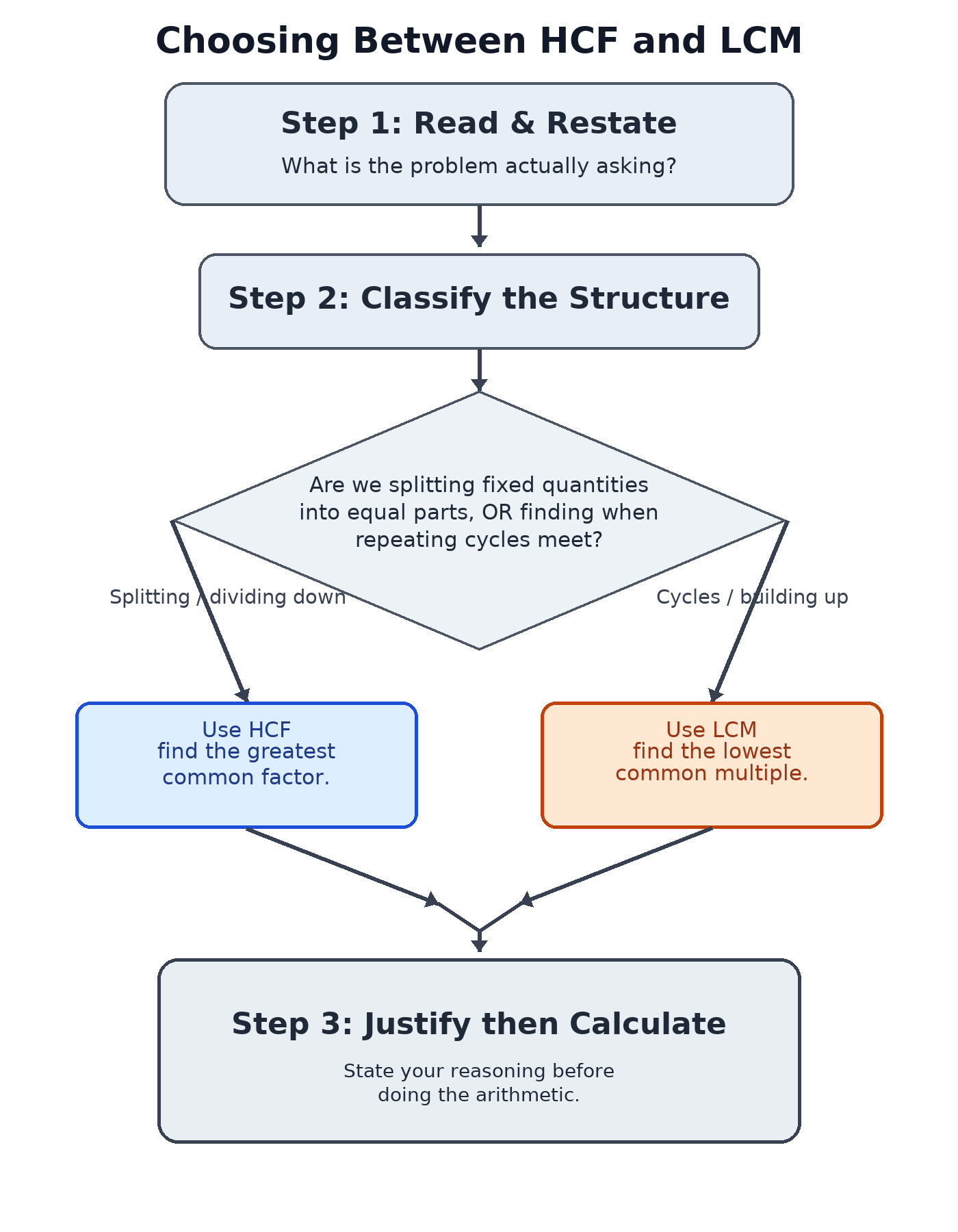
Welcome to the final lesson of Finding the Lowest Common Multiple! Over the previous four lessons, we built a complete toolkit: we generated common multiples, identified the LCM by listing, computed it through prime factorisation, and applied it to real-world word problems. Now it is time for the capstone skill that ties this course — and the broader learning path — together. In this lesson, we answer the question learners encounter most often in practice: "Does this problem need the HCF or the LCM?" By the end, you will be able to look at any word problem involving two or more numbers, decide which tool fits, explain why, and carry out the calculation with confidence.
Two Tools, One Pair of Numbers
You may recall from earlier in the learning path that the Highest Common Factor (HCF) and the Lowest Common Multiple (LCM) both operate on the same set of numbers, yet they answer very different questions. The HCF asks: "What is the largest number that divides evenly into all of the given values?" The LCM asks: "What is the smallest number that all of the given values divide into?"
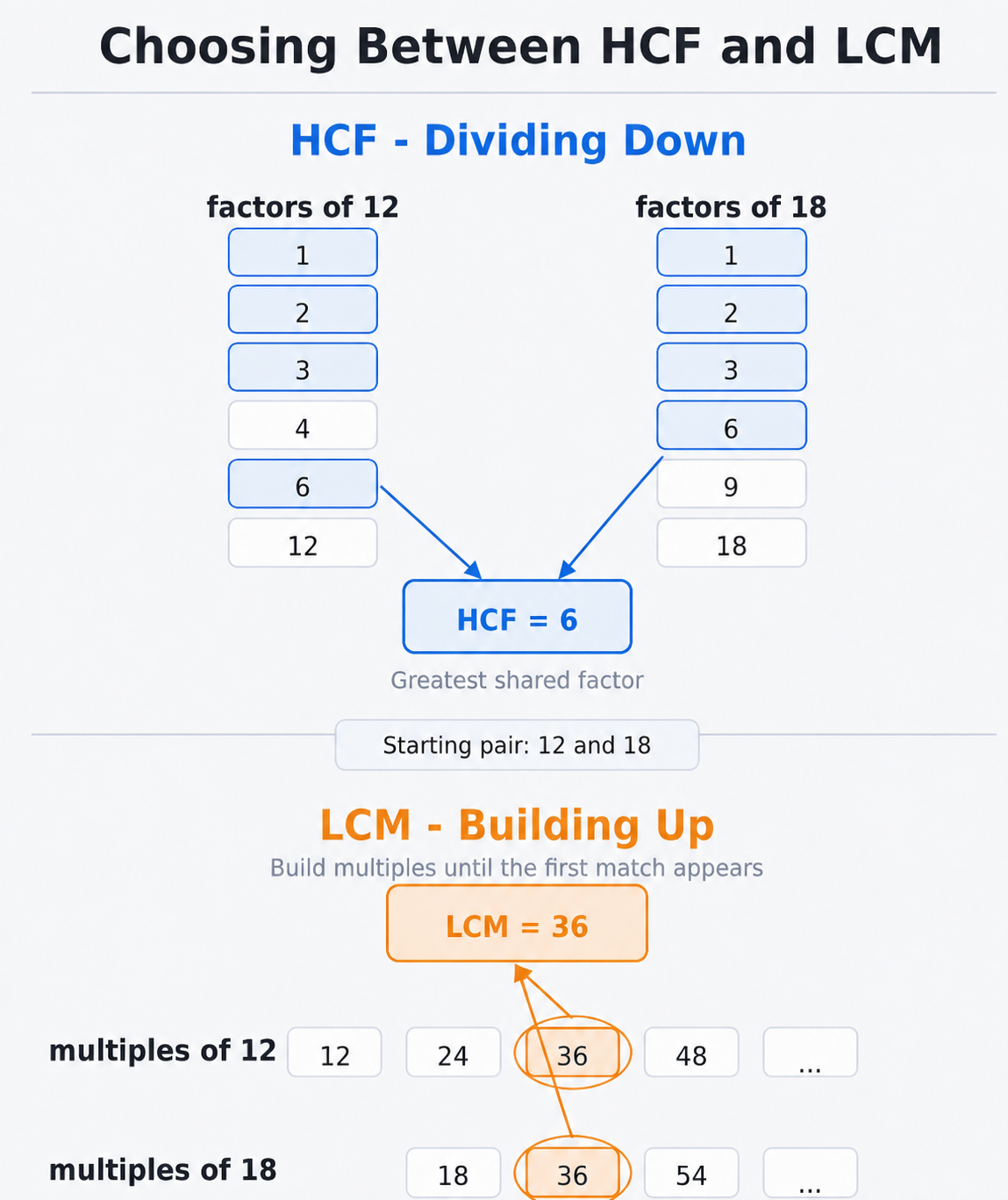
Here is a quick side-by-side look using and :
- — because is the greatest number that fits evenly into both.
- — because is the smallest number both fit into evenly.
Same two numbers, opposite directions. Keeping that distinction crystal clear is the single most important skill in this lesson.
Dividing Down vs. Building Up
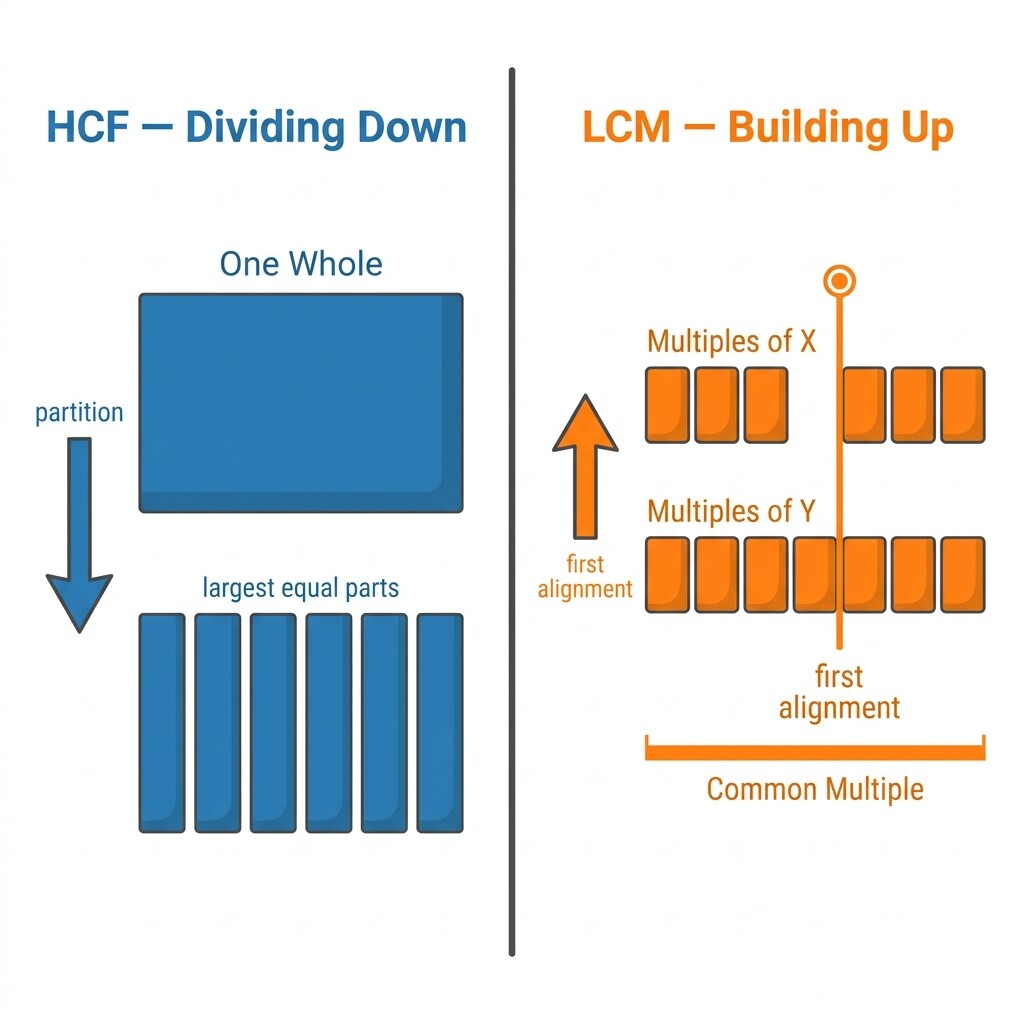
A helpful way to remember the difference is to think about direction. The HCF divides down: we start with the quantities we have and look for the biggest piece that fits inside all of them. The LCM builds up: we start with the quantities we have and look for the smallest total that contains each of them as a factor.
This leads to two distinct families of real-world problems:
| Direction | Operation | Typical situation | Core question |
|---|---|---|---|
| Dividing down | HCF | Equal grouping, fair sharing, cutting into largest equal pieces | "What is the biggest equal part?" |
| Building up | LCM | Coinciding cycles, aligning schedules, matching pack sizes | "When or where do these first line up?" |
If a problem asks us to split or partition quantities into the largest possible equal groups, we reach for the HCF. If it asks us to find the earliest point where repeating events or group sizes meet, we reach for the LCM.