Finding LCM by Listing
Introduction
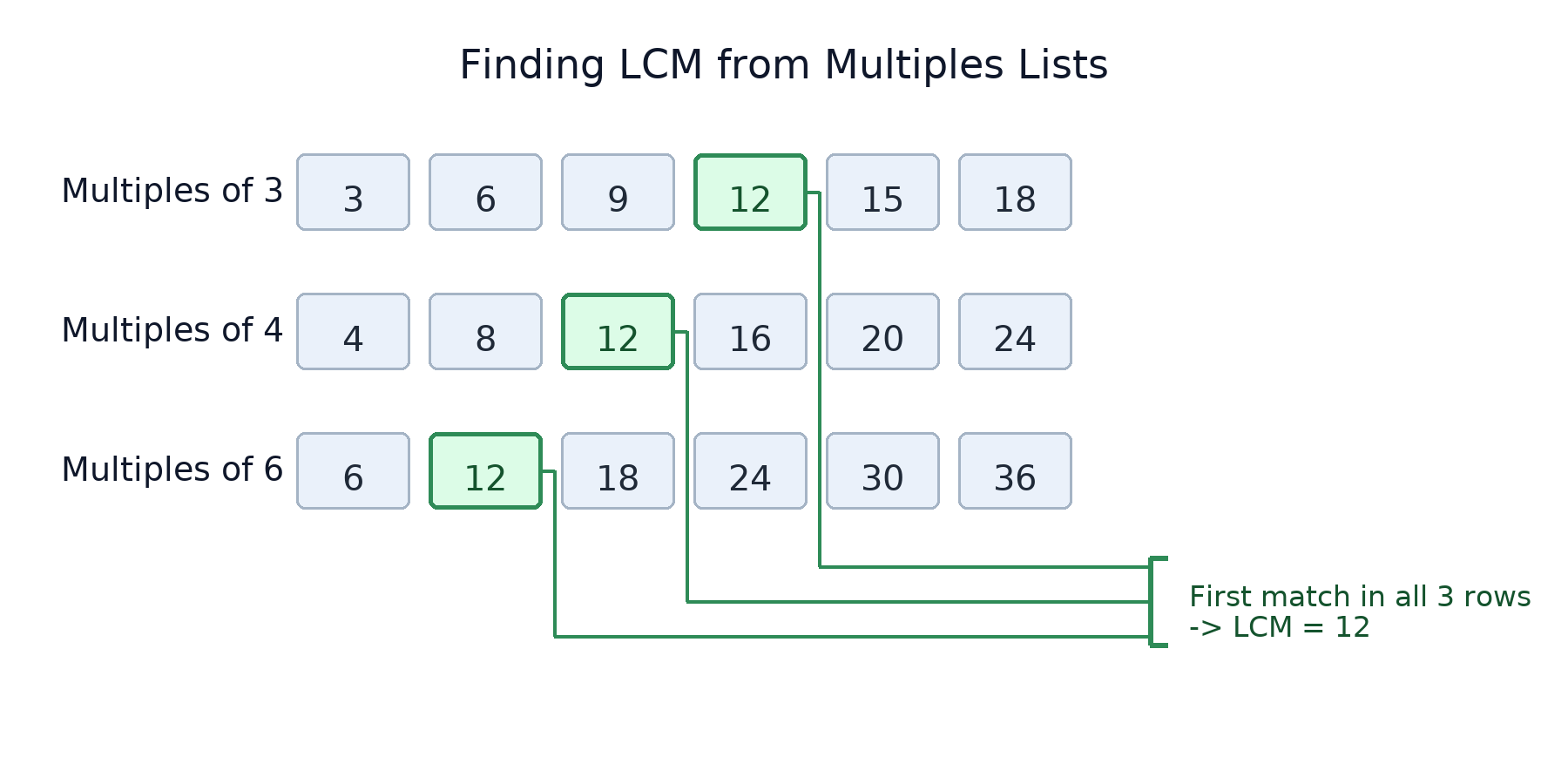
Welcome back to Finding the Lowest Common Multiple! In the previous lesson, you learned how to generate multiples lists for two or more numbers and pick out the values they share — those common multiples. You now know that any set of whole numbers has infinitely many common multiples, and you can find them reliably with a simple listing technique. In this second lesson, we sharpen our focus: instead of collecting all the common multiples we can see, we will learn to identify the smallest one and understand why it deserves a name of its own.
Why the Smallest Common Multiple Matters
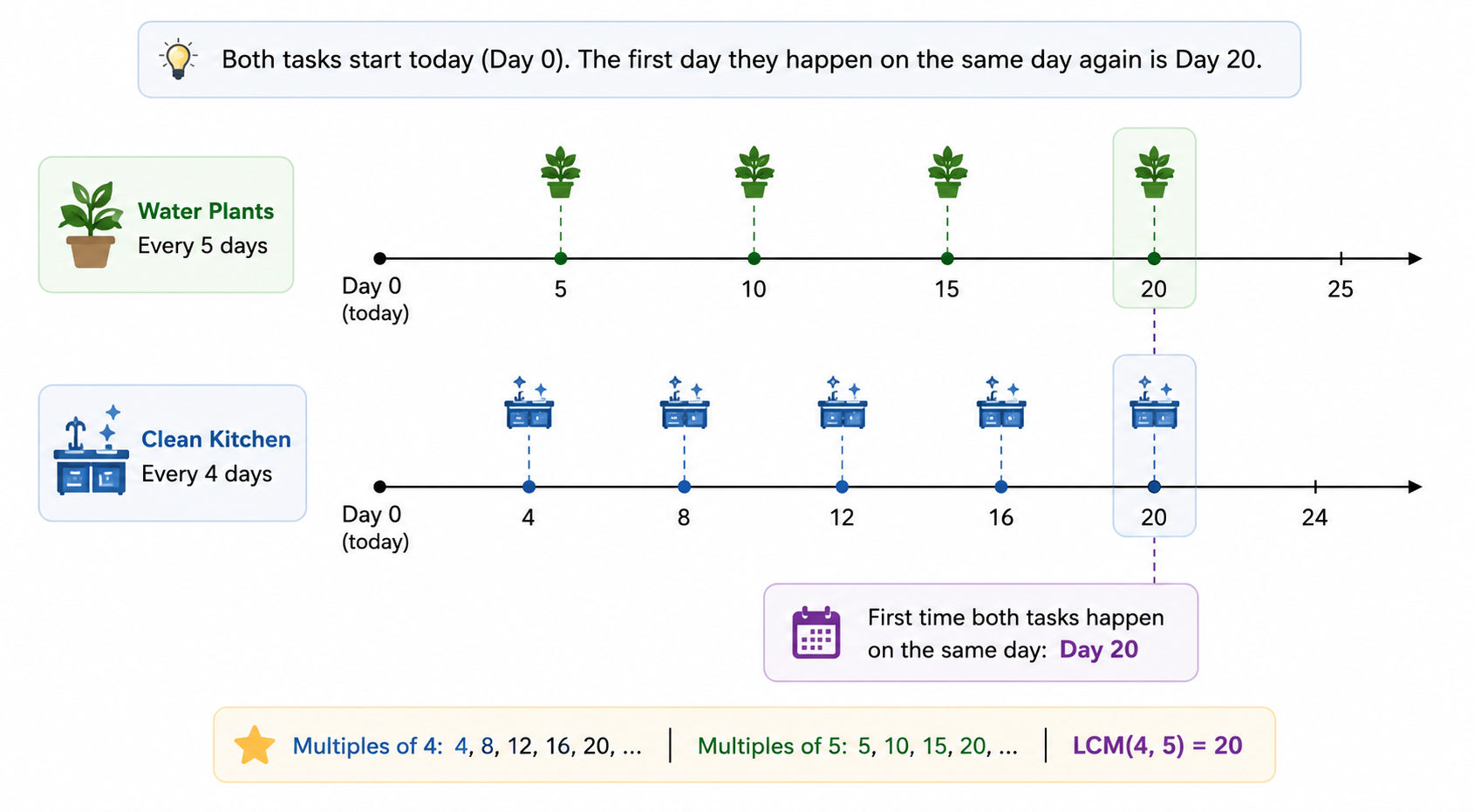
Having infinitely many common multiples is useful to know, but in real life we almost always care about just one of them — the first. Think about two monthly subscriptions that renew on different cycles: the question "When will both renewals first land in the same month?" asks for a single number, not an endless list. That single number is called the Lowest Common Multiple (LCM), and it captures the moment two or more repeating patterns first line up. Learning to find it quickly and confidently is the goal of today's lesson.
Defining the Lowest Common Multiple
The Lowest Common Multiple (LCM) of two or more whole numbers is the smallest positive number that is a multiple of each of those numbers. Equivalently, it is the first value that shows up in every multiples list when we write them in order starting from the number itself.
For example, consider and . Their common multiples are The smallest of these is , so:
Every other common multiple of and is actually a multiple of as well. This is always true: once you know the LCM, all larger common multiples are simply , , and so on. The LCM therefore acts as a kind of building block for the entire family of common multiples.
The Listing Method Step by Step
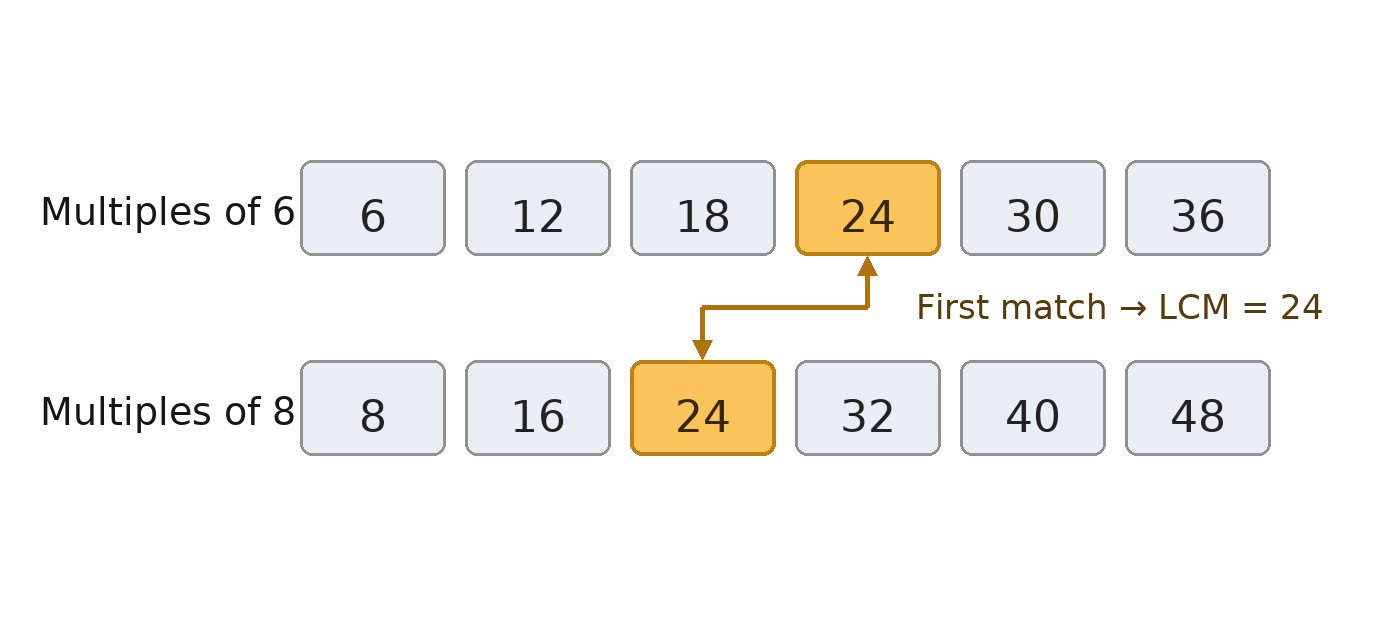
Finding the LCM by listing follows the same process you already know for finding common multiples, with one extra focus: stop as soon as you find the first match. Let us walk through an example with and .
-
List multiples of each number in order, extending just far enough until a shared value appears.
Multiples of Multiples of -
Scan for the first value that appears in both rows. Here, is the first match.
-
Confirm with division.
Both results are whole numbers, so is indeed a common multiple. Because it is the first one we encounter, we write:
Notice that we did not need to list dozens of multiples. Writing them in order and watching for the earliest overlap keeps the work short.