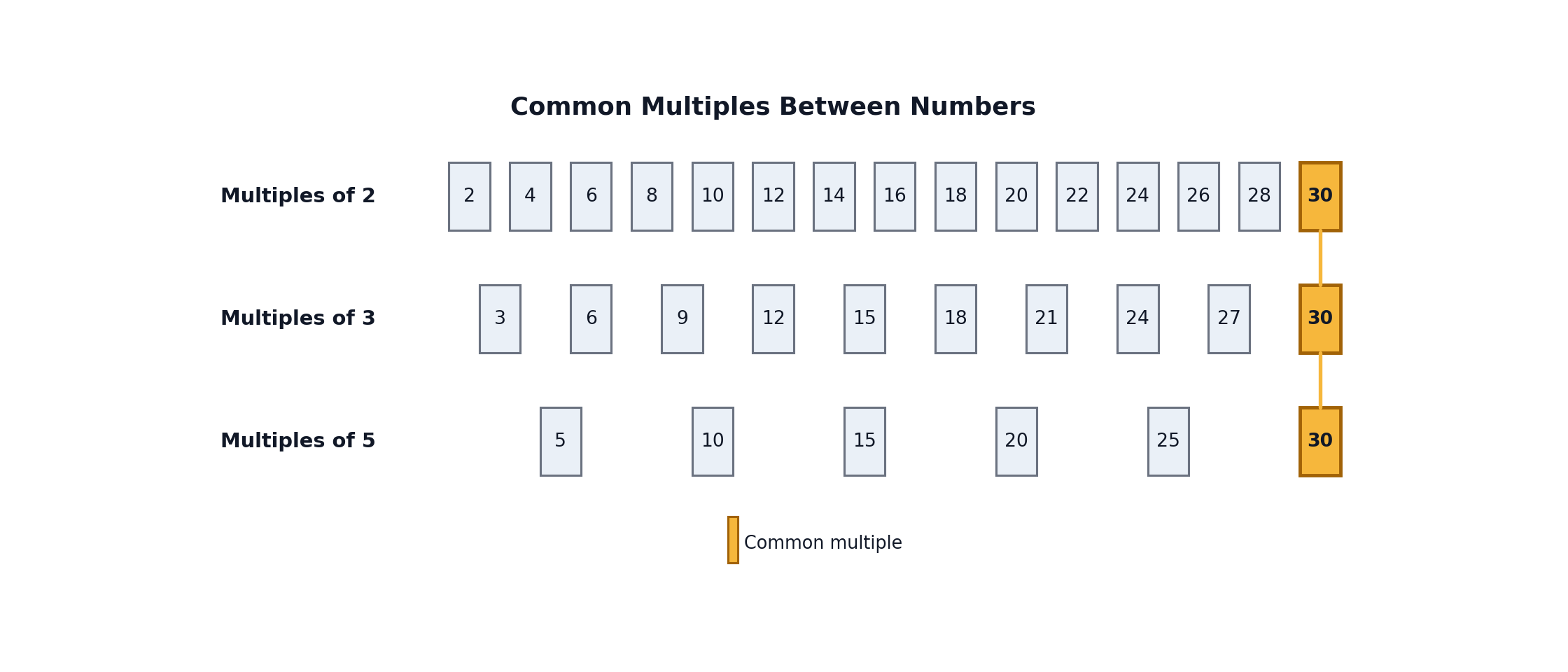
Finding Common Multiples
Introduction
Welcome to Finding the Lowest Common Multiple, the fifth and final course in this learning path! Over the previous four courses, you built a strong toolkit: factors, multiples, prime factorisation, and the Highest Common Factor. Now we will put that foundation to work in a new direction by exploring common multiples and, eventually, the Lowest Common Multiple (LCM).
In this first lesson, we will learn how to generate lists of multiples for two or more numbers, compare those lists, and spot the values that appear in every one. By the end, you will have a clear picture of what a common multiple is and a reliable method for finding one.
A Quick Refresher on Multiples
As you may recall from earlier courses, a multiple of a whole number is the result of multiplying that number by any positive whole number. For example, the multiples of are because , , and so on. Every whole number has infinitely many multiples, so the list never ends.
There is also a handy division perspective: if a number divides evenly into a larger number (with no remainder), then is a multiple of . Keep both views in mind — multiplication for generating multiples, and division for checking them.
What Is a Common Multiple?
A common multiple of two or more numbers is a value that is a multiple of each of those numbers. Put differently, every one of the given numbers divides into it evenly.
Consider the numbers and . The number is a multiple of (since ) and also a multiple of (since ). Because appears in both multiples lists, it is a common multiple of and . So is , and , and infinitely many others — there is no largest common multiple, just as there is no largest multiple of any single number.
Finding Common Multiples by Listing
The most direct way to find common multiples is to list several multiples of each number and then look for matches. Let us walk through an example with and .
Step 1 — List the first several multiples of each number.
| Multiples of | ||||||||||
|---|---|---|---|---|---|---|---|---|---|---|
| Multiples of |
Step 2 — Compare the two rows and pick out every value that appears in both.
Scanning across, we can see that , , and show up in both lists. Each of these is a common multiple of and .
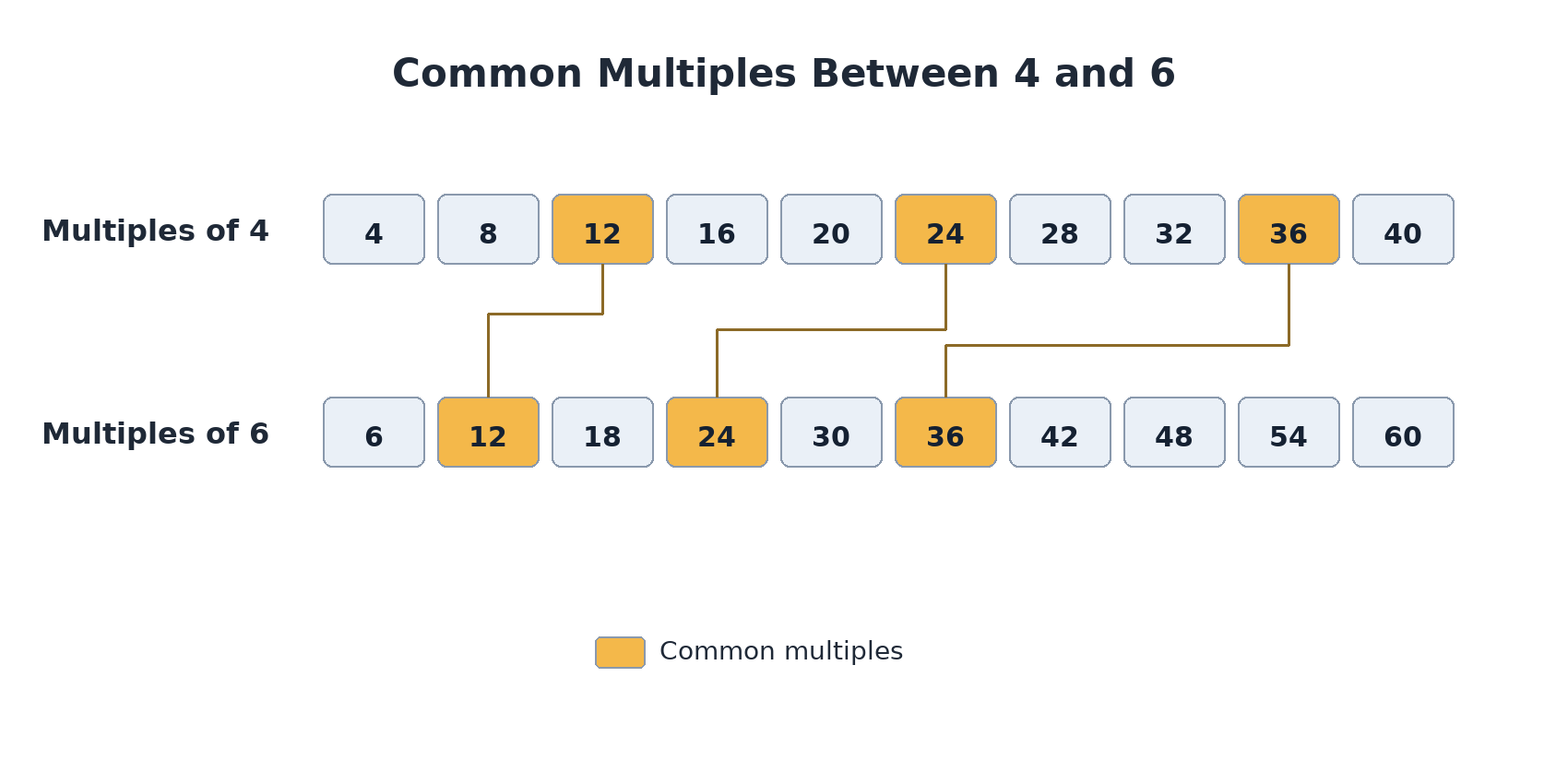
Step 3 — Verify with division. For any match you find, you can confirm it by checking divisibility. Take :
Both divisions are exact, so is indeed a common multiple of and . This quick check is especially helpful when the lists are long and you want to be sure you haven't misread a value.