HCF from Factor Lists
Introduction
Welcome back to Finding the Highest Common Factor! In the previous lesson, you learned how to list all the common factors of two or more numbers by comparing their factor lists. That was an important first step, but in practice, we usually need just one number from that list — the biggest one.
This second lesson zooms in on exactly that idea. We will define the Highest Common Factor (HCF), walk through a reliable method for finding it, and explore two special cases you will encounter regularly. By the end, you will be able to look at any set of whole numbers and confidently pick out the greatest factor they all share.
Why the Greatest Common Factor Matters
Common factors tell us every group size that divides two or more quantities evenly, but in most real situations we care about the largest group size that works. Think of it this way: if you have 20 apples and 30 oranges and you want to make identical fruit bags with no leftovers, you could make 2 bags, or 5 bags. But you probably want to know the most bags you can make, because that means more people served and less waste per bag. That "most bags" number is the HCF.
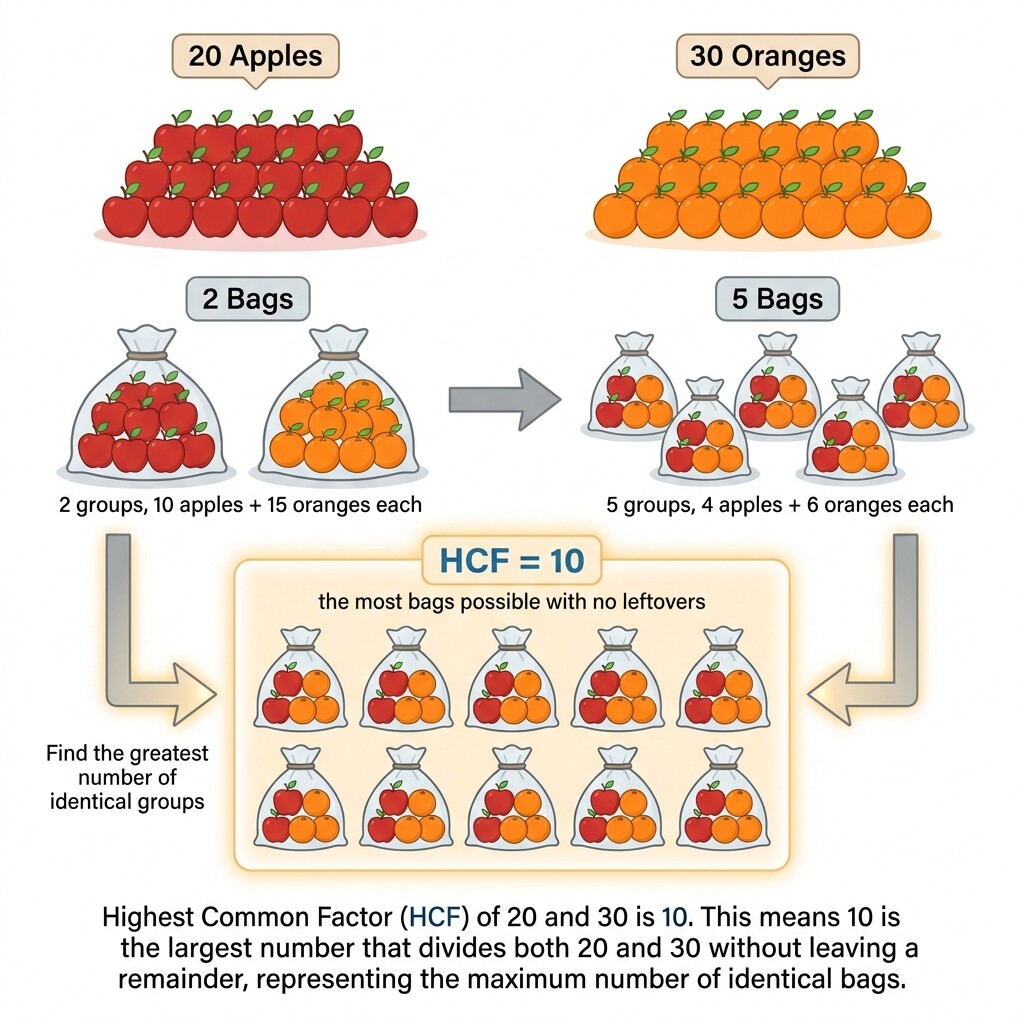
Whenever a problem asks for the greatest, maximum, or largest value that divides several quantities evenly, you are looking for the HCF. Let's give it a precise definition.
What Is the Highest Common Factor?
The Highest Common Factor (HCF) of two or more whole numbers is the largest number that is a factor of every number in the set. You may also see it called the Greatest Common Factor (GCF) or the Greatest Common Divisor (GCD) — all three names mean exactly the same thing.
Because 1 divides every whole number, every set of whole numbers has at least one common factor. This guarantees that the HCF always exists and is at least .
Finding the HCF Step by Step
The method builds directly on the factor-listing skill you practised in the previous lesson. Only one new action is needed at the end:
- List all factors of each number.
- Identify the common factors (those appearing in every list).
- Select the greatest value from that shared list.
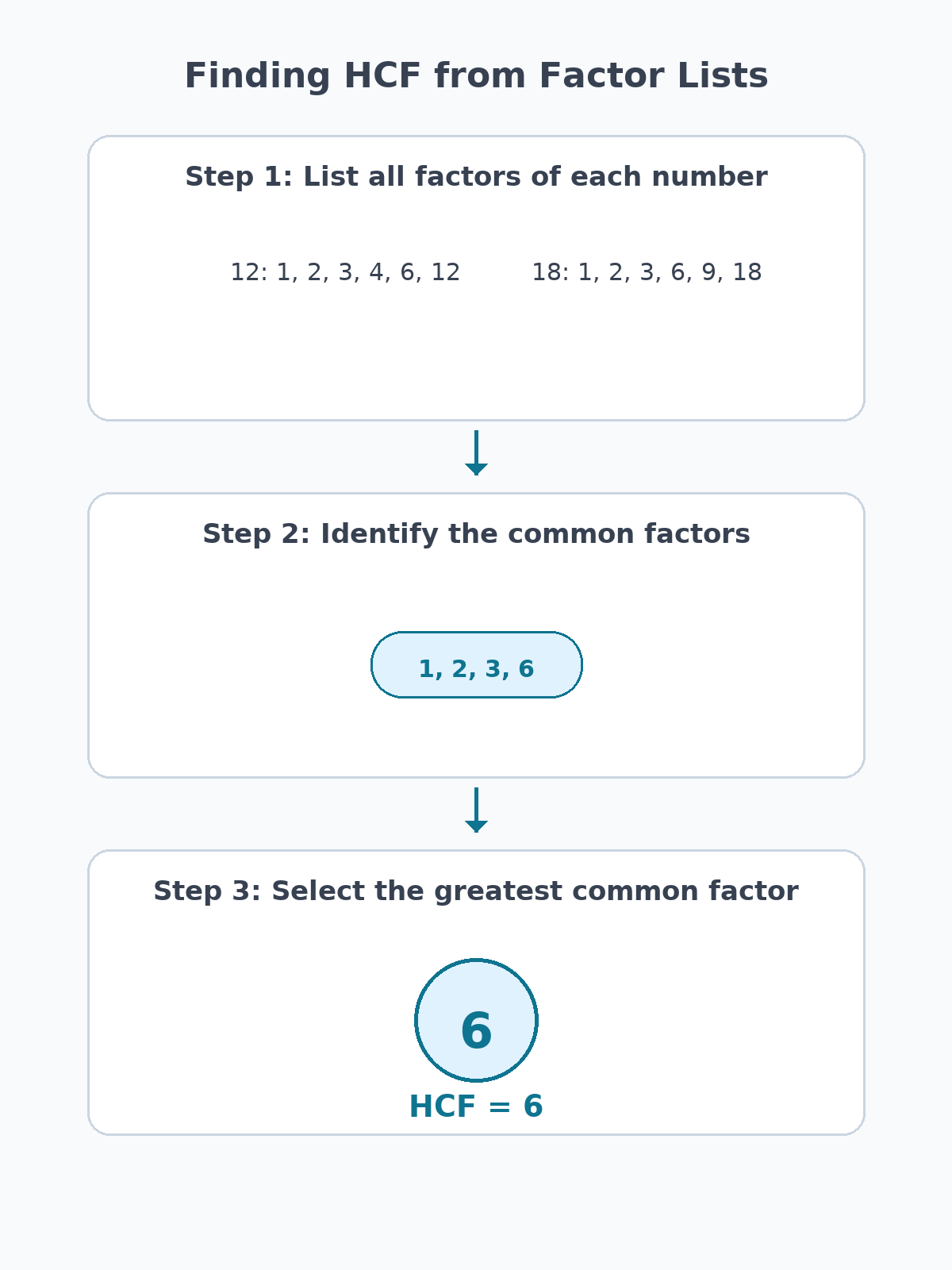
Let's walk through an example with and .
| Factors of 12 | Factors of 18 |
|---|---|
| 1, 2, 3, 4, 6, 12 | 1, 2, 3, 6, 9, 18 |
Comparing the two lists, the common factors are . The largest of these is 6, so:
This means is the biggest number that divides both and exactly. No number larger than can do that.
A Larger Pair: 20 and 30
Let's try and , which have a few more factors to consider.
| Factors of 20 | Factors of 30 |
|---|---|
| 1, 2, 4, 5, 10, 20 | 1, 2, 3, 5, 6, 10, 15, 30 |
The common factors are . The greatest value in this list is 10:
Notice how is a factor of but not of , so it does not qualify. Always check each candidate against every list before including it. Going back to our fruit-bag scenario, this result tells us we can make 10 identical bags — each containing 2 apples and 3 oranges — with nothing left over.
When the HCF Is 1
In the previous lesson, we met the idea of coprime (relatively prime) numbers — pairs whose only common factor is . When that happens, the HCF is simply .
Consider and :
- Factors of :
- Factors of :
The only shared factor is , so:
An HCF of does not mean something went wrong. It just tells us that no number greater than divides both values evenly. This is a perfectly normal outcome, and you will see it often when the two numbers have no overlap in their prime factors.
When One Number Is Itself the HCF
Another special case occurs when the smaller number divides the larger one exactly. Take and :
| Factors of 12 | Factors of 36 |
|---|---|
| 1, 2, 3, 4, 6, 12 | 1, 2, 3, 4, 6, 9, 12, 18, 36 |
The common factors are . The greatest is 12, which is one of the original numbers:
This happens because , so is a factor of . Whenever one number divides the other exactly, the smaller number will always be the HCF. Recognizing this pattern can save you time: if you notice that divides with no remainder, you can immediately conclude that .
Working with Three Numbers
The process extends naturally to three or more numbers. The only change is that a factor must appear in every list to qualify. Let's find the HCF of , , and — numbers you worked with in the previous lesson when practising common factors.
| Factors of 12 | Factors of 18 | Factors of 30 |
|---|---|---|
| 1, 2, 3, 4, 6, 12 | 1, 2, 3, 6, 9, 18 | 1, 2, 3, 5, 6, 10, 15, 30 |
Checking each candidate: ✓, ✓, ✓, (missing from 18 and 30) ✗, (missing from 12 and 18) ✗, ✓. The largest common factor is 6:
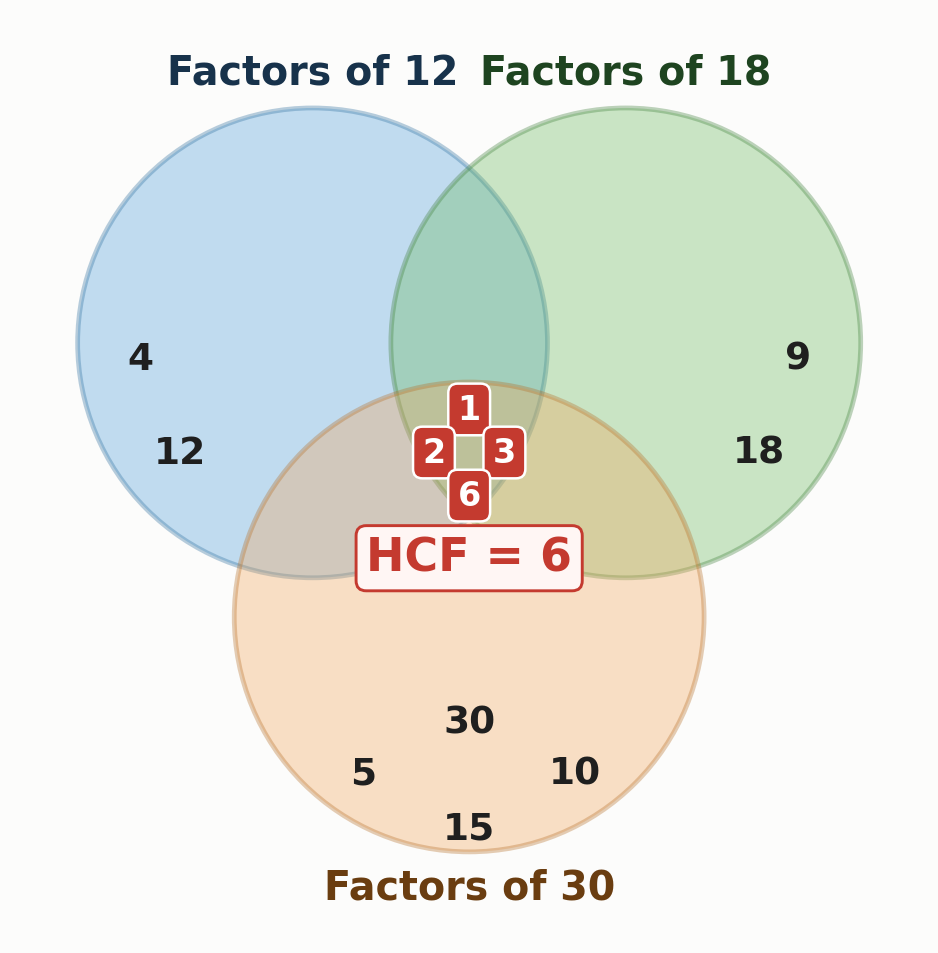
With more numbers in the set, the HCF tends to stay the same or get smaller, because each new list adds another filter. It can never get larger.
Key Patterns at a Glance
Before heading into practice, here is a compact reference for the three scenarios you will encounter:
| Scenario | What happens | Example |
|---|---|---|
| Typical case | Several common factors; pick the largest | |
| Coprime numbers | Only common factor is | |
| One divides the other | Smaller number is itself the HCF |
In every scenario, the method is the same: list, compare, and choose the greatest.
Conclusion and Next Steps
In this lesson, we defined the Highest Common Factor as the largest number that divides every number in a set. We practised a straightforward three-step method — list all factors, find the common ones, and pick the greatest — and we explored two important special cases: coprime numbers (where the HCF is ) and pairs where one number divides the other (where the smaller number is the HCF).
Now it is time to put this knowledge into action! You will work through tasks that range from straightforward HCF calculations to real-world sharing scenarios where the HCF determines the best way to split items into equal groups. Jump in and see how quickly the method becomes second nature.
