Common Factors Between Numbers
Introduction
Welcome to Finding the Highest Common Factor, the fourth course in your learning path! You have already built a strong foundation with factors, multiples, divisibility rules, and prime factorization. Now it is time to put those skills to work in a new way: finding what different numbers have in common.
In this first lesson, we will explore common factors. By the end, you will be able to compare the factor lists of two or more whole numbers and pick out every factor they share. This idea is the stepping stone for everything else in this course, so let's get comfortable with it right away.
Sharing Equally in Everyday Life
Imagine you are helping set up a party and you have 18 cupcakes and 24 juice boxes. You want to split them into equal groups so that every group gets the same number of cupcakes and the same number of juice boxes, with nothing left over. Which group sizes would work?
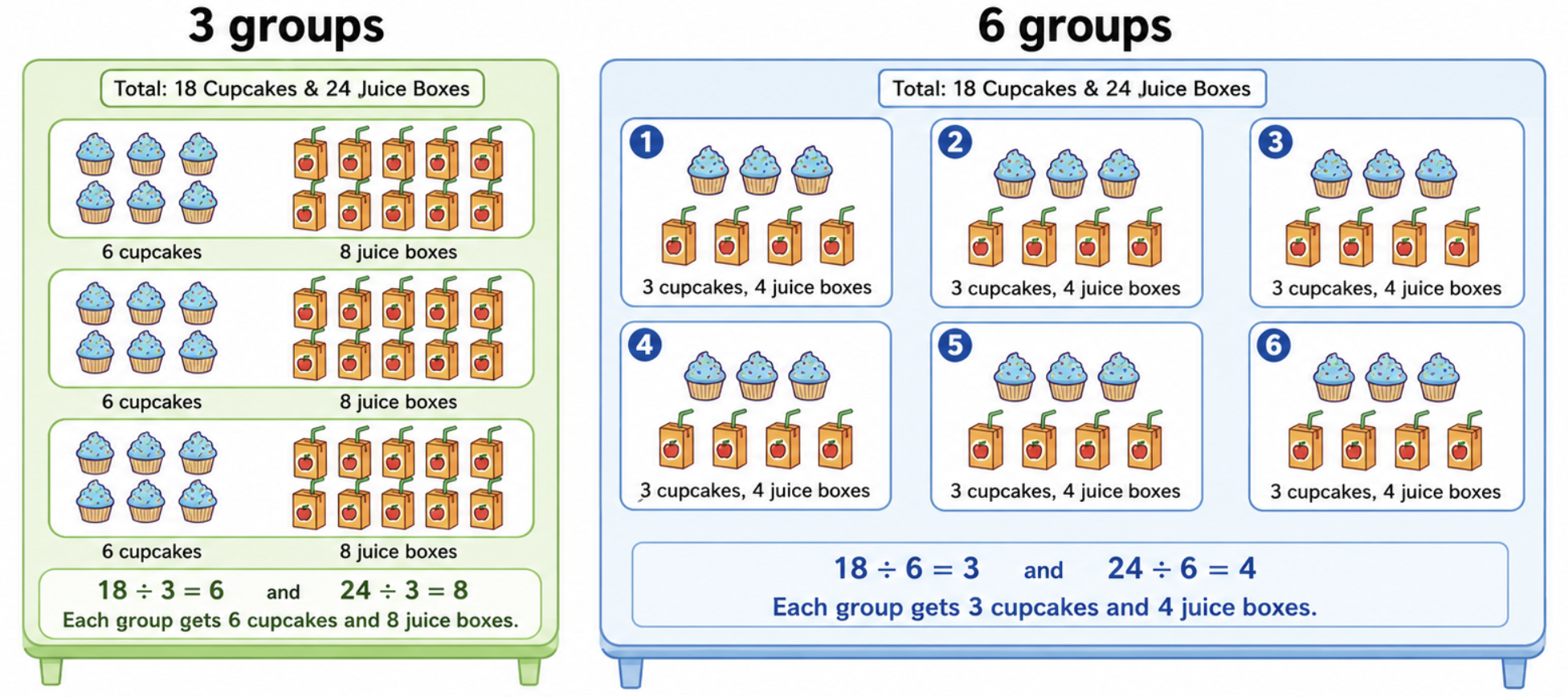
A group size of 3 works because and , both whole numbers. A group size of 6 also works: and . But a group size of 4 does not, because , which is not a whole number.
The group sizes that work for both quantities at the same time are exactly what mathematicians call common factors. Let's define that idea more precisely.
What Is a Common Factor?
As you may recall from earlier courses, a factor of a number divides it exactly, leaving no remainder. For instance, the factors of are .
A common factor of two or more numbers is simply a number that is a factor of every one of them. In other words, if a number divides evenly into each number in the set, it is a common factor of that set. Notice that 1 is always a common factor, because 1 divides every whole number.
With this definition in hand, we can now look at a reliable method for finding all common factors of any set of numbers.
Finding Common Factors Step by Step
The most straightforward approach is to list and compare. Here is the process:
- List all factors of each number (use factor pairs to make sure the list is complete).
- Compare the lists and circle every number that appears in all of them.
- Collect the circled numbers into a single set of common factors.
Let's apply this to and .
| Factors of 18 | Factors of 24 |
|---|---|
| 1, 2, 3, 6, 9, 18 | 1, 2, 3, 4, 6, 8, 12, 24 |
Scanning both lists, the numbers that appear in both columns are:
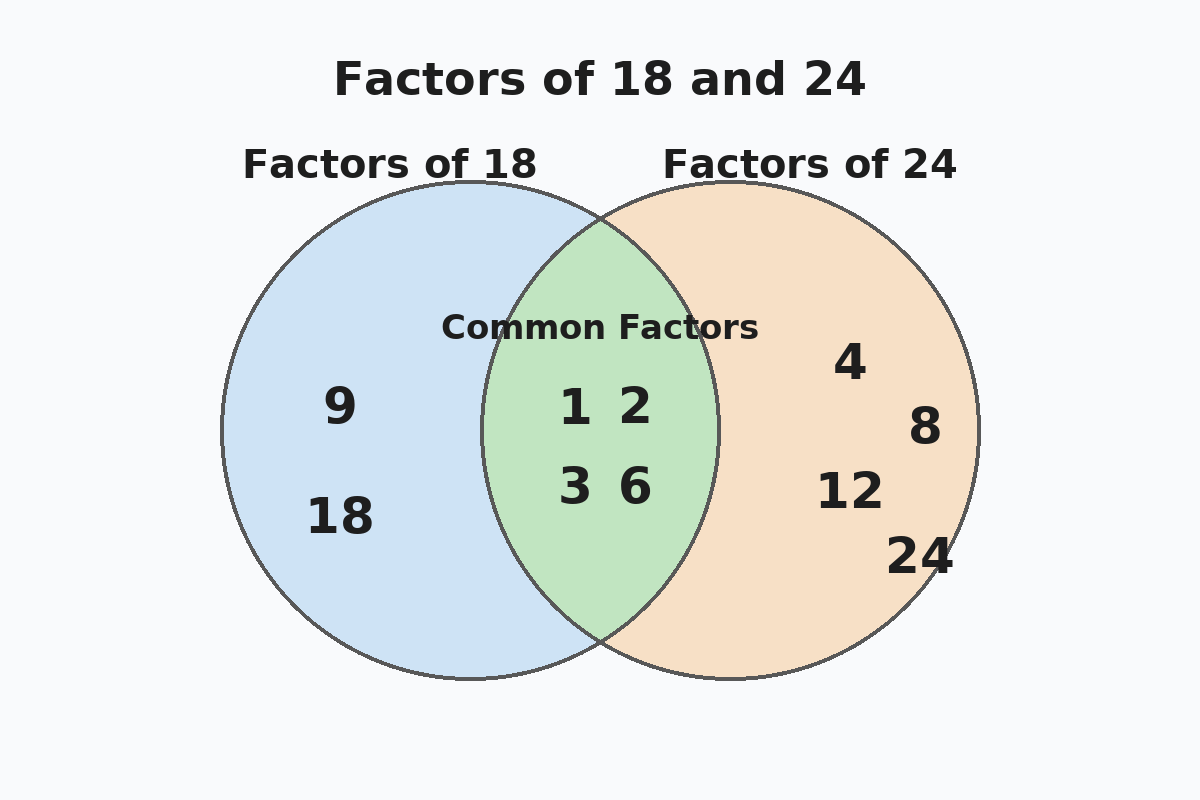
So the common factors of and are and . Going back to our party example, those are exactly the group sizes that divide both quantities evenly.
A Second Example: 36 and 48
Let's try a pair with a few more factors. First, list each set:
| Factors of 36 | Factors of 48 |
|---|---|
| 1, 2, 3, 4, 6, 9, 12, 18, 36 | 1, 2, 3, 4, 6, 8, 12, 16, 24, 48 |
Now we compare. A factor must sit in both columns to qualify:
Factors like and belong only to , while , , and belong only to , so none of those are common factors. The key habit here is checking every entry carefully so that no shared factor is missed.
When Two Numbers Share Only 1
Not every pair of numbers has a long list of common factors. Consider and :
- Factors of :
- Factors of :
The only number in both lists is 1. When the only common factor of two numbers is , we say the numbers are coprime (also called relatively prime). This is a perfectly normal result, and it will come up again later in the course, so it is worth recognizing now.
Extending to Three or More Numbers
The same method scales up naturally when you have three or more numbers. The only difference is that a factor must appear in every list to count. Let's find the common factors of , , and .
| Factors of 12 | Factors of 18 | Factors of 30 |
|---|---|---|
| 1, 2, 3, 4, 6, 12 | 1, 2, 3, 6, 9, 18 | 1, 2, 3, 5, 6, 10, 15, 30 |
Checking one by one: ✓, ✓, ✓, (missing from 18 and 30) ✗, (missing from 12 and 18) ✗, ✓.
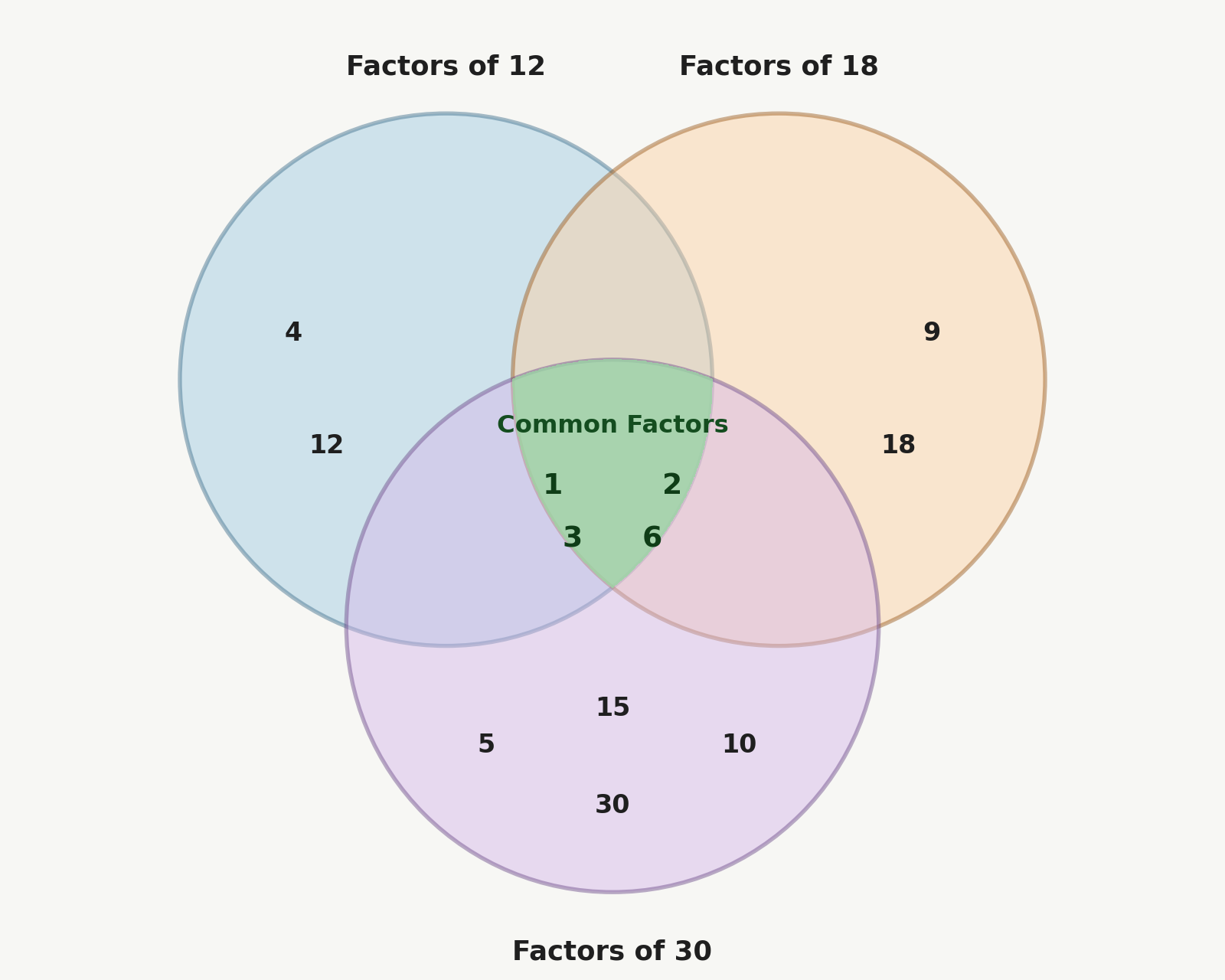
Notice that is a factor of all three numbers even though the numbers themselves look quite different. The process does not change; you simply have one more list to check against.
Quick Tips to Avoid Mistakes
Before we move on, here are a few pointers to keep your work accurate:
- Always start with complete factor lists. A missing factor in one list means a missing common factor in your answer. Use factor pairs (as practiced in earlier courses) to be thorough.
- Check every candidate. It is easy to skip a number that appears in both lists, especially in the middle of a long list. Work through the smaller list entry by entry.
- Remember that 1 always belongs. Every set of whole numbers shares at least the factor , so your common factor list should never be empty.
Conclusion and Next Steps
In this lesson, we defined a common factor as a number that divides evenly into every number in a given set. We practiced a clear, repeatable method — list all factors of each number, then compare the lists to collect every shared value. We also saw that some pairs share many common factors while others share only (the coprime case).
Up next, you will put this skill into action with a set of hands-on practice tasks. You will spot valid group sizes for an event, fill in partial factor lists, and produce complete sets of common factors on your own — jump in and see how quickly the method becomes second nature!
