Evaluating Game Fairness
Introduction
Welcome back to Probability in Practice! This is the second of four lessons in the course, so we are officially halfway through this final stretch of your probability learning path. In the previous lesson, we practiced choosing and combining probability tools to tackle realistic multi-step scenarios like trivia contests and flight delays. Now we turn that skill set toward a focused and fun application: evaluating whether a game is mathematically fair.
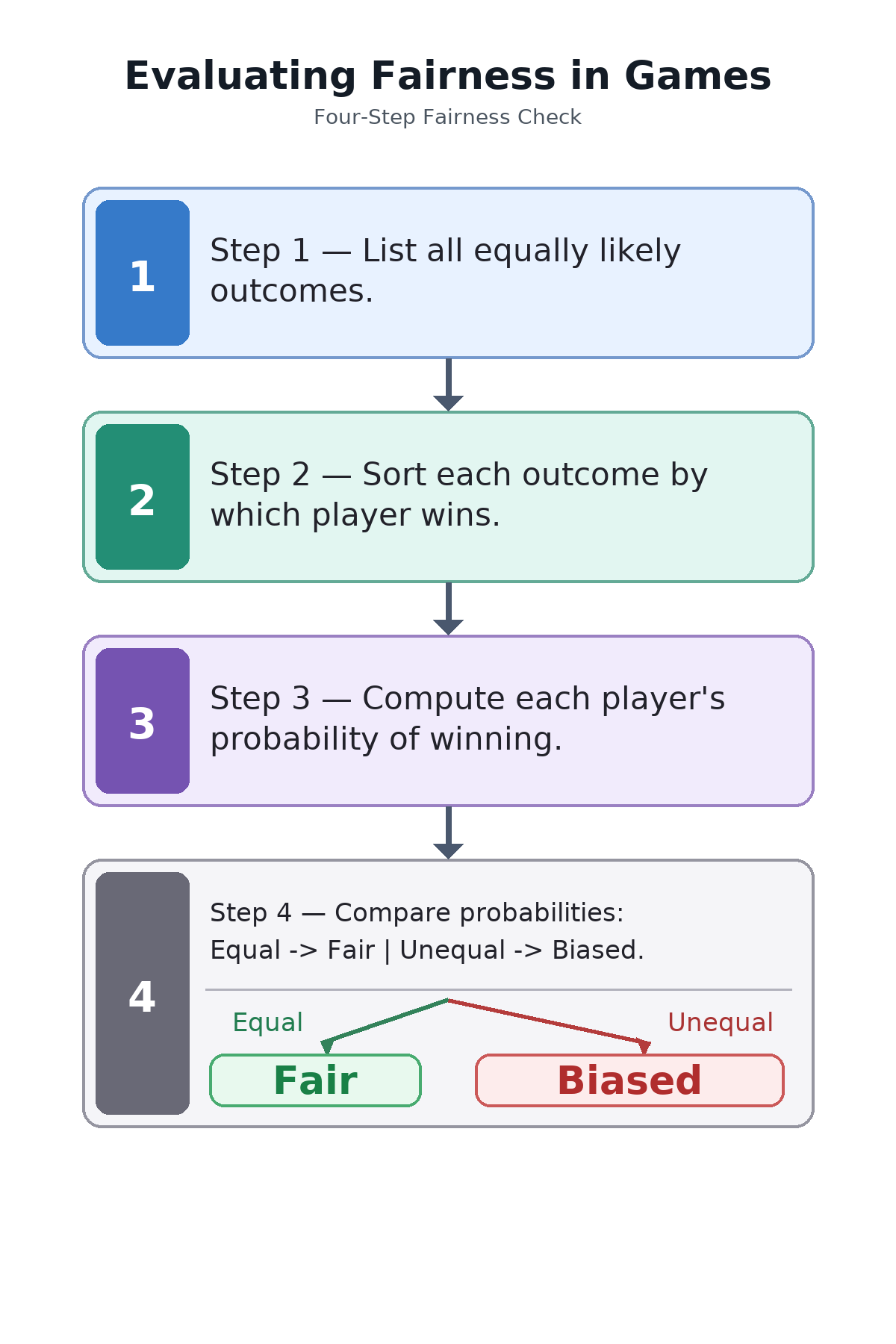
Games of chance are everywhere: board games, card games, carnival booths, friendly bets over dinner. Some give every player an equal shot at winning, while others quietly favor one side. By the end of this lesson, you will be able to tell the difference by computing each player's probability of winning and comparing the results.
What Does "Fair" Really Mean?
In everyday conversation, we call a game "fair" when the rules seem reasonable or when nobody is cheating. In probability, mathematically fair has a more precise meaning: a game is fair if every player has exactly the same probability of winning.
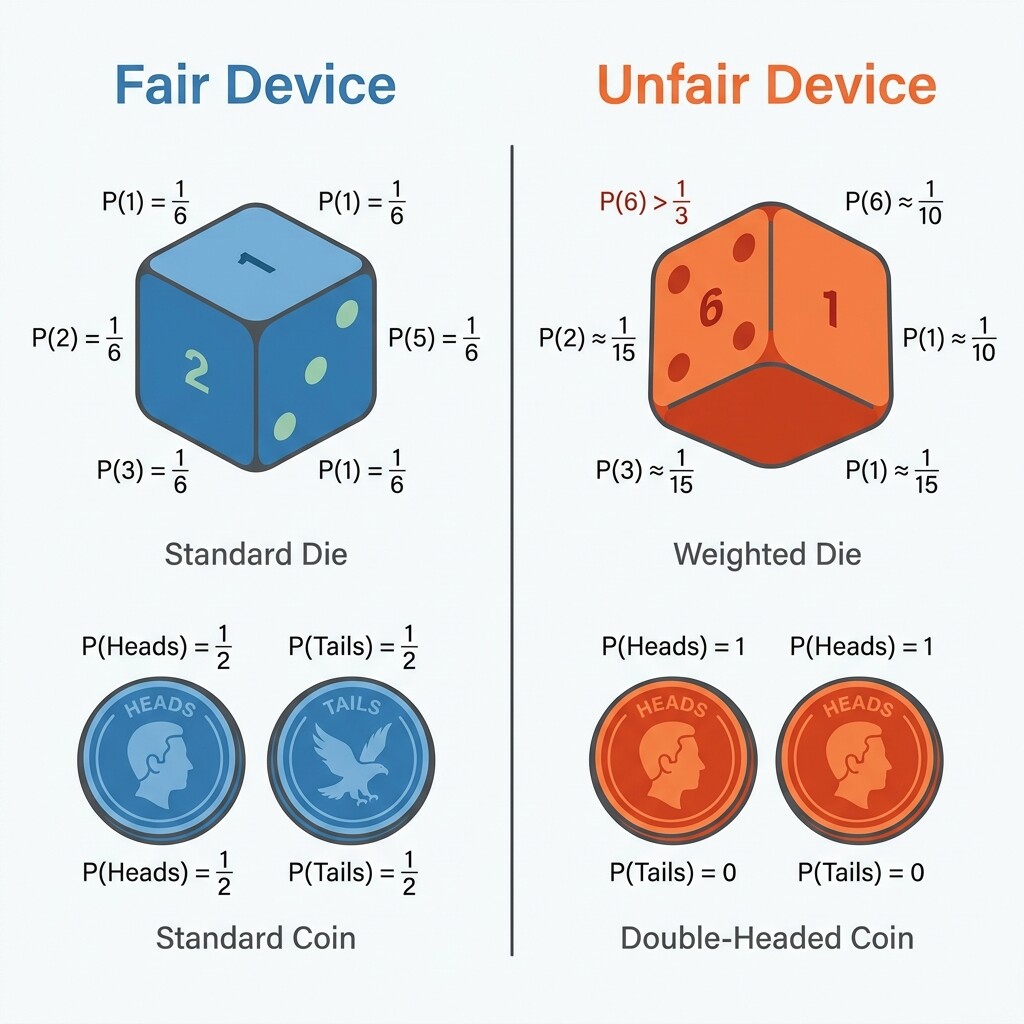
This distinction matters because a game can follow honest rules, use standard dice or coins, and still give one player a hidden advantage. The rules themselves can create an uneven split of outcomes without anyone realizing it. Our goal in this lesson is to look past surface impressions and let the math reveal whether a game truly gives every player an equal chance.
Fair Devices vs. Fair Games
Checking Fairness: A Single-Die Example
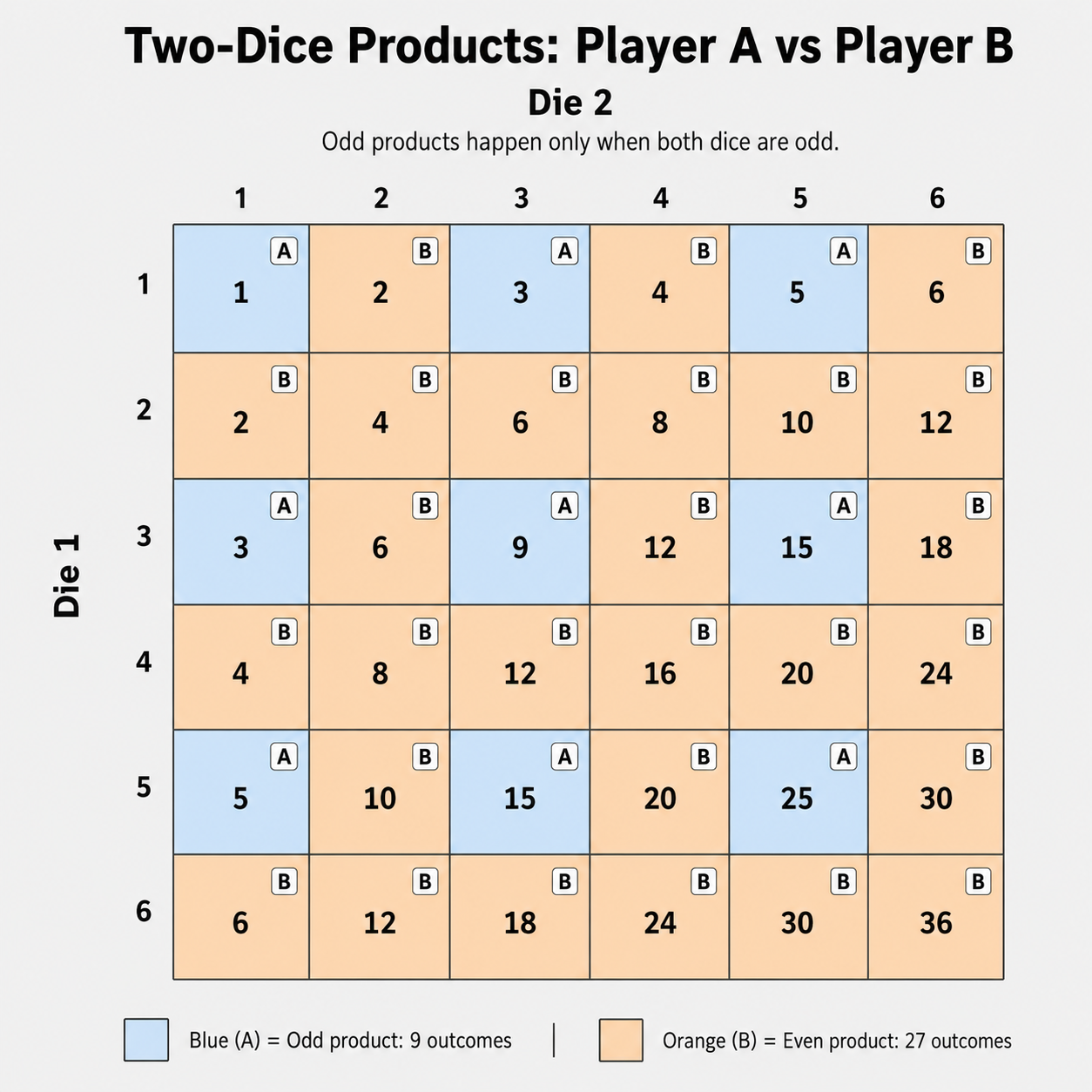
A Game That Looks Fair but Isn't
Why Balanced Labels Can Be Misleading
The dice-product example reveals a pattern worth remembering: equal-sounding conditions do not guarantee equal probabilities. The words "odd" and "even" each describe a single category, but behind those labels sit very different numbers of outcomes in the sample space.
As you may recall from earlier courses, the multiplication rule tells us that requiring two independent events to both occur shrinks the overall probability. Player A needed both dice to land odd — a compound "and" requirement — while Player B only needed at least one even die. Here are some warning signs that a game might be secretly unfair:
- One player's winning condition is a compound event (both dice odd, all coins heads), while the other player's condition is broader.
- The game uses two or more random devices, and the winning rules treat their combinations unevenly.
- Each player "owns" the same number of labels (odd vs. even, match vs. no match), but those labels do not map to the same number of individual outcomes in the full sample space.
Whenever you spot one of these signals, pause and count the actual outcomes before deciding whether the game is fair.
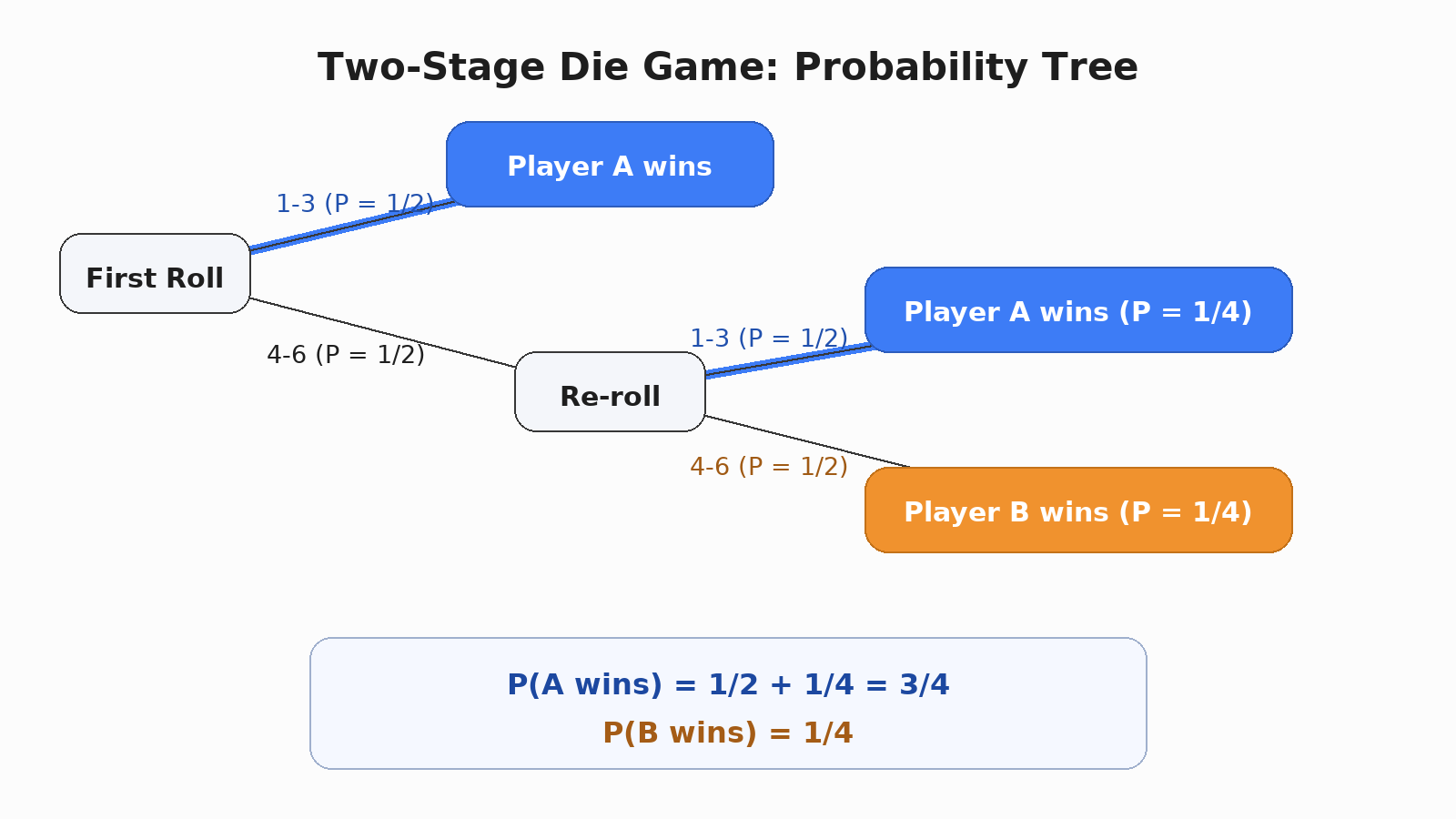
When a Bonus Rule Tips the Balance
Fairness Beyond the Classroom
Fairness analysis is not just a textbook exercise — hidden imbalances show up in competitive games, carnival booths, and casinos all around us.
First-mover advantage in board games. In chess, the player with the white pieces moves first. Since 1851, compiled statistics support this view; White consistently wins slightly more often than Black, usually achieving a winning percentage between 52 and 56 percent. That small edge is why tournament organizers carefully alternate colors so each player gets an equal number of games as White and Black. A similar pattern appears in card games like Magic: The Gathering, where going first provides a measurable advantage. To compensate, the player who goes second typically draws an extra card — a built-in correction that nudges a structurally unfair setup closer to 50/50.
Carnival games. That ring-toss booth might look like a simple test of skill, but the rings are often just a hair wider than the neck of the target bottle and made of hard plastic that bounces easily. Even when the game is technically winnable, the probability of success is far lower than it appears. The game feels fair because every player follows the same rules, yet the physical setup quietly stacks the odds against the player.
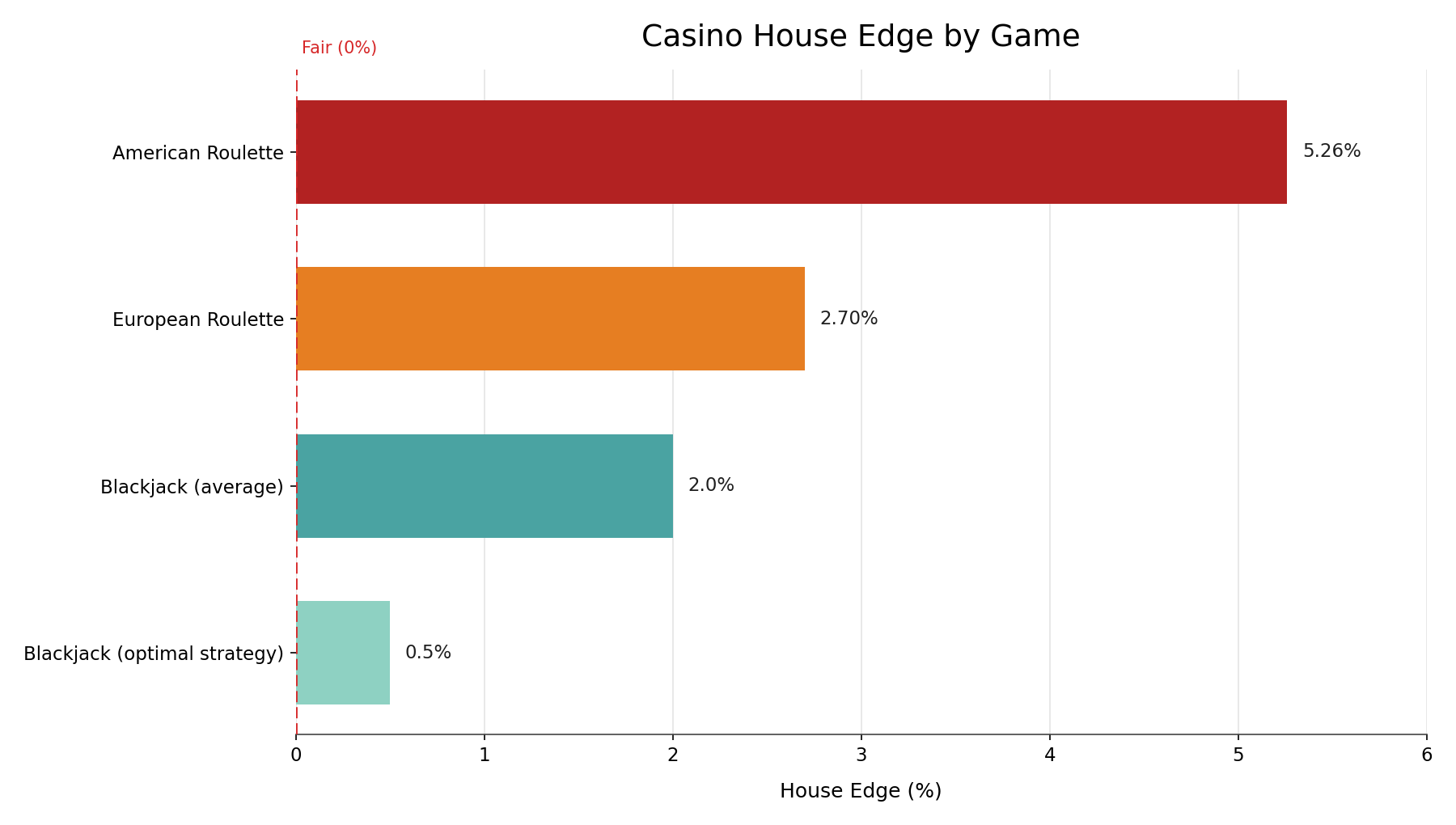
Casino house edge. Casinos are perhaps the clearest real-world example of a game that is not fair by design. Every casino game gives the house a small mathematical advantage. In American roulette it's 5.26% averaged across all bets, European Roulette, by contrast, features only a single zero (0) on the wheel, reducing the house edge to 2.7%, and blackjack can drop as low as about 0.5% when a player uses optimal basic strategy.
These percentages look tiny on a single bet, but over thousands of rounds they guarantee the casino profits in the long run. This is exactly the kind of hidden bias our four-step check is designed to reveal.
Conclusion and Next Steps
In this lesson, we defined what it means for a game to be mathematically fair and distinguished it from simply using a fair device. We built a reliable four-step process for checking fairness, applied it to a balanced die game, a deceptively unfair dice-product game, and a bonus-rule scenario where a single re-roll shifted the odds from 50/50 to 75/25. We also saw that hidden imbalances appear everywhere, from chess tournaments to carnival midways to casino floors.
Now it is your turn to put these ideas to work. In the upcoming tasks, you will identify which games are fair from their descriptions, walk through guided fairness computations step by step, uncover hidden bias in a game with balanced-looking labels, and run a simulation to watch theoretical probabilities come to life over many trials. Time to sharpen your eye for spotting when the odds are truly even!