Welcome to Extra Tools and Practices, the final course in your probability learning path! This is the first of four lessons, and it marks an exciting shift in how we work with probability. Instead of learning new rules, we will focus on applying everything you have built so far to realistic, everyday chance scenarios.
Over the previous courses, you developed a solid set of probability tools — from basic single-event probability and complements, all the way through addition and multiplication rules, and finally tree diagrams. In this lesson, we will practice recognizing which tool fits a given situation, combining tools when a problem calls for more than one, and making sense of the numbers we calculate. Think of it as moving from individual skill drills to playing the full game.
The Toolkit So Far
A Framework for Multi-Step Problems
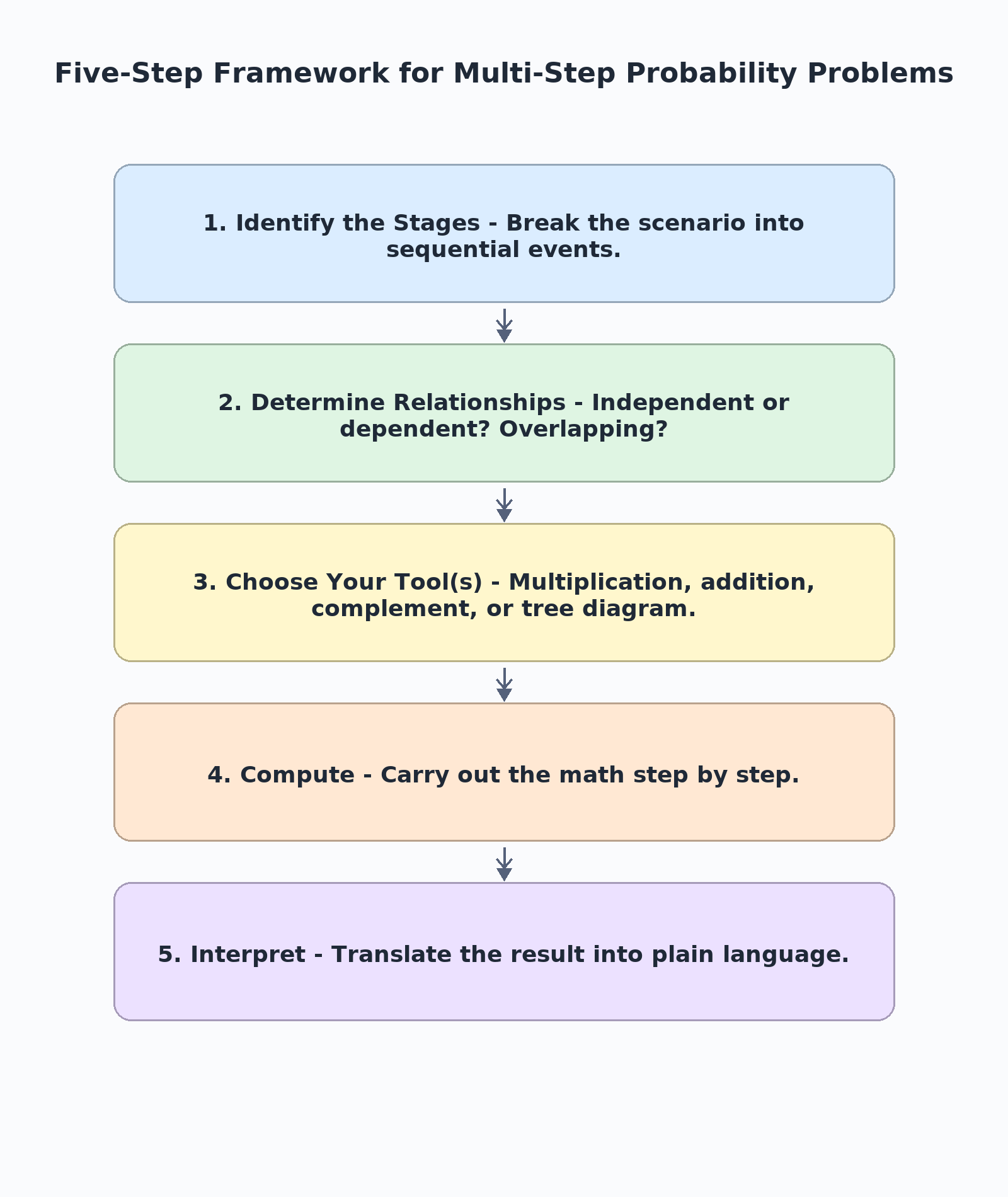
When you face a multi-step chance scenario in everyday life, a consistent process keeps you from getting lost in the details:
Identify the stages. Break the scenario into sequential steps or events.
Determine relationships. Ask: are the events independent or dependent? Can they overlap?
Choose your tool(s). Match the structure of the problem to the right rule or diagram.
Compute. Carry out the math step by step.
Interpret. Translate the number back into plain language and consider what it means for the situation.
This five-step framework works whether you are analyzing a game show, a travel plan, or a store promotion. Let's see it in action with two complete examples.
Example: A Two-Round Trivia Contest
Example: At Least One Flight Delay
Recognizing Common Patterns
Interpreting Results in Context
Verifying Fairness with Simulation
Once we have calculated the theoretical probability, we can use a simulation to see the game in action. While a few coin flips might result in a "streak" for one player, a mathematically fair game will show both players winning a similar number of times as the number of trials grows.
Running a simulation is a great way to "double-check" your math. If your calculations say a game is 50/50, but after 1,000 trials one player has won 80% of the time, it’s a strong signal to re-count the outcomes and look for a hidden bias. In this course, we will use simulations to confirm that our theoretical win rates match what actually happens in practice.
Conclusion and Next Steps
In this lesson, we brought together every probability tool from the learning path and practiced selecting and combining them for realistic multi-step scenarios. We walked through a structured five-step framework, applied it to a trivia contest and a flight-delay situation, and saw that interpreting results in plain language is just as important as computing them.
Up next, you will put these skills to work in a set of hands-on practice tasks. You will match strategies to scenarios, fill in the steps of a connecting-flight problem, calculate delay risks on your own, and model a scratch-off promotion from start to finish. It is time to see just how sharp your probability instincts have become!
Be a part of our community of 1M+ users who develop and demonstrate their skills on CodeSignal
Before we dive into new scenarios, let's take a quick inventory of what we carry in our probability toolkit. Each tool is best suited to a particular type of question:
Tool
When to Use It
Multiplication rule
Finding the probability that multiple events all happen (A and B)
Addition rule
Finding the probability that at least one of several mutually exclusive outcomes occurs (A or B)
General addition rule
Same idea, but for overlapping events: P(A or B)=P(A)+P(B)−P(A and B)
Complement rule
Easier to calculate "none" and subtract: P(at least one)=1−P(none)
Tree diagrams
Mapping out sequential steps, especially when probabilities change between stages
The real skill now is choosing and combining these tools for a given real-world problem. To do that consistently, we need a simple, repeatable process — and that is exactly what we will build next.
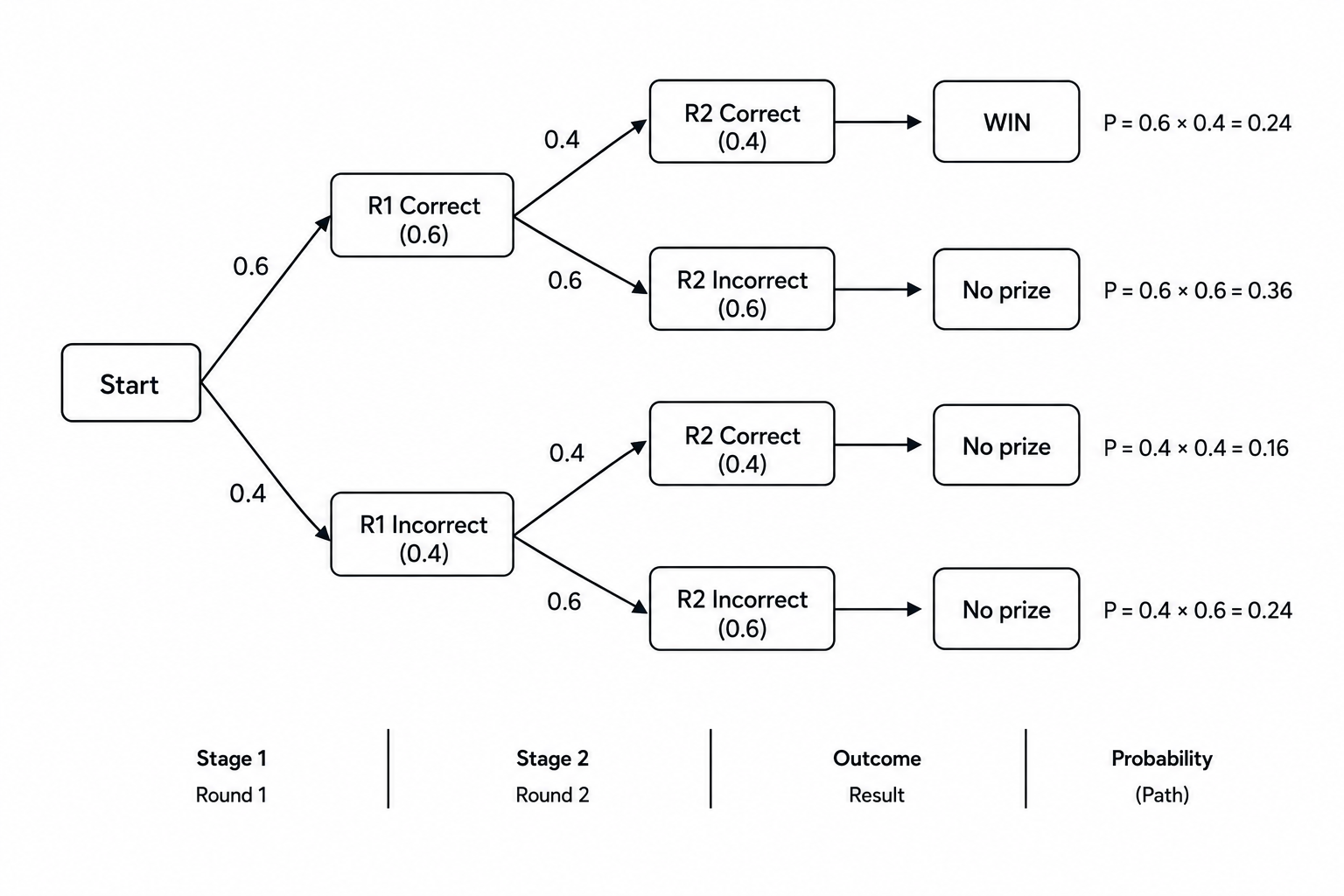
Imagine you enter a trivia contest with two rounds. In Round 1, contestants answer a question from a general-knowledge pool where the probability of answering correctly is 0.6. In Round 2, the question is harder, with a probability of 0.4. The rounds are independent, meaning the Round 1 outcome does not affect Round 2. You win a prize only if you answer both rounds correctly.
Step 1 — Stages: Two rounds, each with a correct or incorrect outcome.
Step 2 — Relationships: The rounds are independent.
Step 3 — Tool: Since we need both events to happen and they are independent, we use the multiplication rule for independent events.
Step 5 — Interpret: There is a 24% chance of winning the prize, which is roughly 1 in 4. Decent odds, but far from a sure thing. If 100 people play, we would expect about 24 winners.
Notice how cleanly the problem mapped to a single tool. Many everyday problems, however, require us to combine tools. The next example shows what that looks like.
Now consider a practical travel scenario. You are taking two connecting flights to reach your destination. Each flight independently has a 15% chance of being delayed, so P(delay)=0.15. What is the probability you experience at least one delay during your trip?
Step 1 — Stages: Two flights, each with a delay or no-delay outcome.
Step 2 — Relationships: The flights are independent of each other.
Step 3 — Tool: The phrase "at least one" is our signal to consider the complement rule. Computing every way to get one or more delays would require multiple cases (delay on flight 1 only, flight 2 only, or both). Instead, it is much simpler to find the probability of zero delays and subtract from 1.
Step 4 — Compute: The probability of no delay on a single flight is 1−0.15=0.85. Because the flights are independent, we multiply:
P(no delays at all)=0.85×0.85=0.7225
Then we apply the complement:
P(at least one delay)=1−0.7225=0.2775
Step 5 — Interpret: Even though each flight only has a 15% delay risk, the probability of running into at least one delay across two flights rises to nearly 28%. That is a useful insight when planning layover times — the more flights you chain together, the more likely it becomes that something goes wrong.
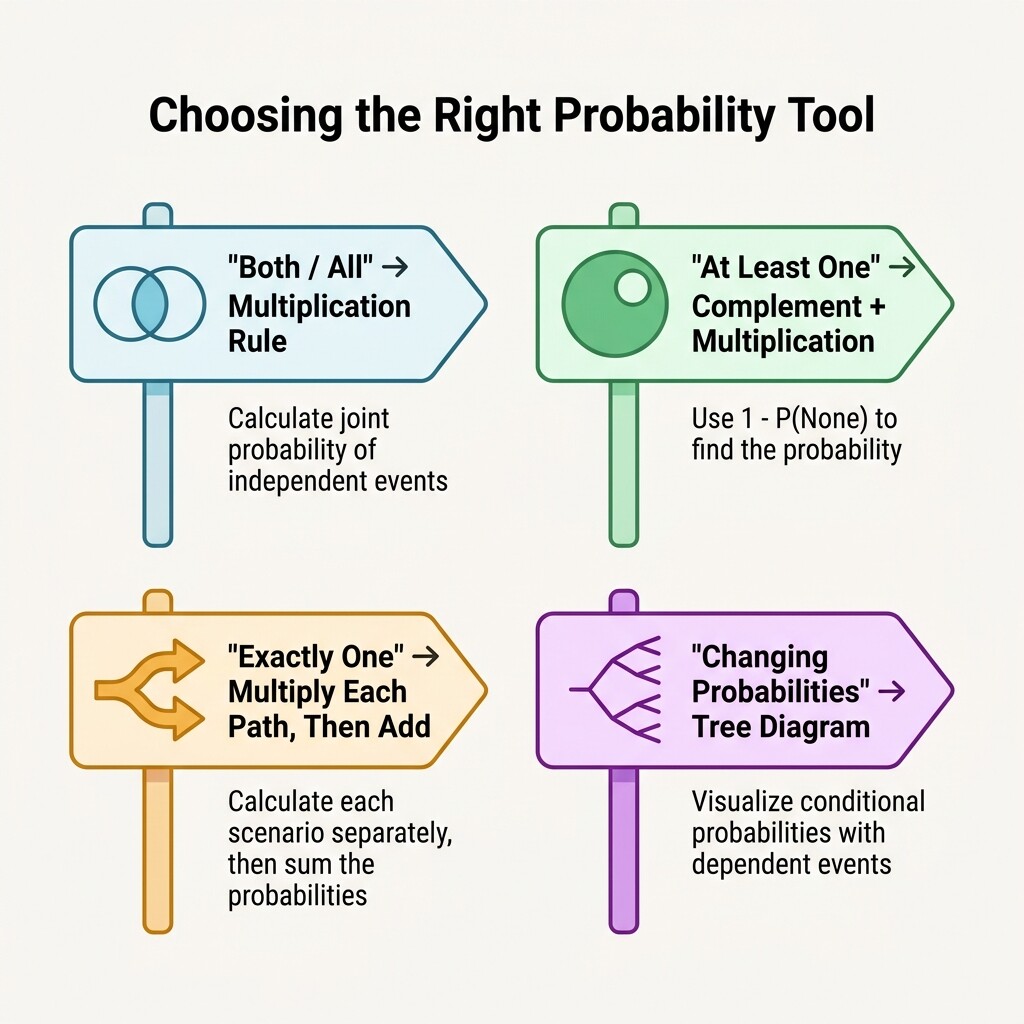
In the flight example above, we used the multiplication rule (to find the probability of no delays on both flights) together with the complement rule (to flip from "none" to "at least one"). This kind of combination appears frequently in real life. Recognizing the pattern in a question's wording can point you to the right strategy almost instantly.
Here is a quick reference for common question patterns and the tool combinations they suggest:
"Both" or "all happen" → Multiplication rule (check independence first).
"At least one" → Complement + multiplication: find P(none), then compute 1−P(none).
"Exactly one of the two" → Identify each winning path, compute each with multiplication, then add the paths.
Probabilities change after the first event → Tree diagram to track the dependent branches, then multiply along paths.
The key habit is to pause and ask yourself what the question is really asking before jumping into calculations. A few seconds of planning can save you from choosing a harder path to the answer.
Computing a probability is only half the job. A number like 0.2775 means little until we place it in context. Good interpretation is what turns a math exercise into a practical decision-making skill.
Compare to intuition. In our flight example, many travelers might assume their delay risk is "about 15%" because that is each flight's individual risk. The actual 28% is nearly double — a meaningful difference for trip planning.
Use everyday language. Saying "roughly a 1-in-4 chance" is often more helpful than quoting four decimal places when communicating with others.
Consider the stakes. A 5% chance of light rain might not change your plans, but a 5% chance of a canceled flight certainly could. The same number can call for very different responses depending on what is on the line.
When you finish a calculation, try writing one plain-language sentence that summarizes what the number means for the person in the scenario. If you can do that clearly, you truly understand the result.