Identifying When Outcomes are Independent
Introduction 🎉
Welcome to the final lesson! Throughout this course, you have explored why real-world results often look different from what probability predicts. You separated theoretical probability from observed frequency, discovered how small samples can mislead, and watched results stabilize as data grows. In each of those lessons, one quiet assumption kept doing heavy lifting behind the scenes: the idea that each observation does not influence the next. That assumption has a name — independence — and today we give it the spotlight it deserves.
In this lesson, you will explore the quiet assumption that has been doing heavy lifting behind every topic in this course — the idea that one observation does not influence the next. By the end, you will be able to:
- Explain what independence means and express it using the relationship between conditional and unconditional probability.
- Use a simple test — "Does knowing one outcome change the other's probability?" — to decide whether two events are independent or dependent.
- Recognize common situations where events are and are not independent, from coin flips to card draws to weather patterns.
- Articulate why past outcomes cannot change future probabilities in an independent process, and spot flawed reasoning that assumes otherwise.
🔗 Thinking About Connections Between Events
Before we define anything formally, let's build some intuition. Consider two questions:
- If it rained heavily this morning, is your coworker more likely to arrive late?
- If you flipped a coin and got heads, is a stranger across the country more likely to win a raffle?
Most people quickly sense that the first pair of events is connected, since rain can cause traffic delays, while the second pair is not. A coin flip in your kitchen has no link to a raffle drawing elsewhere.
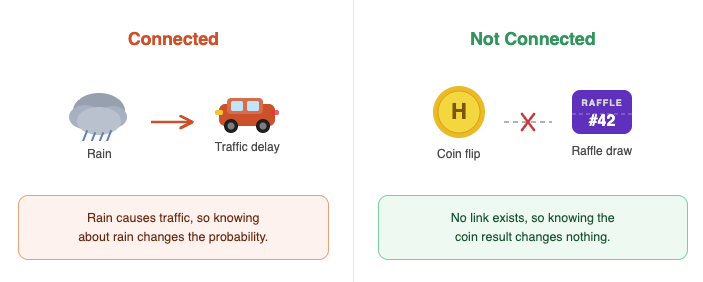
That gut feeling is exactly the concept we are formalizing today. The rest of this lesson turns that intuition into a clear, testable idea you can apply to any pair of events.
⛓️💥 What Independence Means
Two events are independent when knowing the outcome of one gives no new information about the probability of the other. In other words, the occurrence of Event A does not make Event B any more or less likely than it already was.
There is a simple way to test this: ask whether the probability of Event B stays the same after you learn that Event A happened. If it does, the two events are independent. If it changes, they are not.
For example, suppose we roll a standard die twice. The probability of getting a 4 on the second roll is . Does knowing that the first roll was a 2 change that? Not at all! The second roll is still . The two rolls are independent because the die does not "remember" what happened on the previous throw.
🤔 A Simple Test: Does Knowing Help?
Whenever you need to decide if two events are independent, ask one practical question: "If I learn the outcome of Event A, does the probability of Event B change?"
- If the answer is no, the events are independent.
- If the answer is yes, the events are not independent.
Let's try this test with a concrete example. Imagine a bag containing 3 red marbles and 2 blue marbles. We draw one marble, note its color, and put it back before drawing again. Does knowing the first marble was red change the probability for the second draw? No. After replacement, the bag is exactly the same since regardless of the first draw. You can conclude that the draws are independent in this case.
Now imagine the same bag, but this time we do not replace the first marble. If the first draw was red, only 2 red and 2 blue marbles remain, so . That differs from the original . Since the first outcome changed the probability of the second outcome, you can conclude these draws are not independent.
| Scenario | First draw red → P(red on draw 2) | Independent? |
|---|---|---|
| With replacement | Yes | |
| Without replacement | No |
This "with vs. without replacement" comparison is one of the clearest ways to see the difference between independent and dependent events. Whenever you encounter a similar scenario, ask whether the first outcome physically changes the setup for the second.
💡 Recognizing Independence in Everyday Life
Many everyday events are independent because there is simply no mechanism connecting them. Recognizing this pattern quickly becomes second nature once you know what to look for.
- Successive coin flips. Each flip is a fresh physical event; the coin has no memory of past results.
- Separate lottery drawings. The numbers drawn last week have no influence on this week's numbers, since each drawing starts from scratch.
- Unrelated personal events. Whether your morning coffee order is correct has no bearing on whether your neighbor's package arrives on time.
The key feature in all of these is that nothing about one outcome physically or logically feeds into the other. When no such link exists, the events are independent.
🪢 Recognizing When Events Are Not Independent
Dependent events, by contrast, share some connecting factor that lets one outcome shift the probability of the other. Spotting that connection is the crucial skill.
- Drawing cards without replacement. Removing a card changes what is left in the deck, so each draw affects the next.
- Weather on consecutive days. A storm system today makes rain tomorrow more likely because weather patterns tend to persist over short periods.
- A student's grades in related courses. Strong performance in Algebra often predicts strong performance in Calculus, because the same skills and study habits carry over.
Notice that dependence does not require one event to cause the other directly. Sometimes both events simply share a common influence. A student's grades in two courses may be linked not because one course causes the other, but because the same underlying preparation affects both. The test stays the same: does knowing one outcome change the probability of the other?
🔮 Why Past Outcomes Cannot Shift Future Probabilities
Now let's connect independence to a mistake people make all the time. In an independent process, each trial starts fresh. No result from the past can reach forward and tilt the probability of the next outcome.
Consider a fair coin. Suppose we flip it five times and get heads every time. What is the probability of heads on the sixth flip? It is still . The coin has no memory, and the physical process resets completely each time. The five previous heads are interesting to us, but they are invisible to the coin.
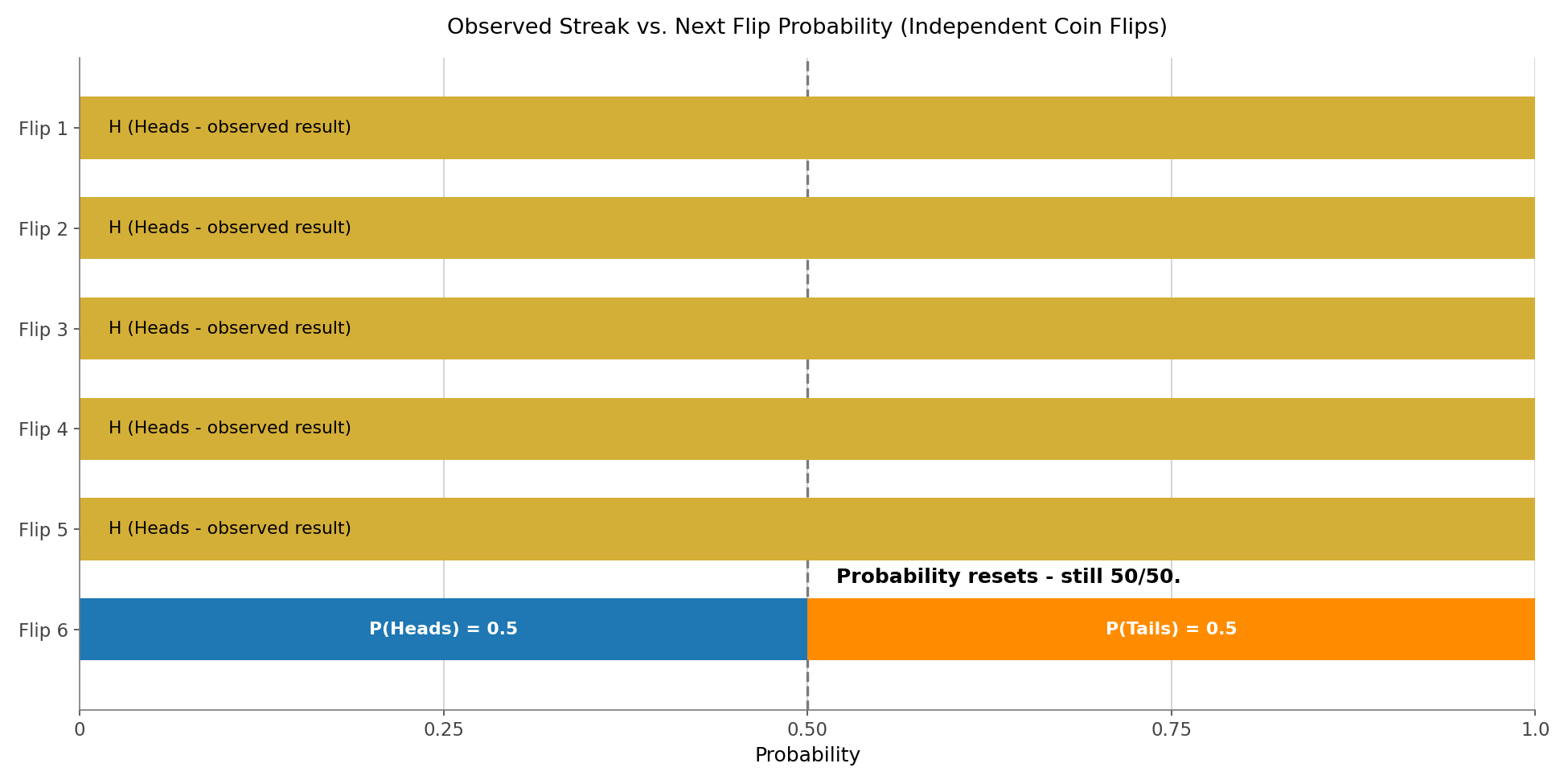
This idea can be hard to believe. Our brains naturally look for patterns, so after a streak of heads, it is normal to feel that a tails is "due" to balance things out. But in an independent process, nothing is ever "due." Every flip is a fresh start with the exact same chance it always had.
This principle extends well beyond coins. If a factory's defect rate is 2%, and the last 20 items off the line were all perfect, the probability that the next item is defective is still 2% — assuming each item's quality is independent of the others. Past perfection does not lower or raise the chance of a future defect. Recognizing this is one of the most practical takeaways from the entire course.
Conclusion and Next Steps
Today you explored independence — the idea that two events are independent when the outcome of one does not change the probability of the other. You practiced a simple test ("Does knowing one outcome change the other's probability?"), walked through real-world examples of both independent and dependent events, and saw why past outcomes in an independent process cannot influence what comes next. This concept ties together everything in the course: independence is the reason small samples bounce around unpredictably and the reason large samples eventually stabilize.
In the upcoming practice exercises, you will evaluate real-life scenarios to decide whether past outcomes affect future ones, sort event pairs into independent and dependent categories, spot flawed reasoning about streaks, and explain in your own words why knowing the past does not rewrite the future. Let's close out this course on a high note!
