Estimating Volume and Capacity
Introduction
You are halfway through Estimation and Sense of Scale, and your estimation toolkit is growing fast. In the first two lessons, we built benchmarks for lengths — hand spans, strides, and familiar objects — and then for weights, from smartphones up to bags of sugar and gallons of milk. Now, in this third lesson, we tackle a quantity that comes up every time we cook, pour, or shop for beverages: volume and capacity.
How much soup does this pot actually hold? Will one bottle of juice be enough for the table? Is the claim on that fish tank's label even realistic? Being able to estimate capacity quickly helps us plan meals, shop smarter, and spot numbers that simply do not make sense. In this lesson, we will assemble a set of container-based benchmarks, learn to scale them up and down, and practice catching volumes that are too large or too small to be true.
Why Volume Fools the Eye
Volume is trickier to estimate than length or weight for one big reason: our eyes are not very good at judging three-dimensional space. A tall, narrow vase and a short, wide bowl might hold the same amount of liquid, yet they look completely different. Research on perception has shown that people consistently overestimate how much a tall container holds compared to a short one, even when the actual capacities are identical.
That is exactly why we need to anchor our estimates to real containers we have filled, poured, or drunk from. The same core principle we used for length and weight still applies — start with a familiar reference and compare the unknown to it — but this time our references are everyday containers whose capacity we already know through lived experience. A coffee mug, a water bottle, or a gallon jug becomes our mental measuring cup, and physical familiarity with these objects beats visual guessing every time.
Building a Volume Benchmark Table
Let's lay out a set of familiar containers and their approximate capacities. We list both US customary and metric values, since both show up in daily life.
| Container | Approx. Capacity (US) | Approx. Capacity (Metric) |
|---|---|---|
| A teaspoon | 1 tsp | ≈ 5 mL |
| A standard coffee mug | ≈ 12 fl oz (1.5 cups) | ≈ 350 mL |
| A disposable water bottle | ≈ 16.9 fl oz | ≈ 500 mL |
| A quart of milk | 32 fl oz (4 cups) | ≈ 946 mL |
| A gallon jug | 128 fl oz (16 cups) | ≈ 3.8 L |
| A standard bucket | ≈ 5 gal | ≈ 19 L |
| A household bathtub | ≈ 40–50 gal | ≈ 150–190 L |
Seeing the benchmarks in order can help fix them in memory:
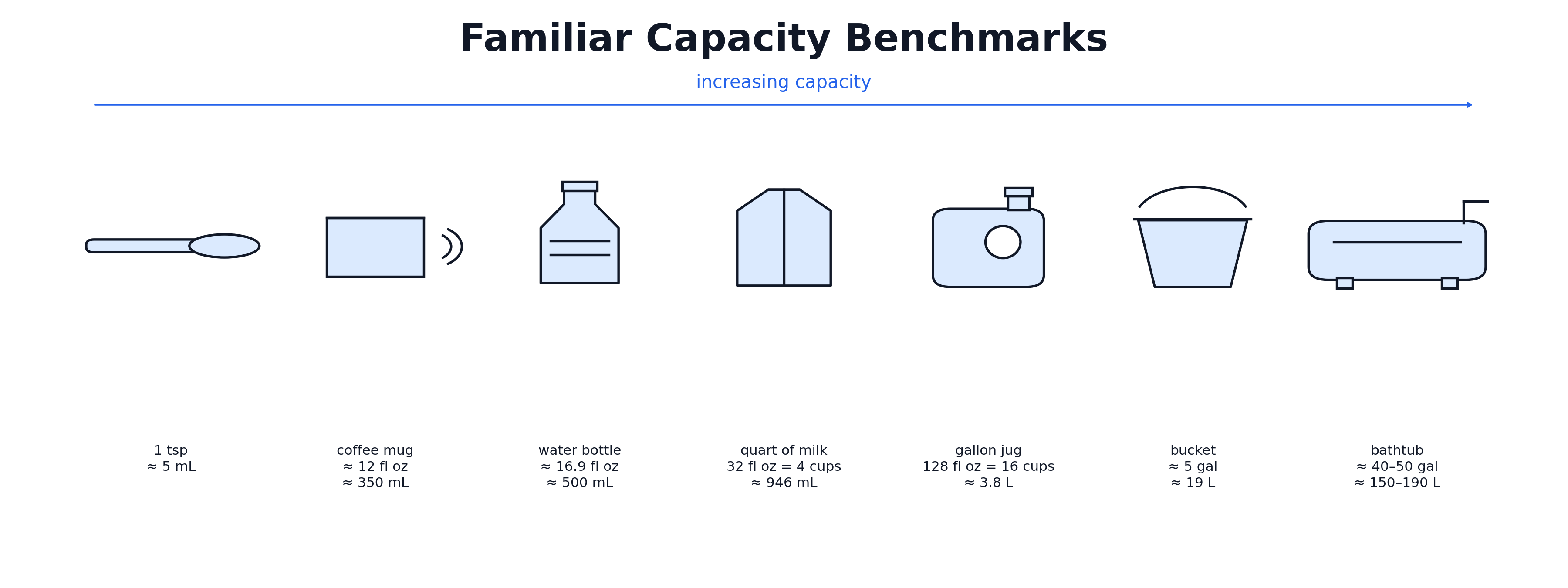
A few quick relationships are worth memorizing:
- 1 cup = 8 fl oz
- 1 gallon = 16 cups = 128 fl oz
- 1 liter ≈ about 4.2 cups, or roughly a quart plus a small splash
The water bottle (roughly 500 mL or 16.9 fl oz) is an especially handy benchmark because most of us grab one regularly. Thinking "how many water bottles would it take to fill this?" is a fast way to estimate almost any everyday volume.
