Welcome back to Estimation and Sense of Scale! In our first lesson, we turned body parts and familiar objects into a toolkit for estimating lengths and distances. Now, in this second lesson, we shift our focus to a different physical quantity: weight.
Weight shows up constantly in daily life — shipping a package, checking airline luggage limits, loading a shelf, or deciding how many grocery bags we can carry in one trip. Being able to make a quick, reasonable estimate can save us from unpleasant surprises. In this lesson, we will build a mental library of weight benchmarks drawn from items we handle regularly, learn how to anchor estimates to those references, and practice spotting stated weights that simply do not add up.
From Lengths to Weights: Estimating What We Cannot See
The core principle behind every good estimate has not changed: start with a benchmark we already know and compare it to the unknown. That strategy worked beautifully for lengths, and it works just as well for weight. The key difference is that weight is much harder to judge by sight alone. Two boxes sitting on a table might look identical, yet one could be three times heavier than the other.
Because we cannot "see" weight the way we can see length, we rely instead on feel — the physical memory of effort from picking things up, carrying them, or setting them down. Most of us have hefted a gallon of milk, tossed a phone into a bag, or dragged a heavy suitcase through an airport. Those experiences are our raw material. The goal of this lesson is to organize that raw material into a dependable set of benchmarks, just as we organized hand spans and strides for length.
Lightweight Benchmarks: Items We Handle Daily
Join the 1M+ learners on CodeSignal
Be a part of our community of 1M+ users who develop and demonstrate their skills on CodeSignal
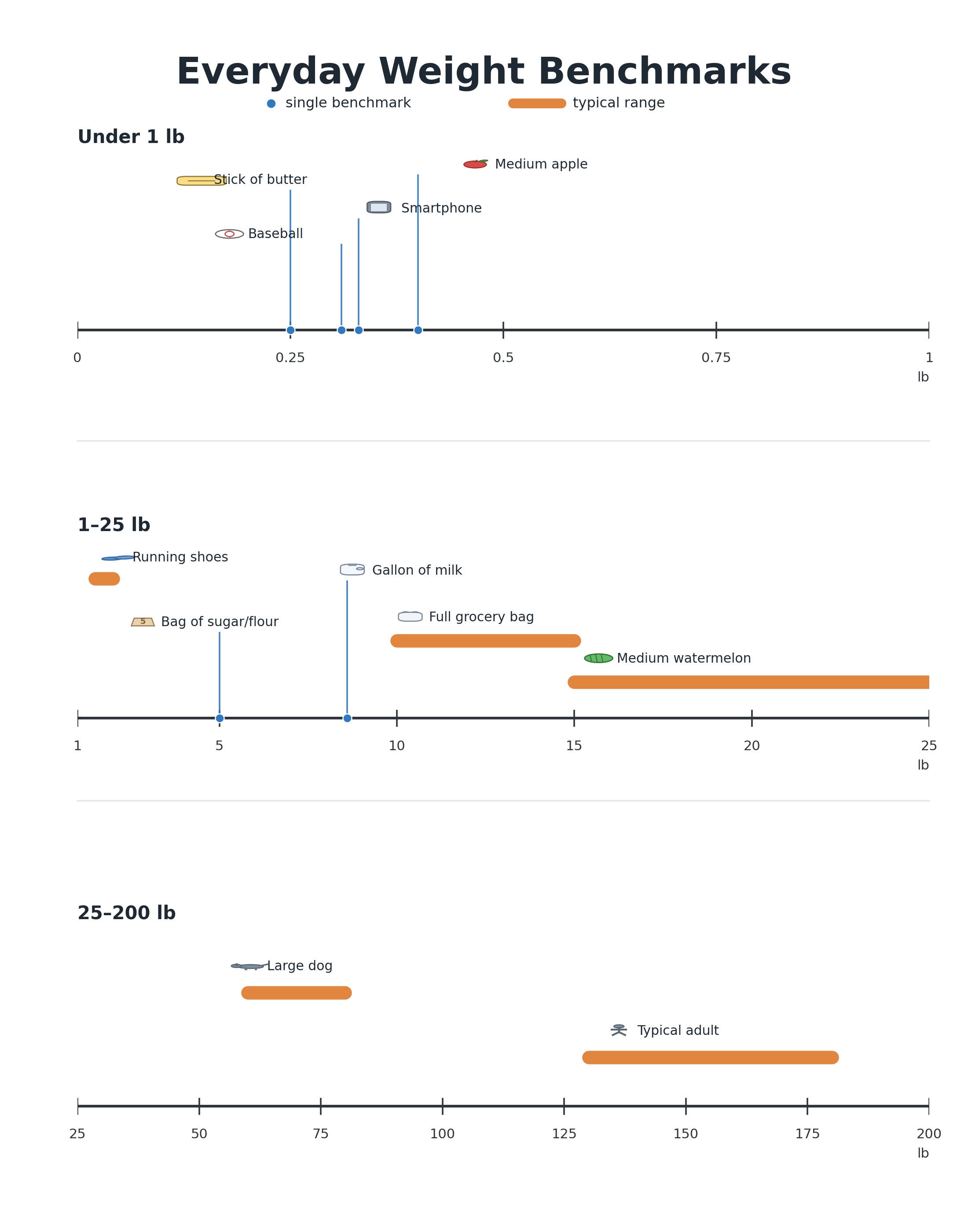
Let's begin at the lighter end of the scale. The items below are things most of us pick up often enough that their weight should feel familiar.
Item
Approximate Weight
A smartphone
≈ 6 oz (about 31 lb)
A stick of butter
≈ 4 oz (41 lb)
A medium apple
≈ 6–7 oz
A baseball
≈ 5 oz
A pair of running shoes
≈ 1.5–2 lb
Notice how several of these items cluster around the half-pound or less range. That makes them handy for gauging lighter things. If someone hands us a small package and it feels like two or three smartphones stacked together, we can estimate it weighs roughly 1 to 1.5 lb. Thinking in terms of "how many smartphones is this?" turns an abstract guess into a grounded comparison.
Medium and Heavy Benchmarks: Household and Beyond
For heavier objects, we need bigger reference points. The table below covers a wide range of everyday weights that most adults have encountered.
Item
Approximate Weight
A 5 lb bag of sugar or flour
5 lb
A gallon of milk
≈ 8.6 lb
A full grocery bag (plastic, loaded)
≈ 10–15 lb
A medium watermelon
≈ 15–25 lb
A large dog (e.g., Labrador)
≈ 60–80 lb
A typical adult
≈ 130–180 lb
A particularly useful anchor in this group is the 5 lb bag of sugar. It is a common grocery item, easy to picture, and its weight is a convenient round number. If something feels about twice as heavy as that bag, we are looking at roughly 10 lb. Four bags stacked together would be about 20 lb — close to the weight of a carry-on suitcase.
Seeing these benchmarks laid out on a visual scale can make the size jumps easier to internalize:
With our benchmarks in place, the estimation technique itself is straightforward: pick a benchmark close to the object's weight, then think in multiples or fractions of that benchmark.
Suppose we want to estimate the weight of a loaded backpack for a day hike. We know a gallon of milk weighs about 8.6 lb. The backpack feels roughly twice as heavy as that gallon, so our estimate is:
2×8.6≈17 lb
Now imagine we are mailing a small package and need a rough weight for the shipping label. The package feels about as heavy as three smartphones. Each smartphone is about 31 lb, so:
3×31=1 lb
When in doubt, a simple three-step process keeps us on track:
Pick the benchmark whose weight is closest to the object in question.
Compare — does the object feel lighter, about the same, or heavier?
Scale the benchmark weight by the appropriate factor (half, double, triple, etc.).
This mirrors what we did with hand spans and strides for length. The unit changes, the set of benchmarks changes, but the reasoning stays the same.
Estimation is not only about measuring things ourselves — it is also about catching mistakes in numbers we read. A stated weight that is wildly off from what we expect should raise a red flag, just like the suspicious length values we spotted in the previous lesson.
A product listing says a watermelon weighs 80 lb. A typical watermelon is 15–25 lb, so 80 lb is roughly four times too heavy. This could be a decimal error (8.0 lb entered as 80) or a unit mix-up.
A shipping label says a laptop weighs 0.5 lb. Most laptops weigh 3–5 lb. Half a pound is closer to a smartphone, so the number is almost certainly wrong.
A recipe calls for 10 lb of salt. A full bag of sugar is only 5 lb, and that is already a lot for a kitchen. Ten pounds of salt for a single recipe is a clear red flag — perhaps 10 oz was intended.
The strategy is always the same: compare the stated value against a trusted benchmark. If the number is many times larger or smaller than expected, look for a misplaced decimal point, a swapped unit (pounds vs. ounces, or pounds vs. kilograms), or a plain typo. Building this habit of quick mental comparison takes only seconds and can save us from ordering the wrong product, overpaying for shipping, or ruining a recipe.
In this lesson, we assembled a set of weight benchmarks spanning from a smartphone (about 31 lb) all the way up to a typical adult (130–180 lb). We practiced anchoring estimates to a familiar reference and scaling up or down, and we sharpened our ability to spot stated weights that do not pass a basic reality check.
Up next, you will put these skills to work in a set of hands-on practice exercises. You will match everyday items to realistic weights, calculate estimates using given benchmarks, judge whether stated values are plausible, and even plan out the weight of a packed suitcase — let's find out how well-calibrated your inner scale really is!