How to Give Upward Feedback to Your Boss
How to Give Upward Feedback to Your Boss 📈
Providing feedback to your boss represents one of the most delicate challenges you'll face as a people manager. Throughout your interactions with your boss, you observe them in various settings—client meetings, team presentations, one-on-ones, and negotiations—giving you unique insight into their strengths and weaknesses. You might notice troubling patterns, such as how their tendency to shut down when challenged publicly demoralizes the team, or how their obsessive mobile phone use during meetings sends the wrong message about priorities. Yet even when your observations could genuinely help them become more effective, you may wonder whether it's appropriate to share this feedback.
Amy Gallo proposes that the answer is yes, but only when done thoughtfully and strategically. The HBR Guide to Managing Up and Across provides insights on methods to offer upward feedback correctly. Delivering feedback effectively not only helps your boss improve their performance but it also strengthens your relationship and demonstrates your value as a trusted advisor.
Wait to Be Invited ⏳
The golden rule of upward feedback is to never launch into unsolicited criticism of your boss's behavior. Even if you have an excellent relationship and genuinely want to help, uninvited feedback can trigger defensiveness and damage the trust you've built over time.
Instead, you should wait to be invited or carefully test the waters before sharing your observations. In ideal situations, some bosses will explicitly request feedback at the end of your formal review. In the real world, such explicit invitations are rare. However, you can gently prompt an invitation:
Ask if they'd like feedback. This approach respects the hierarchical relationship while opening the door for constructive dialogue.
Use questions for in the moment feedback. For example, you might say "Can I share something I noticed in that meeting that might be helpful?"
These questions serve a dual purpose: they test your boss's openness to feedback while framing your input as supportive rather than critical. The beauty of using questions lies in how they position you as a thought partner rather than a critic, making it easier for your boss to accept and act on your insights.
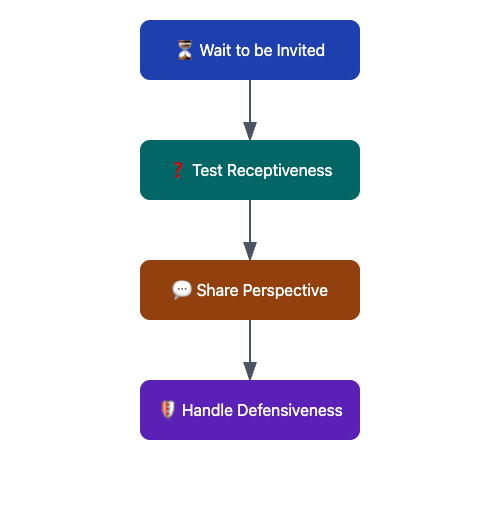
Share Your Perspective 🗣️
When your boss demonstrates receptiveness to feedback, the way you deliver it becomes crucial to its effectiveness. Focus on sharing your perspective about what you're observing rather than prescribing what your boss should do differently. This subtle but important distinction acknowledges that you're seeing only a partial picture of your boss's reality and respects their autonomy to decide how to respond to your input.
The structure of your feedback should follow a careful pattern that opens positively before moving into constructive territory. Begin by acknowledging something your boss does well that relates to the area you're addressing.
Furthermore, your constructive suggestions should be specific and focused on observable behaviors and their impacts rather than personality traits or intentions.
Here's how this approach might play out in a real conversation:
- Victoria: Dan, do you have a few minutes to debrief yesterday's client presentation?
- Dan: Sure, I thought it went pretty well overall. What's your take?
- Victoria: I agree—your technical expertise really came through, especially when you explained the implementation phases. The client seemed impressed with your depth of knowledge.
- Dan: Thanks, I did prepare quite a bit for those questions.
- Victoria: It showed. I did notice something that might be helpful for next time. Would you like my observation?
- Dan: Of course, what did you see?
- Victoria: When the client pushed back on our timeline and suggested their competitor did it faster, you went quiet for what felt like a long time. From my seat, it looked like the client might have interpreted that as uncertainty about our approach. I know you were probably processing the information carefully, which is one of your strengths.
- Dan: Hmm, I hadn't realized the pause was that noticeable. I was trying to think through the best response.
- Victoria: That makes complete sense. What if next time you verbalized that process? Something like, "That's an important point — let me think through how we can address that." It might help the client understand you're being thoughtful rather than uncertain.
Notice how Victoria tested Dan's receptiveness first, opened with genuine positive feedback about his technical expertise, shared her observation from her perspective, acknowledged his thought process, and then offered a specific, actionable suggestion. This approach makes the feedback feel collaborative rather than critical.
Handle Defensive Reactions Effectively 🛡️
Despite your best efforts to deliver feedback constructively, your boss may still react defensively. This reaction is natural—no one enjoys hearing about their shortcomings, especially from someone who reports to them. When defensiveness emerges, the following tactics can help you effectively navigate the situation:
- Reframe the feedback around your boss's own goals rather than abandoning the conversation entirely. This reframing helps your boss see that your feedback isn't personal criticism but rather support for their success.
- Understand and respect your boss's preferences for receiving feedback proves crucial for maintaining a productive feedback relationship. Some bosses prefer written feedback they can process privately before discussing it, while others want face-to-face conversations. Additionally, some appreciate frequent, informal check-ins, while others prefer structured, scheduled feedback sessions.
- Step back temporarily while maintaining the relationship. Remember that building a feedback relationship is a gradual process—one defensive reaction doesn't mean you should never offer feedback again. Give your boss time to process, and look for future opportunities when they might be more receptive.
Your upcoming role-play sessions will challenge you to practice these delicate feedback techniques. You'll navigate scenarios where you wait for the right moment to offer feedback, share observations about your boss's meeting behavior, and handle defensive reactions with grace and professionalism. These practical exercises will help you develop the confidence and skill to provide upward feedback that strengthens rather than strains your relationship with your boss.
