Finding Exact Distances
Introduction
On a coordinate map, a direct walk between two locations may cut across the grid instead of following horizontal and vertical paths. In this third of four lessons in Distance Between Two Points, you’ll use the right-triangle legs from the previous lesson to calculate that straight-line distance exactly—whether it is a whole number or a square-root expression.
A Square Root Completes the Triangle
Last lesson, you connected the legs and to the hypotenuse with the Pythagorean relationship:
This gives you , so take the square root to find :
Because is a length, it cannot be negative; use the nonnegative square root. In other words, square the leg lengths, add them, and then take the square root of the sum.
From Coordinates to Distance
For points and , the horizontal and vertical leg lengths are the absolute differences of their coordinates. Substituting those lengths into the Pythagorean relationship gives the distance formula:
Absolute values keep the leg lengths nonnegative, even when a coordinate subtraction is negative. Reversing the endpoints changes the signs of the subtractions, but not the absolute differences or the distance.
Use this sequence to find an exact distance:
- Find the absolute differences of the -coordinates and the -coordinates.
- Square the two differences and add them.
- Take the square root. If the sum is a perfect square—a whole number such as with a whole-number square root—evaluate it; otherwise, leave it under the square-root symbol.
When the Sum Is a Perfect Square
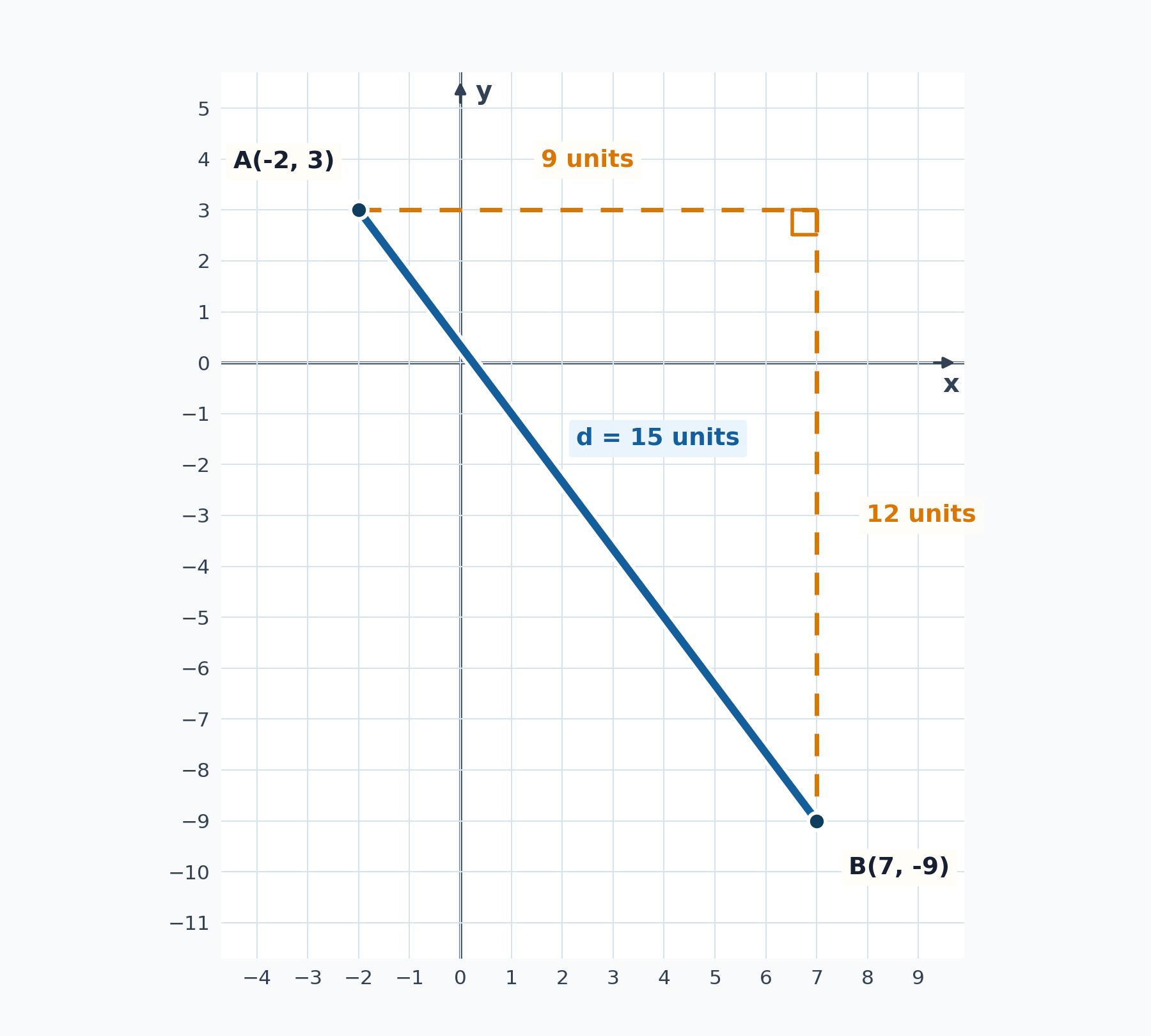
Suppose and mark two park locations on a coordinate map. Their leg lengths are and , so the direct distance is:
Because , the distance is exactly 15 coordinate units. The points are in different quadrants, but the absolute coordinate differences still give the leg lengths.
When the Sum Is Not a Perfect Square
Now suppose and mark two stops on a coordinate map. Their leg lengths are and , so:
Since is not a perfect square, the exact distance is coordinate units. A square-root expression can be a complete exact answer; there is no need to replace it with a decimal or simplify the radical.
Conclusion and Next Steps
To find a straight-line distance, use the coordinate differences for the leg lengths, square and add them, and take the nonnegative square root. Evaluate the result when the sum is a perfect square; otherwise, keep the sum under the square-root symbol as an exact expression.
In the practice that follows, you’ll select exact answers, complete calculations, and find distances from coordinates—including points in different quadrants. The focus is on exact results, not decimal estimates.
