Rounding Distance Estimates
Introduction
Suppose you are comparing the straight-line separation between two locations on a map. An exact answer such as a square root is precise, while a decimal can be quicker to read when a prompt asks for an estimate. In this fourth and final lesson of Distance Between Two Points, you’ll learn to keep those answer types distinct and round a distance to the nearest tenth using a supplied table.
Keep the Exact Distance
From the previous lesson, you know that a diagonal distance comes from the coordinate differences and the Pythagorean relationship:
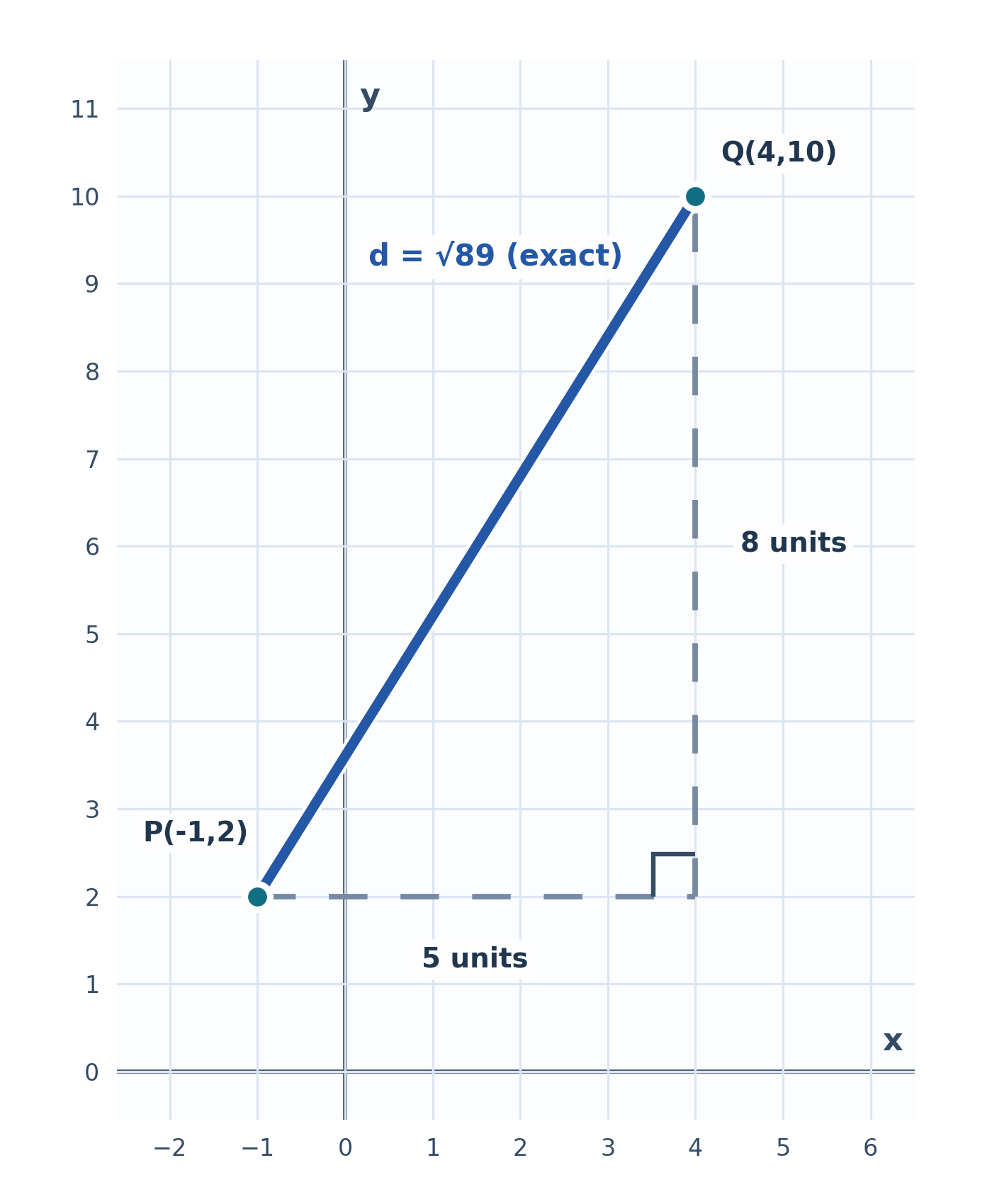
For points and on a coordinate map, the leg lengths are and . So the exact distance is coordinate units. Since 89 is not a perfect square, is a complete exact answer; a decimal is optional unless the question requests one.
Check the Whole-Number Bounds
Before looking up a decimal, check the size of the square root using nearby perfect squares, such as and . For a nonsquare radicand , if , then .
For , , so the distance is between 9 and 10 coordinate units. This bound is a reasonableness check; it does not yet tell us which tenth to report.
Use the Supplied Table and Round
Once the bounds make sense, use a square-root reference table to find a decimal value. Every practice question that requests a decimal will include the needed table in its text, with values to at least three decimal places, so you won’t need a calculator.
| Number under the square root | Approximate square root |
|---|---|
| 41 | 6.403 |
| 50 | 7.071 |
| 52 | 7.211 |
| 89 | 9.434 |
To round to the nearest tenth, inspect the hundredths digit. If it is below 5, keep the tenths digit unchanged. If it is 5 or greater, increase the tenths digit by 1.
The table gives . To round to the nearest tenth of a coordinate unit, check the hundredths digit, which is 3; keep the tenths digit, 4, unchanged. So coordinate units to the nearest tenth.
For a round-up example, leg lengths of 7 and 1 coordinate units give coordinate units. The table gives . Its hundredths digit is 7, so increase the tenths digit from 0 to 1: the distance rounds to 7.1 coordinate units. The exact distance remains .
Keep the coordinate differences, their squares, and their sum exact; round only the final square-root value. The exact distance remains coordinate units, and the decimal is used only when requested.
Conclusion and Next Steps
Start with the exact square-root distance, use neighboring perfect squares to check its whole-number bounds, and consult the supplied table when a decimal is requested. Round the final square-root value—not the coordinate differences or their squares—to the precision named in the prompt.
In the practice that follows, you’ll identify an exact form and its bounds, complete a table-guided nearest-tenth calculation, and estimate distances between plotted stores and park entrances. Each approximation question provides the needed table, so you can focus on the reasoning without a calculator.
