Coordinate Right Triangles
Introduction
In this second lesson of Distance Between Two Points, you’ll use horizontal and vertical distances to understand a straight path between points that do not share a grid line. Imagine two park locations on different rows and columns: moving in two directions along the grid creates a right-angle route beside the direct path. The hypotenuse is the side opposite a right triangle’s right angle. By the end, you’ll be able to identify it and connect it to the two leg lengths.
Why the Route Forms a Right Triangle
On a coordinate map, a horizontal move changes the -coordinate while keeping the -coordinate fixed. A vertical move changes the -coordinate while keeping the -coordinate fixed. These directions are perpendicular, so the moves meet at a angle.
The two moves form the triangle’s legs. The straight segment connecting the original locations closes the triangle and lies opposite the right angle.
Add a Corner Between the Points
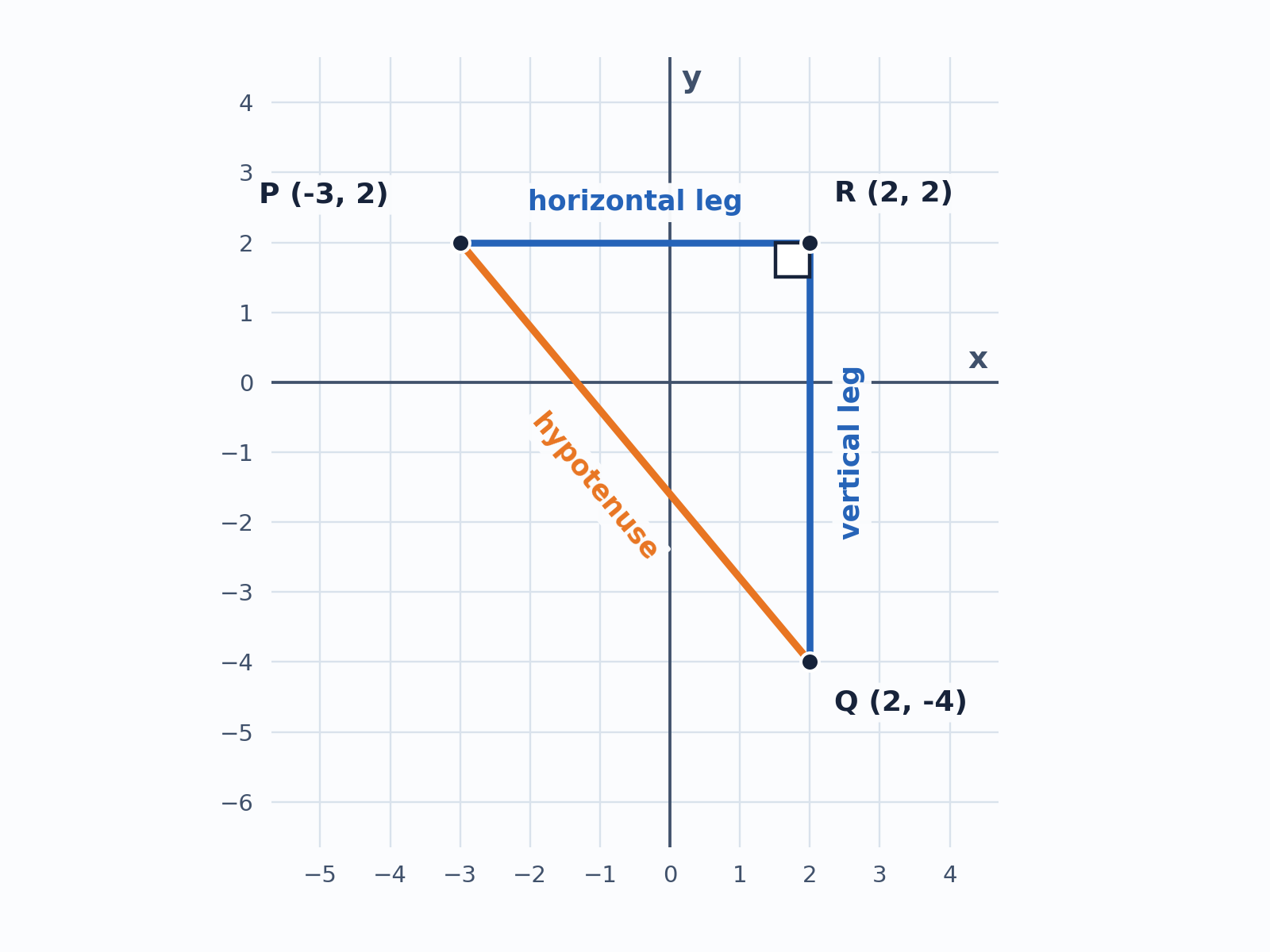
Suppose park locations are at and . Both coordinates differ, so the points do not share a grid line. Add a corner at , using ’s -coordinate and ’s -coordinate. Then is horizontal and is vertical, meeting at a right angle at .
The segment connects the original locations, so it is opposite the right angle. You could instead add the other mixed-coordinate corner, ; that also makes a right triangle with the same leg lengths.
Read the Leg Lengths From Coordinates
The horizontal and vertical rules from the previous lesson give the lengths of these legs. For endpoints and , use the absolute difference of the -coordinates for the horizontal leg and the absolute difference of the -coordinates for the vertical leg:
For and , the leg lengths are:
So the horizontal leg is 5 coordinate units and the vertical leg is 6 coordinate units. The coordinates change signs along both legs, but the absolute differences still give nonnegative lengths.
Connect the Legs to the Hypotenuse
The side opposite a right angle is called the hypotenuse. Here, that side is , the direct segment between the park locations. If the leg lengths are and , and the hypotenuse length is , the Pythagorean relationship is:
The exponent means to multiply a length by itself. For this triangle, the relationship is , where is the length of . We’ll leave unsolved for now; this lesson focuses on identifying the triangle’s parts and writing the relationship between them.
Conclusion and Next Steps
When two points differ in both coordinates, combine one point’s -coordinate with the other point’s -coordinate to create a corner. The resulting horizontal and vertical segments are the legs, and the original connecting segment is the hypotenuse, linked to the legs by .
In the practice ahead, you’ll identify the hypotenuse, build an axis-aligned right triangle, and find its leg lengths from the coordinates. You’ll also use the same coordinate-difference method for points in different quadrants.
