Engaging Social Audiences
Engaging Audiences via Social Media
In search, you caught people who had already raised their hand. Social runs the opposite motion: nobody typed a query, so you go find the right person and put something in front of them worth stopping for. Same budget discipline, different logic. This unit walks that logic, then the platform choices that follow from it.
Why Social Targets Audiences, Not Intent
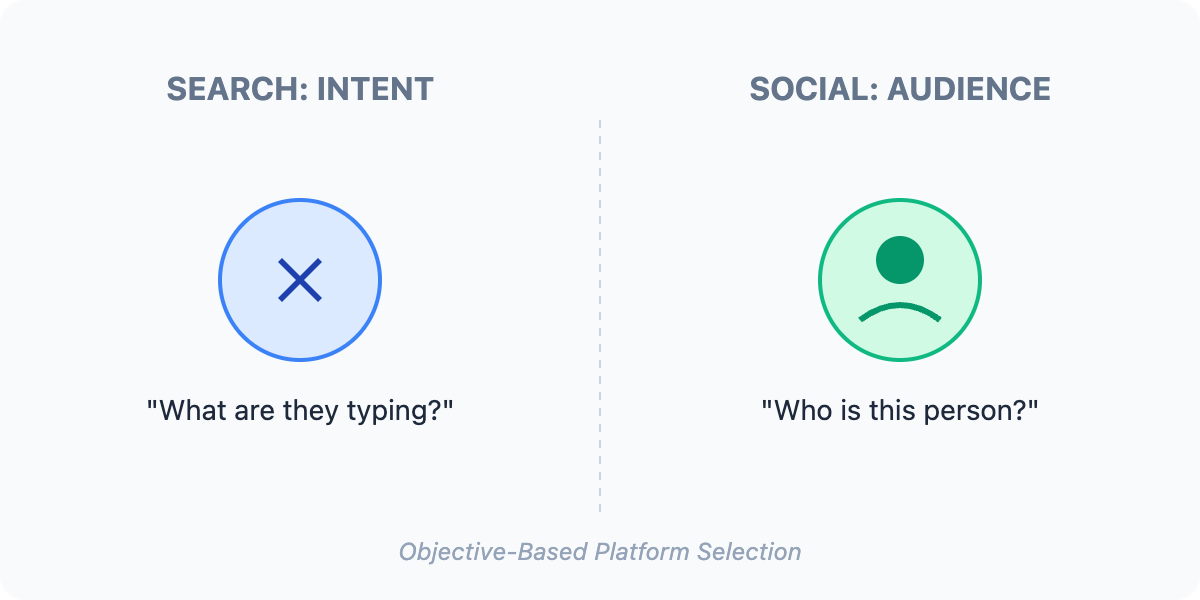
Start with the mental switch. Search runs on intent-based targeting, where the keyword is a live signal that someone wants the thing right now. Social runs on audience-based targeting, where you define who the person is (their demographics, interests, behaviors, job title, the accounts they follow) and reach them whether or not they're currently shopping.
That difference sets everything else. On search you capture demand; on social you often create it. So your job shifts from "match the query" to "define the audience and interrupt them with something relevant enough to earn a pause." A plumber on search answers a flooded-kitchen query. The same business on social has to find likely homeowners in a service area and give them a reason to care before anything breaks.
Consequently, a good click looks different here. A social click can be curiosity rather than purchase-readiness, so you lean harder on the funnel: awareness first, then nurture, then convert. Judge social by whether it moves the right people through those stages, not by whether every click converts today.
Matching Each Platform to Its Audience and Objective
Once you accept that you're buying an audience, platform choice becomes an audience question, not a taste question. Each platform concentrates a different crowd in a different mindset.
Meta (Facebook and Instagram) is the broad-reach workhorse: massive scale, deep interest and behavioral targeting, and the strongest retargeting engine, which makes it a default for consideration and conversion across most consumer categories. LinkedIn is the professional network, where targeting by job title, seniority, industry, and company makes it the home of B2B lead generation, though clicks cost more. X fits real-time, news, and conversation-driven moments. TikTok is short-form video and trend-led discovery, skewing younger, strong for top-of-funnel awareness. Pinterest is planning-oriented discovery around home, fashion, food, and weddings, close to purchase in those verticals. Snapchat skews to younger audiences with playful, casual formats. The move is always the same: name the objective and the audience first, then let the platform fall out of that.
- Jessica: A competitor's video blew up on TikTok, so I want our whole B2B budget there.
- Milo: What's the objective underneath that?
- Jessica: Qualified leads for our software.
- Milo: Then start from where B2B buyers are reachable by role. That's LinkedIn for lead gen, Meta for scale and retargeting. TikTok can run as a small awareness test, not the core.
- Jessica: So the goal picks the platform, not the trend.
Notice Milo didn't attack the channel. He anchored on the objective and let platform fit do the persuading.
Designing a Cross-Platform Social Mix
Rarely does one platform do the whole job, so you build a mix where each plays a defined role across the funnel. Give one platform the awareness role, another the consideration-and-retargeting role, and treat anything unproven as a small, measured test with its own budget cap. For a B2B lead-gen goal, that often means LinkedIn as the lead-gen core, Meta carrying scale and retargeting for warm visitors, and a contained TikTok or X experiment at the top. Every platform in the plan should have a one-line justification tied to audience and objective. If you can't write that line, it doesn't belong in the mix.
The takeaway for this unit: on social you buy an audience, not intent, so the objective and the people you're after dictate the platform, and the platform dictates the role it plays in your mix. Your next step is a quick sorting exercise to lock in the audience-versus-intent distinction before it gets tested in a live conversation. Before you click in, try the habit that carries this whole unit: for any platform someone pitches you, ask "which objective and which audience justifies this?" and refuse to move until there's an answer.
