Measuring Digital Performance
Measuring and Integrating Digital Channels
You've now built out the channels: a website hub, search, paid ads, social, email, and content. The work ahead is making sure they're actually paying off and pulling in the same direction. This unit is about reading the numbers without getting fooled by them, then stitching the channels into one experience your customer never sees as separate.
Identify Key Digital Metrics and the Analytics Tools That Track Them
Start by knowing which number lives where, because the wrong tool gives you a confident answer to the wrong question. Five metrics carry most of your day-to-day decisions:
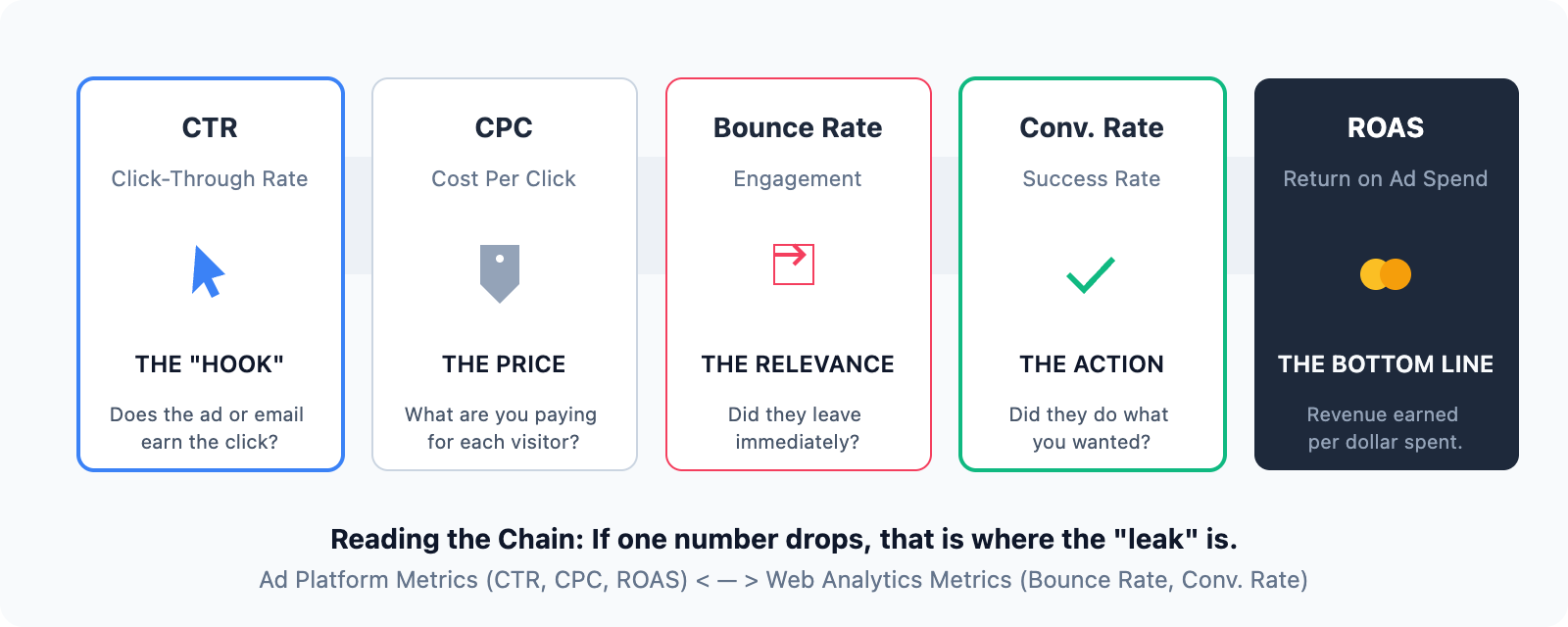
- Click-through rate (CTR) tells you whether your ad or email earned the click.
- Cost per click (CPC) tells you what that click cost you.
- Conversion rate tells you what share of visitors did the thing you wanted.
- Return on ad spend (ROAS) tells you the revenue earned per dollar of ad spend.
- Bounce rate tells you how many landed and left without engaging.
Each lives in a predictable place. Your ad platforms (Google Ads, Meta Ads Manager) own CTR, CPC, and ROAS for paid campaigns. Your web analytics tool (GA4) owns on-site behavior: sessions, bounce rate, conversions, and the path visitors take. Your email platform owns open rate, click rate, and the conversions its flows drive. When someone asks "how's the campaign doing," your first move is naming which metric answers their actual question, then opening the tool that owns it. Guessing across tools is how teams end up arguing about numbers that were never measuring the same thing.
Analyze Campaign Performance Data to Optimize Digital Decisions
A metric on its own is just a fact. The skill is reading metrics in sequence to locate where the funnel leaks, then fixing that exact spot. Don't react to one number in isolation. Trace the path: did they click, did they land, did they convert? The break in that chain tells you what to touch.
- Chris: Our search ad's CTR jumped to 6%, but sales are flat. Should we rewrite the ad?
- Nova: Hold on. If people are clicking, the ad is doing its job. What's the conversion rate on that landing page?
- Chris: Only 0.8%, way below our other pages.
- Nova: Then the leak is the page, not the ad. Match the headline to the ad promise and shorten the form before you touch the creative.
Notice the move: a high CTR with low conversion almost never means "fix the ad." It means the click is fine and the page is failing. Run that logic in reverse too. A low CTR with strong page conversion points at the creative or targeting, not the landing experience. High bounce rate on a paid page usually signals a mismatch between what the ad promised and what the page delivered. Before you recommend any change, say out loud which metric points to which lever, so you optimize the cause and not the symptom.
Integrate Website, Search, Social, Email, and Content into a Cohesive Omnichannel Experience
Once each channel works on its own, your job shifts to the handoffs between them. Customers don't experience channels; they experience your brand once, across many touchpoints. So map the journey as a relay. Social and content create discovery; search captures the intent that discovery sparked; the website converts it; email retains and reactivates; and content feeds every stage with the value that makes each step worth taking. When a Meta ad's tone, your landing page's headline, and your welcome email all say the same thing, the customer feels continuity and trusts faster. When they contradict, you pay for clicks that leak away at the seams. Use your performance data to decide where integration matters most: fix the handoff where you're losing the most qualified people, not the one that's easiest to tinker with.
The one idea to carry out of this unit: numbers don't tell you what to do until you read them in sequence and connect the channels they describe. Next you'll line up metrics with the tools that own them in a quick matching check, then sit with a live dashboard to diagnose and decide optimizations in real time, and finally draft an integration plan you could actually hand to your team. Make it a habit to ask "which metric, which lever, which handoff" before you ever recommend a change.
