Mastering Core Metrics
Mastering Core Metrics and Vocabulary
You now know who carries an ad from your idea to a person's screen. The next question is the one every stakeholder eventually asks: "Is it working, and is it worth the money?" To answer that with confidence instead of a shrug, you need four numbers and the vocabulary that goes with them. Get fluent in these, and a spreadsheet stops being intimidating and starts telling you a story.
Speaking the Language: CPM, CPC, CPA, and CTR
Before you can judge a campaign, you have to name what each number measures. Think of these four as answering four different "how much" and "how well" questions.
CPM stands for cost per thousand impressions (the "M" is the Roman numeral for a thousand). An impression is simply one ad shown once. CPM tells you how much you pay to be seen, so it's your cost-of-reach number, most useful when the goal is awareness. CPC, cost per click, tells you how much you pay each time someone actually clicks, which measures the cost of getting a person to take a first step toward you.
CPA, cost per acquisition, tells you how much you pay for a real result, a sale or a signup, so it's the number closest to the money. And CTR, click-through rate, is the one percentage in the group: it's the share of people who clicked after seeing your ad, a read on how compelling the ad itself is.
Here's the mental model to keep: CPM measures being seen, CPC measures being clicked, CPA measures being bought, and CTR measures how tempting the ad was. When someone asks whether a campaign is healthy, you'll almost never look at just one.
Running the Numbers From a Raw Data Pull
A raw export usually gives you four columns: spend, impressions, clicks, and acquisitions. Everything above is built from those. Let's walk one example so the formulas feel concrete.
Say a campaign spent $2,000, earned 400,000 impressions, drove 8,000 clicks, and produced 100 acquisitions. Using the Core Pricing Models, CPM is (cost ÷ impressions) × 1,000, so ($2,000 ÷ 400,000) × 1,000 = $5 to reach a thousand people. CPC is cost ÷ clicks, so $2,000 ÷ 8,000 = $0.25 per click. CPA is cost ÷ acquisitions, so $2,000 ÷ 100 = $20 per customer. Then, from the Core Performance Metrics, CTR is (clicks ÷ impressions) × 100, so (8,000 ÷ 400,000) × 100 = 2%.
Notice the pattern: for the cost metrics you divide spend by whatever you're measuring, and for CTR you turn a ratio into a percentage by multiplying by 100. The discipline that keeps you accurate is watching your units. CPM is dollars per thousand, CPC and CPA are dollars per one thing, and CTR is a percent. Mixing those up is the most common slip, so say the unit out loud with every answer.
Reading CTR Against CPA to Spot Trouble
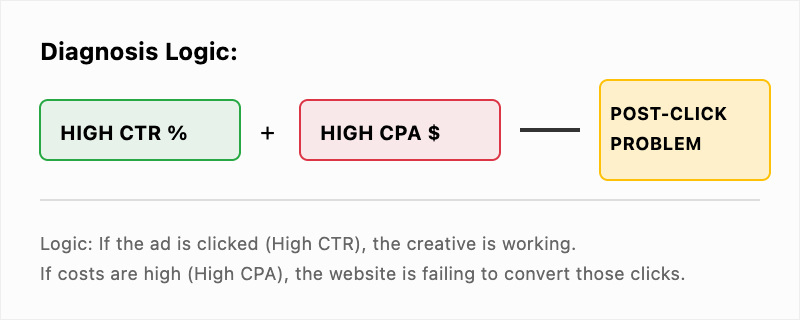
The real skill isn't the arithmetic, it's what two numbers say when you hold them side by side. The most revealing pairing is CTR against CPA, because they measure two different halves of the journey. CTR tells you whether the ad wins the click; CPA tells you whether that click turns into an affordable result. When they disagree, the gap points you straight to the problem.
- Nova: This ad group has a 6% click-through rate but the cost per acquisition is triple our target. What's going on?
- Dan: A high CTR means the ad is winning the click, so the creative isn't the problem. The money is leaking after the click.
- Nova: So people arrive and then just... leave?
- Dan: Right. Check the conversion rate, conversions divided by clicks. If that's tiny, the landing page or the offer is where it breaks, not the ad.
- Nova: So a strong CTR can actually hide a weak campaign.
That's the move to internalize. A high CTR paired with a high CPA almost always means the ad is doing its job but the post-click experience isn't, and Conversion Rate (CVR = conversions ÷ clicks) is the number that confirms it. The ad earns attention; the landing page loses it.
The single takeaway of this unit: four numbers tell four different stories, and the sharpest diagnoses come from reading them against each other, not alone. Next you'll do a quick recall check to lock the term, formula, and unit for each metric into memory, then you'll compute them live with an analyst and write a diagnosis of a campaign that's clicking but not selling. For now, build one habit: whenever you read a metric, say its unit out loud, then ask what a second metric would confirm or contradict.
