Tracing Customer Journeys
Tracing the Customer Journey Across Devices
You can now name and calculate CPM, CPC, CPA, and CTR. But here's the catch: a metric only means something when you know where in the customer's path it sits. Nobody sees your ad and buys in the same breath. People move through a sequence, and each of those numbers is really a snapshot of one moment in it. This unit hands you the map: how to trace that path, which metric belongs at each stage, and how to adapt when your customers are living on their phones.
Following the Path: Impression to Click to Conversion
Start every campaign read by placing what happened onto a simple line. The Customer Journey Metric Sequence runs impression (exposure) to click or engagement (interaction) to conversion (the final action). An impression is the moment your ad is shown, one exposure. A click or an engagement is the person choosing to interact, the first active step toward you. A conversion is the outcome you actually paid for: a signup, a subscription, a sale. The value of the sequence is that it tells you where people fall away, not just that they did.
- Chris: The launch only drove 40 signups. Should we just kill it?
- Jessica: Before we do, let's trace the path. How many people saw the ad, and how many clicked?
- Chris: Tons of impressions, decent clicks... but the signups dropped off a cliff.
- Jessica: So exposure and interaction are both healthy. The leak is at the final step. Killing the ad won't fix a conversion problem.
- Chris: So each stage tells us something different about where people are dropping.
Notice the move: tracing the sequence points to where the problem actually lives. Now, the right thing can be fixed instead of scrapping something that's working.
Matching Metrics to Each Stage of the Journey
Once you can see the path, the next discipline is putting each metric on the correct stage, because a number read at the wrong stage lies to you. Group your metrics into three buckets that mirror the sequence. Awareness metrics measure exposure: impressions and reach tell you how many people the campaign put your brand in front of. Consideration metrics measure interaction: clicks, engagement, and CTR tell you whether that exposure sparked interest. Conversion metrics measure the action: signups, subscriptions, sales, plus CPA and conversion rate, tell you whether that interest turned into a result.
The mistake to guard against is lumping exposure and action together. Reach is not a result, and a strong CTR is not a sale. If someone hands you a dashboard where impressions sit next to purchases with no separation, you can't tell whether a soft quarter came from too few people seeing the ad or too few of the interested ones converting. Keeping the buckets clean means that when a number dips, you know exactly which stage to investigate.
Adapting a Desktop Campaign for Mobile Behavior
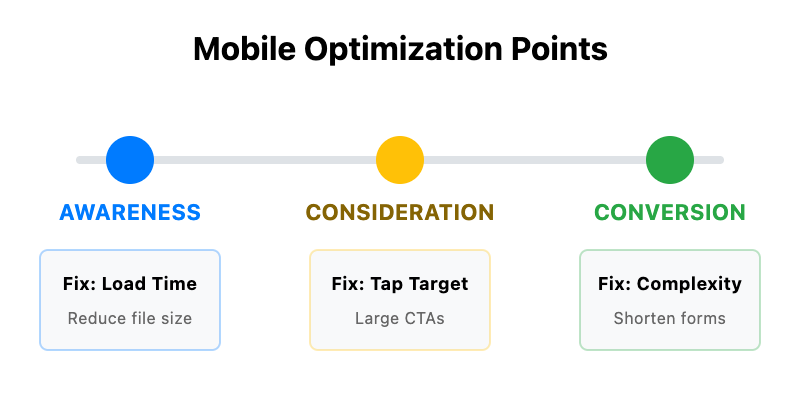 Now apply the map to where your customers actually are, which is increasingly a phone. When the data shows most of your traffic is mobile but your creative and landing pages were built for desktop, don't order a full rebuild. Instead, make targeted adjustments tied to each stage. At the awareness stage, prioritize mobile-optimized creative and fast load times, because a slow-loading ad on a phone loses the exposure before it registers. At consideration, make calls-to-action thumb-friendly and large enough to tap without pinching, so the interaction step isn't sabotaged by fiddly design. At conversion, shorten the signup flow: fewer form fields, autofill where possible, and a checkout that doesn't demand a keyboard marathon. Each change maps to a stage, and each protects the moment where mobile users otherwise abandon.
The single takeaway of this unit: the customer journey is a sequence, and both your metrics and your fixes only make sense when you attach them to the right stage. Three practices sit ahead. First, a quick sorting check to lock the impression-to-conversion order into place. Then a live discussion with an analytics partner where you'll defend which metrics belong at awareness, consideration, and conversion, and finally a recommendation you could actually hand to a product owner to shift a desktop campaign toward mobile. Your habit to carry in: before judging any number, say out loud which stage it belongs to.
