Mapping the Ad Ecosystem
Mapping the Digital Advertising Ecosystem
In the last unit, you saw why digital's edge lives in targeting and measurement. But before you plan a single campaign, you need to know who actually carries an ad from your idea to a person's screen. Think of this unit as the map you'll pull up every time an ad "isn't showing" and someone turns to you for the answer.
The Four Players in the Marketplace
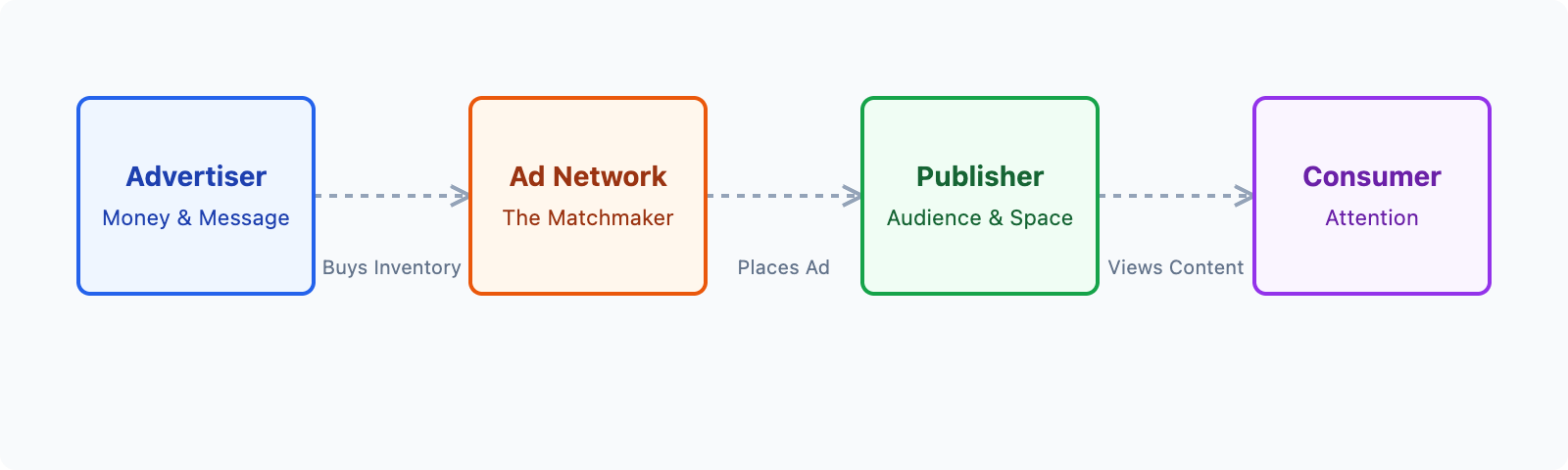 The advertiser is you, or your client: the brand that wants to reach people and pays to do it. The publisher is anyone with digital space to sell, like a news site, a blog, a mobile app, or a YouTube channel. They own the "shelf space" (called ad inventory) where your ad can appear.
The consumer is the person on the other end: the reader, viewer, or shopper you're trying to reach. And the ad network is the connector in the middle that matches advertisers who want space with publishers who have it. Here's a simple way to hold it: the advertiser has money and a message, the publisher has audience and space, the consumer has attention, and the ad network is the matchmaker. Once you can name which player owns which piece, campaigns stop feeling like a black box.
How Ad Networks Connect Everyone
The obvious question is why the ad network needs to exist at all. Why not just call each website and buy space directly?
You could, but picture doing that across hundreds of sites: negotiating a price with each one, tracking each contract, adjusting each placement by hand. It doesn't scale. The ad network solves this by aggregating inventory from thousands of publishers into one place, so you buy across all of them through a single system, set the audience you want, and let the network decide where each impression is served.
- Dan: So if we want to appear on twenty different sites, we negotiate with all twenty?
- Nova: You could, but picture managing twenty contracts and twenty invoices. That's exactly the problem the ad network solves.
- Dan: Meaning we buy from the network instead of from each site?
- Nova: Right. The network pools space from thousands of publishers, so we set our audience once and it places the ads for us.
- Dan: So we get scale without chasing every site individually.
Notice how the "why not just buy direct?" question answers itself the moment you picture the manual version. That contrast is the cleanest way to explain the network's value.
Diagnosing Where Delivery Breaks Down
Here's the payoff. When an ad "isn't showing," the map tells you where to look, and in what order. Walk the chain from your own side outward.
Start advertiser-side: is the campaign approved, is there budget left, and is the targeting so narrow it excludes the site? Then check the ad-network side: is matching inventory available, and is your bid competitive enough to win the placement? Only then look publisher-side: does that specific site have space, or has it blocked your ad category? Most breakdowns trace back to the advertiser side (budget, approval, or over-tight targeting), so audit your own setup before you point at the network or the publisher.
The single takeaway of this unit: four players (advertiser, publisher, ad network, consumer), and the network in the middle is what makes buying at scale possible. First you'll do a quick sorting exercise to lock in who plays which role, then you'll walk a new teammate through the flow out loud, and finally you'll draft a client-facing note diagnosing a real delivery breakdown. For now, build one reflex: the next time an ad isn't showing, don't guess, walk the chain in order and check your own setup first.
