Traditional Versus Digital Advertising
Welcome to the Course
As a Digital Marketing Manager, you're expected to plan and defend where every dollar of ad spend goes, and that starts with understanding how modern advertising actually reaches people. This course gives you the shared vocabulary and mental models you'll rely on in nearly every planning meeting, client call, and budget conversation for the rest of your career.
By the end of this course, you'll be able to:
- Distinguish traditional and digital advertising, and build a clear case for shifting budget between them.
- Map the players in the digital ad ecosystem (advertisers, publishers, ad networks, consumers) and diagnose where a delivery breakdown happens.
- Calculate and interpret the core pricing and performance metrics: CPM, CPC, CPA, and CTR.
- Trace a customer's journey from first impression to conversion, and adapt a campaign for mobile behavior.
This first unit focuses on the most fundamental comparison of all: how digital advertising differs from traditional advertising, and how to spot where a brand should shift its money.
Traditional vs. Digital: Reach, Targeting, Measurement, and Cost
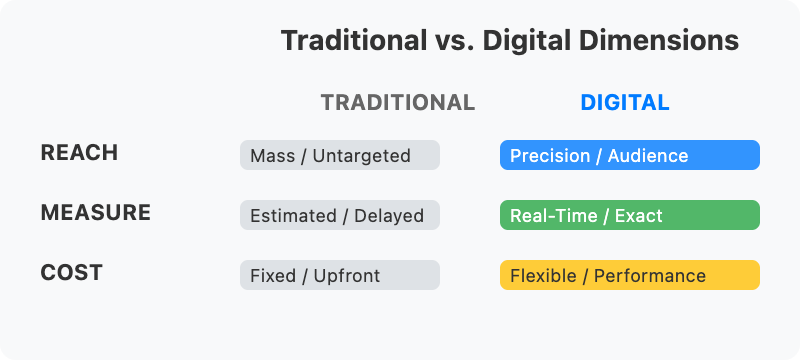 Traditional advertising covers channels like newspaper print, radio, television, and billboards. Digital advertising covers channels delivered through connected screens: search ads, social media, display banners, and video. The cleanest way to tell them apart is to compare them across four dimensions, because those four are exactly what leadership will ask you about.
The first is reach, meaning how many people see the ad. Traditional media is built for mass reach: a radio spot goes out to everyone tuned in, whether or not they'd ever buy the product. Digital can reach large audiences too, but it usually trades sheer volume for precision.
That precision is the second dimension, targeting, meaning your ability to choose who sees the ad. Traditional targeting is blunt (you pick a station or a publication and accept whoever it attracts). Digital targeting is sharp: you can narrow by location, age, interests, and past behavior.
The third dimension is measurement, meaning how well you can see what the ad did. This is digital's biggest edge. With print or radio, you rarely know who responded. With digital, you see clicks, purchases, and cost in near real time.
The fourth is cost structure. Traditional media is a fixed upfront cost: you pay for the slot whether it performs or not. Digital is flexible, so you typically pay per impression, click, or action, and you can pause or reallocate at any moment.
- Chris: The radio spot reaches the whole city, so why bother splitting the budget?
- Jake: Reach isn't the question. Can you tell me who actually responded to it?
- Chris: Not really. We just know sales ticked up that month.
- Jake: That's the gap. With a digital campaign, I can show you exactly who clicked, where they came from, and whether they bought.
- Chris: So same reach, but I'd finally see what's working.
Notice that Jake didn't attack radio. He reframed the conversation around measurement, which is where the real difference lands.
Reading a Brand's Marketing Mix for Digital Openings
A brand's marketing mix is simply the set of channels it currently spends money on. Your job when you inherit one is to read that mix and find where digital would add value that traditional can't.
Start by listing where the money goes and what each channel is meant to achieve. Then hold each channel up against those four dimensions and look for blind spots. When a brand pours budget into a channel it cannot measure, that's an opening: digital lets you finally track results. When a brand pays to reach everyone but sells to a narrow slice, that's an opening too: digital targeting cuts the waste. And when spend is locked into fixed placements with no way to adjust mid-flight, digital's flexibility becomes the argument.
The skill isn't to declare traditional media obsolete. It's to name two or three concrete places where digital closes a specific gap, while respecting what the existing channels still do well.
Making the Case for a Budget Shift
Once you've spotted the openings, the recommendation writes itself, as long as you keep it honest. A strong case names a specific shift (for example, moving a defined portion of print budget into search and social), ties it directly to the four dimensions, and states which new channels the freed money will fund and what they'll deliver in sharper targeting and clearer measurement.
Just as important, name the trade-offs before anyone else does. A shift usually means reduced local print presence, a ramp-up and learning period while campaigns optimize, and the need to set up tracking properly. Leaders trust a recommendation more when it lets them decide with their eyes open rather than feeling oversold.
The single takeaway of this unit: digital's advantage over traditional lives in targeting and measurement, and your job is to translate that advantage into a specific, trade-off-honest budget recommendation. Next, you'll get a quick sorting exercise to lock in which characteristics belong to traditional versus digital, then you'll coach a skeptical traditional-media colleague through a real brand's mix and draft the recommendation memo. For now, try this reflex in your next planning chat: whenever someone defends a channel by its reach, ask what they can actually measure about it.
