Making To-Do Lists That Work
Making To-Do Lists that Work
You've mastered the 15/35/10 method and learned how to break through overwhelming workdays with focused cycles and micro-wins. Now it's time to tackle a fundamental problem that undermines even the best time management systems: the broken to-do list. If you've ever stared at items like "strategic planning" or "improve team communication" and felt paralyzed, or if you consistently underestimate how long tasks will take, this lesson will transform how you capture and execute work.
As is emphasized in the HBR Guide to Getting the Right Work Done, the difference between a to-do list that creates anxiety and one that drives action lies in specificity and integration. Most professionals maintain wish lists disguised as action items. By converting these nebulous items into concrete next actions with realistic time estimates and calendar placements, you'll create a system where every task has a clear path to completion. This isn't about working harder or faster; it's about working with precision and clarity that eliminates the mental overhead of constantly deciding what to do next.
Turning Vague Items into Next Steps
The transformation of your to-do list begins with a simple but powerful formula: context + verb + object. This structure forces you to define exactly where you'll work, what action you'll take, and what specific outcome you'll produce. Compare the vague task list with the actionable task list in the image below:
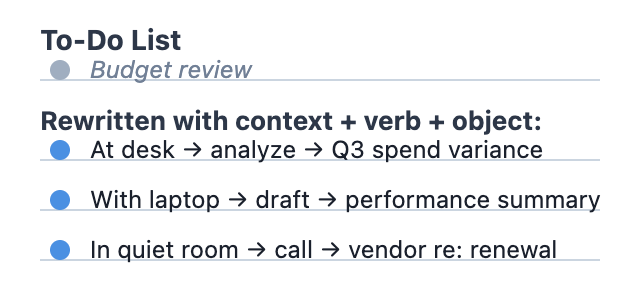
Every properly constructed next action answers three critical questions that your brain needs to initiate work. First, what context or tool do you need? This might be your computer, a quiet space for calls, or access to specific documents. Second, what is the very next physical action required? Not the project, not the outcome, but the actual thing you'll do with your hands or mind. Third, what will exist when this action is complete? This could be a drafted email, a reviewed document with comments, or a scheduled meeting with agenda items.
Here's how this transformation looks in practice when a manager helps a team member clarify their tasks:
- Jessica: I'm feeling stuck on my to-do list. I have "employee engagement initiative" written down, but I don't even know where to start.
- Ryan: That's a perfect example of a project disguised as a task. What's the very first physical thing you need to do to move this forward?
- Jessica: Well, I guess I need to figure out what the current engagement issues are.
- Ryan: Good instinct. But "figure out" is still too vague. What specific action would help you understand the issues? Would you read something, talk to someone, or analyze data?
- Jessica: I should probably look at our last engagement survey results first.
- Ryan: Perfect! Now let's make that actionable. Where will you do this, what exactly will you do, and what will you have when you're done?
- Jessica: So... "At desk + review + Q3 engagement survey results and list top three problem areas in a document"?
- Ryan: Exactly! Now you know precisely what to do, where to do it, and what success looks like. How different does that feel from "employee engagement initiative"?
- Jessica: So much clearer. I can actually start this right after our meeting instead of procrastinating for another week.
Notice how Ryan guided Jessica from a overwhelming project label to a specific, executable next action. This coaching process helps build the mental habit of breaking down ambiguity into concrete steps.
Consider how this transformation changes your entire relationship with work. The vague task "Performance reviews" becomes the actionable "At desk + write + three bullet points of Jane's key achievements for Q3". Similarly, "Team offsite planning" transforms into "In quiet space + call + three venues for pricing and availability (capture in spreadsheet)". Even technical tasks benefit from this precision—"Fix the Jenkins pipeline" becomes "At workstation + debug + authentication error in deployment script (push fix to staging)".
This precision becomes even more powerful when you're delegating or coordinating with others. Instead of asking someone to "look into the customer complaint", you request they "By EOD Friday + investigate + root cause of billing error for account #4521 and document findings in shared folder". This clarity eliminates the back-and-forth clarification that wastes everyone's time and ensures that both parties understand exactly what success looks like.
Determining Realistic Duration and Calendarization
Once you've defined your next actions with surgical precision, the next critical step is estimating how long each will actually take and placing it directly on your calendar. This practice transforms your calendar from a record of meetings into a complete picture of how you'll spend your time, creating a realistic plan that you can actually execute rather than an aspirational list that breeds guilt and frustration.
The key to accurate estimation lies in historical observation rather than optimistic guessing. Track how long similar tasks have taken in the past, then add a 1.5x buffer to account for the inevitable friction of context switching, unexpected questions, and the need for brief mental breaks. If you think drafting that email will take 20 minutes, calendar 30. If the analysis seems like an hour's work, block 90 minutes. This buffer isn't pessimism, it's realism that prevents your entire day from cascading into delay when the first task runs over.
Here's how this calendaring discipline transforms your daily execution. Your Monday morning might begin with 9:00-9:30 AM blocked for "At desk + review + competitor pricing analysis and highlight three insights", followed by a 30-minute buffer and transition time. From 10:00-11:00 AM, you've scheduled "In meeting room + facilitate + product roadmap discussion with engineering (prepare three priority questions)". Then from 11:00-11:45 AM, you've reserved time to "At desk + write + follow-up email with roadmap decisions and next steps".
Notice how each item lives on the calendar as a real appointment with yourself, not just floating on a list hoping to get done "when you have time". This practice forces you to confront the mathematical reality of your day—if you have six hours of true working time after meetings, you cannot fit eight hours of tasks. The calendar doesn't lie, even when your optimistic planning brain wants to.
Making Team Norms for Scheduling and Buffers
The final evolution of your to-do system involves establishing team-wide norms that protect everyone's ability to execute their carefully planned work. Without explicit agreements about scheduling, buffers, and focus time, even the best personal system crumbles under the weight of constant interruptions and meeting requests that destroy deep work blocks.
Start by establishing the concept of maker time versus manager time with your team. Maker time consists of long, uninterrupted blocks needed for creative or analytical work such as writing code, designing solutions, analyzing data, or strategizing. Manager time operates in 30-minute chunks suitable for conversations, decisions, and coordination. The key insight is that makers need protection from the fragmentation that managers often take for granted. A "quick 15-minute sync" in the middle of a maker's morning can destroy two hours of productivity as they lose flow state and struggle to regain focus.
Your team's scheduling norms should establish clear boundaries and expectations. For instance, morning blocks from 9 AM to 12 PM could be reserved for maker time with no meetings except genuine emergencies, and team members would mark their calendars as "Deep Work - Building [specific thing]" rather than just "Busy". Afternoon slots from 1 PM to 5 PM would then be available for meetings, with the understanding that back-to-back scheduling is discouraged and 15-minute buffers between meetings are standard for processing and transitioning.
Additionally, your meeting scheduling protocol should require that all meeting requests include specific outcomes needed, explain why each person's input is essential, share pre-read materials 24 hours in advance, and provide time estimates that include buffer. Furthermore, the team should agree on standard language for protecting focus time, such as responding to non-urgent interruptions with "I'm in a focus block until [time]. Can we connect at [specific alternative time]?" This response should not only be acceptable but actively encouraged.
Ready to transform these concepts into practical skills? In our upcoming roleplay session, you'll practice coaching a skeptical peer who insists on keeping everything "in their head" rather than externalizing and calendaring their work. You'll learn how to guide them toward better task capture while respecting their current working style and building trust through small wins.
