Breaking Through Overwhelm
Welcome to the Course
Welcome to Designing Your Time, where you'll transform overwhelming workdays into structured, productive sessions that actually deliver results. If you've ever felt like you're drowning in tasks, constantly switching between priorities, or ending your day wondering what you actually accomplished, this course is your practical roadmap to taking control.
Throughout this course, you'll master the art of turning intention into execution through proven techniques highlighted in the HBR Guide to Getting the Right Work Done such as timeboxing, single-tasking, and strategic calendar management. You'll learn how to create to-do lists that actually work, manage long-term projects without the last-minute panic, and build sustainable email systems that don't consume your entire day. Once you master these skills, you'll move through your workday with clarity and confidence, knowing exactly what to focus on and when.
What makes this system particularly powerful is that it's built for real professionals managing real complexity. Rather than offering theoretical concepts, you'll practice concrete techniques that you can implement immediately, starting with the transformative 15/35/10 method that breaks through even the most overwhelming situations.
Timeboxing Overwhelming Tasks into 15/35/10 Cycles
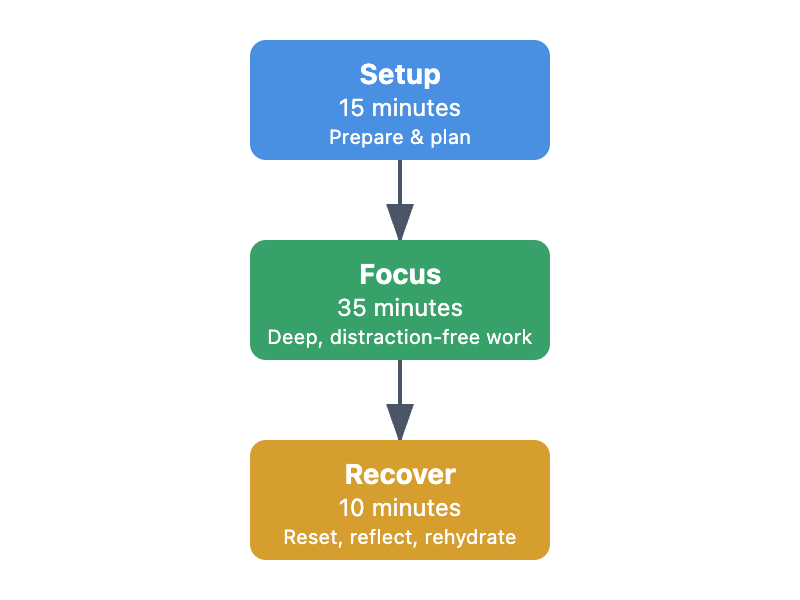
When you're facing a mountain of work and don't know where to start, the 15/35/10 method provides immediate traction. This elegantly simple framework divides your work into manageable cycles consisting of 15 minutes to set up, 35 minutes of deep focus, and 10 minutes to recover and reset.
The effectiveness of this approach stems from its alignment with how your brain naturally operates. Research consistently shows that most people can maintain peak focus for approximately 30 to 40 minutes before attention begins to wander. By working with this natural rhythm rather than against it, you create sustainable momentum throughout your day. Think of it as interval training for your productivity—short bursts of intense focus followed by strategic recovery that keeps you fresh and engaged.
Your 15-minute setup phase serves as the crucial foundation for productive work. During this time, you review what needs to be accomplished, gather all necessary materials and resources, close distracting browser tabs and applications, and set a crystal-clear intention such as "In the next 35 minutes, I will complete the first draft of the project timeline". This preparation eliminates the friction that often derails deep work and ensures you can dive straight into meaningful progress when your focus block begins.
The 35-minute focus block represents the heart of the system, where you dedicate complete attention to a single task. This means no email checks, no quick Slack responses, and absolutely no "let me just quickly look at this other thing" moments that fragment your concentration. When interruptions inevitably arise, you simply capture them on a list to handle during your break rather than breaking your flow.
Here's how this boundary-setting looks in practice:
- Jessica: Hey, do you have a minute? I need your input on the team restructure proposal.
- Ryan: I'm actually in the middle of a focus block right now—I've got about 20 minutes left. Can we connect at 11:15?
- Jessica: Oh, is it urgent? The leadership meeting is tomorrow morning.
- Ryan: I understand the timeline pressure. Let me wrap this analysis I'm doing, and I'll give you my full attention at 11:15. I'll block 30 minutes so we can really think it through properly. Will that work?
- Jessica: That's actually perfect—it'll give me time to organize my specific questions. Thanks for protecting the time to focus on it properly.
- Ryan: Great! I'll message you right when I'm done here. And if something becomes truly urgent before then, just text me and I'll reassess.
Notice how Ryan maintains his boundary while showing respect for Jessica's needs. He acknowledges the importance of her request, offers a specific alternative time, and even provides an emergency escape valve. This approach protects deep work while strengthening professional relationships rather than damaging them.
Finally, your 10-minute recovery period is a strategic renewal that prepares you for the next cycle. During this time, you stand up and stretch to reset physically, grab water or a healthy snack, process any truly urgent messages that arrived during your focus block. Perhaps most importantly, it allows you time to celebrate what you just accomplished. This brief reset prevents the mental fatigue that inevitably comes from trying to power through for hours without pause, keeping your energy and focus sharp throughout the day.
Focusing on Micro-Wins
The secret to making the 15/35/10 method truly effective lies in choosing the right task for each cycle. Instead of vaguely attempting to "work on the presentation", you commit to achieving a specific micro-win such as "create the outline with all section headers" or "write the executive summary paragraph". These carefully defined micro-wins create tangible progress that builds unstoppable momentum throughout your day.
A properly constructed micro-win possesses three essential characteristics that set it apart from typical to-do list items. First, it must be completable within your 35-minute window, preventing the frustration of partially finished tasks. Second, it produces a visible output that you can point to as evidence of progress. Third, it meaningfully advances an important project or goal rather than just keeping you busy with administrative tasks. When you successfully string together six or seven micro-wins throughout your day, you've created substantial progress while completely avoiding the paralysis that comes from staring at enormous, undefined tasks.
Using To-Go Framing for End-of-Day Adjustments
The final piece that elevates this system above rigid time management approaches is the concept of to-go framing. Rather than planning what you'll do throughout the day, you instead plan what you'll have accomplished by day's end. At the close of each workday, you look ahead to tomorrow and define your to-go milestones—the specific, concrete outcomes you'll have achieved when tomorrow ends.
This subtle yet powerful shift in language creates remarkable psychological momentum that pulls you forward. Compare the vague intention of "Work on the analysis" with the concrete commitment of "Have three key insights documented with supporting data". The second version creates a clear destination that guides your efforts throughout the day. When 3 PM arrives and your energy starts flagging, knowing exactly what "done" looks like helps you either push through the resistance or make intelligent trade-offs about what truly matters.
Your end-of-day adjustment ritual requires just five minutes but delivers massive returns on that small investment. During this time, you review what you actually accomplished versus what you planned, identifying patterns and obstacles. One particularly powerful practice involves writing a brief note to your morning self, something like: "Tomorrow by 5 PM, I will have completed the stakeholder feedback summary, sent the project update, and reviewed all pending pull requests." This simple act creates accountability while eliminating the morning scramble of figuring out what's important. You wake up with absolute clarity about what success looks like, allowing you to hit the ground running.
The beauty of to-go framing lies in its perfect balance of firmness and flexibility. You commit to specific outcomes rather than rigid activities, creating room for adaptation without losing focus. When a meeting gets cancelled unexpectedly, you gain an additional cycle to accelerate progress on your priorities. When a crisis emerges, you can consciously choose which to-go items to defer rather than watching your entire day dissolve into reactive chaos. This approach ensures that regardless of what surprises arise, you maintain control over your most important outcomes.
Up next, you'll work through an interactive roleplay scenario where you'll practice setting and maintaining boundaries during deep work blocks, learning how to respectfully defer interruptions while preserving positive relationships with your colleagues.
