Friction and Habit Stacking
Reducing Friction and Stacking the Habit
Your habit is tiny and your cue is visible. There's still one thing that can kill it: the distance between the cue firing and the behavior starting. Every step in that gap is a place where a tired version of you quits. This unit closes the gap and then bolts the behavior onto something already running in your day.
Strip the Path to Two Clicks
The Two-Click Rule says count every step between the cue and the behavior, then remove steps until your habit is the path of least resistance. Two clicks, or its physical equivalent, is the target.
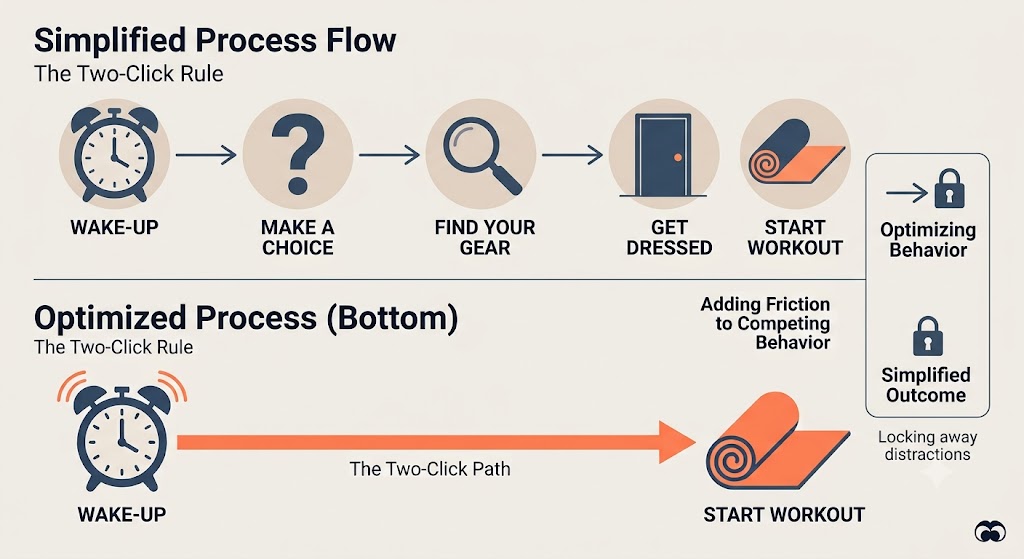 The trick is counting honestly. Cognitive steps count as steps. "Find the app" is a step. "Decide which podcast" is a step. "Remember where I left the notebook" is a step. Most people count three physical movements and miss the four decisions buried between them, then wonder why a thirty-second habit feels heavy.
There's a second half to the rule that people skip: add friction to the competing behavior. Reducing your habit to two clicks doesn't help if the thing you actually do instead takes zero. So the phone charges in the kitchen. The remote goes in a drawer. You log out of the app so re-entry costs a password. To see how this works in practice, let’s look at a coaching session between Natalie and Dan. Dan is struggling to get a morning stretching routine to stick, so Natalie acts as a "path auditor" to help him identify the hidden friction he’s overlooking:
- Natalie: Walk me from your alarm to your first stretch. Count out loud.
- Dan: Alarm off, get up, go find the mat in the hall closet, unroll it, start.
- Natalie: That's five, and you skipped one. You also had to decide whether today was a stretch day.
- Dan: Fine, six. So leave the mat unrolled by the bed. That's alarm off, step onto mat. Two.
- Natalie: Better. What's the competing behavior at that exact moment?
- Dan: Reaching for my phone on the nightstand. Which means it charges across the room now.
Notice that Natalie doesn’t negotiate with Dan’s motivation. She doesn’t ask how much he "wants" to stretch or try to pump him up. Instead, she treats the habit like a design flaw rather than a character flaw. By stripping away the cognitive load of making decisions and the physical load of searching for gear, she ensures the habit doesn't require Dan to be his "best self" at 6:00 a.m.—it just requires him to follow the path of least resistance.
Stack It onto a Reliable Anchor
Once the path is short, attach it to something that already happens. The Habit-Stacking Formula is one line: "After I [current habit], I will [new habit]."
The word doing the work is "current." Your anchor has to be a behavior that already runs on autopilot, not one you're also trying to build. And it has to fire on weekends, sick days, holidays, and travel days. Apply that test out loud: does this happen the Saturday you wake up at someone else's house? If the answer is no, you don't have an anchor, you have a hope. Brushing teeth, filling the kettle, putting your keys down, and locking the front door tend to survive. "After my morning workout" and "after I check email" tend not to.
State the stack in full formula form, with no hedging: After I put my keys in the bowl, I will do one push-up. If you can't say it without adding "usually" or "when I can," rewrite it.
Diagnose the Three Stacking Failures
Stacks fail in three predictable ways, and knowing them lets you catch yours before it breaks.
An unstable anchor is the most common. The anchor itself is inconsistent, so your new habit inherits its unreliability. "After I check email" fails because some days it happens at 7 a.m. and some days at noon, and on vacation it doesn't happen at all.
Mismatched context is subtler: the anchor fires reliably, but the moment around it can't hold the new behavior. Journaling attached to a rushed school drop-off fails not because the anchor is unstable but because you're standing in traffic with a coffee in your hand. The physical and emotional context has no room in it.
Oversized additions fail because the new behavior is too big for the seam you dropped it into. A thirty-minute workout after brushing teeth technically has an anchor, but a two-minute routine can't absorb a thirty-minute load. The stack snaps at the size mismatch.
The honest move is to assume your own stack is exposed to one of these too, name which one, and make the single change that reduces it.
A habit doesn't need discipline when it's two clicks from a cue that already fires and small enough to fit the gap it lives in. Next up is a quick sorting exercise on Two-Click tactics, splitting the ones that remove steps from your habit from the ones that add friction to its competitor. Then you'll build your own stack live and diagnose where it's weakest, so bring a real morning: alarm to behavior, every step, decisions included.
