Habit Rewards and Accountability
Reinforcing with Rewards and Accountability
Your habit is small, cued, and stacked. It still hasn't been taught. The brain doesn't learn from a behavior it performed; it learns from what happened immediately after. This unit installs that closing piece, first inside your own head in the seconds after completion, then outside it, in a contract someone else can hold you to.
Fire the Celebration Within Seconds
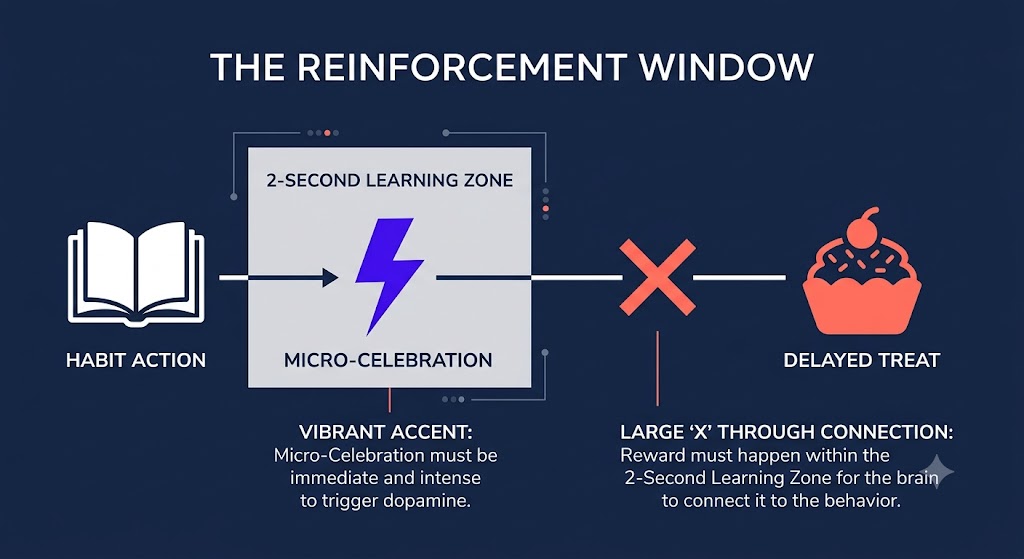
A micro-celebration is a deliberate burst of positive emotion you generate the instant the behavior ends. Not later that day, not at the end of the week. Seconds. The window matters because the wiring happens while the behavior is still fresh, and a reward that arrives an hour later attaches to whatever you were doing an hour later.
Three constraints make a celebration work. It has to be immediate, it has to cost effectively nothing, and it has to actually produce a feeling rather than a thought. "I noted that I did it" is a purely cognitive tick and does no reinforcing work. A fist pump, saying "that's who I am" out loud, a genuine grin at your own reflection, whispering "nailed it" - these land because they're physical and they carry emotion.
This might feel silly, and that's normal. The feeling of success is what the brain is encoding, and self-consciousness fades faster than the reinforcement does.
- Milo: So you did the one push-up. What happened next?
- Jessica: I got up and made coffee.
- Milo: Then the habit taught your brain nothing. What could happen in the two seconds before the coffee?
- Jessica: I could say "good" out loud, I guess. It feels a bit forced.
- Milo: Focus on the feeling of achievement. Does it land in your body, or is it just an observation?
- Jessica: Fine - fist pump, and "that's who I am." Two seconds, on the mat, before I stand up.
Notice Milo doesn't accept a mental acknowledgement. He pushes for something physical, timed to the exact moment the behavior ends.
Separate a Reinforcer from a Treat
Most people reach for rewards that quietly work against the habit. The test has two questions: does the payoff arrive within seconds, and does it reinforce the behavior or compete with it?
A treat is a pleasant thing you give yourself afterward. A reinforcer is a payoff tied so tightly to the behavior that it strengthens the loop. A pastry after a workout is a treat, and worse, it partly cancels the outcome the habit exists to produce. A Sunday cheat meal fails on both counts: it's days late and it frames the habit as something you endure until relief arrives.
The subtler trap is a reward that becomes the real behavior. Ten minutes of Instagram after reading one page looks harmless, but the scroll is more immediately rewarding than the page, and within a week you're doing the habit as a toll to pay for the scroll. If your reward is more compelling than your habit, you've built a habit of collecting the reward.
Additionally, watch for rewards that reintroduce the friction you removed. Anything requiring a purchase, an app, or a decision is too heavy for a behavior that takes thirty seconds.
Negotiate the Contract Before You Need It
External accountability catches the days your own reinforcement isn't enough. The Habit Contract has five elements, and skipping any one of them is how accountability quietly dissolves into two friends who used to text about it:
- Habit and Identity Statement: State what you are doing and why it matters to you so your partner knows what they are supporting.
- Observable Proof: Define something your partner can verify without taking your word for it, such as a photo, a timestamp, or a shared log.
- Check-in Rhythm: Set a cadence your partner will genuinely keep rather than the one that sounds most rigorous.
- Social Stake: Specify a consequence with real weight that you would both actually enforce.
- Named Accountability Partner: Explicitly name the person, because "I'll tell my friends" names nobody and binds no one.
Expect the negotiation to be blunt. A good partner will ask how they'll know you did it and what happens if you simply go quiet. Have answers ready.
This is where it gets concrete. A habit becomes durable when the payoff lands in seconds and someone else can see whether it happened. First a quick self-check on spotting celebrations that actually fire in time, then you'll assess four candidate rewards in writing before committing to one, and finally you'll negotiate the full contract live with a partner who won't accept a vague term.
