Anchoring Observable Cues
Anchoring Actions to Observable Cues
You now have a behavior small enough to survive a bad day. But a tiny behavior with no trigger just floats. The recipe you wrote last unit already has an anchor slot in it, and this unit is about filling that slot with something your brain can actually notice.
Write the Intention as "When X, Then I Will Y"
An Implementation Intention locks the behavior to a situation: "When [specific observable situation - time, place, or preceding event], then I will [specific behavior]." That's the whole form. The value sits entirely in the X.
X has to be something a stranger standing in your kitchen could see happen. "When I put my coffee mug in the sink" is observable. "When I have a free moment" is not, because free moments don't announce themselves. Pick the moment with the tightest boundaries you can find: not "after breakfast" (which spans forty minutes and ends fuzzily) but "when I set my plate in the dishwasher."
Then write Y with the same precision. "Then I will stretch" leaves a decision in the middle of it. "Then I will do one downward dog on the mat by the fridge" leaves none. Your intention should read like an instruction you could hand to someone else and have them execute correctly on the first try.
Diagnose and Rewrite Vague Triggers
Three trigger types fail predictably, and almost every plan you've abandoned used one of them:
- Time-of-day windows: "In the morning" gives you a hundred chances to do it and therefore no particular chance.
- "Later": This fails because later is always available, so it is never now.
- Mood triggers: "When I'm feeling motivated" or "when I'm calm enough" makes the cue dependent on the exact resource the habit was supposed to stop depending on. If the trigger requires you to already want it, the design is circular.
The rewrite move is simple: find something that already happens every day without your involvement, and hang the behavior off that.
- Nova: Your plan says you'll journal in the evening when things settle down. When did things settle down last night?
- Ryan: They didn't, really. Kid was up, then I was answering emails at ten.
- Nova: So the cue never fired. What's something that happened last night no matter what?
- Ryan: I plugged my phone in on the dresser. That happens every single night.
- Nova: Then say it back as a When-Then.
- Ryan: When I plug my phone in on the dresser, then I will write one line in the journal next to it.
Notice Nova never asks whether Ryan wanted to journal. She only asks what physically happened, then borrows a moment that already exists.
Make the Cue Impossible to Miss
A correct intention still fails if the cue is invisible at the moment it fires. Run yours through the Cue Salience Checklist:
- Is the cue visible?
- Is it in a path you already walk?
- Is it present before motivation is needed?
- Is it unmistakable to a distracted version of you?
That last question is the one people skip. Design for the version of you who is tired, holding a phone, and thinking about tomorrow, not the version reading this now. This means the gear goes in the physical path, not in storage. The journal sits on the dresser beside the charger. The mat stays unrolled in the walkway rather than folded in a closet. The book lies on the pillow, not on a shelf across the room. Visual priming isn't decoration; it converts an abstract intention into an object you trip over.
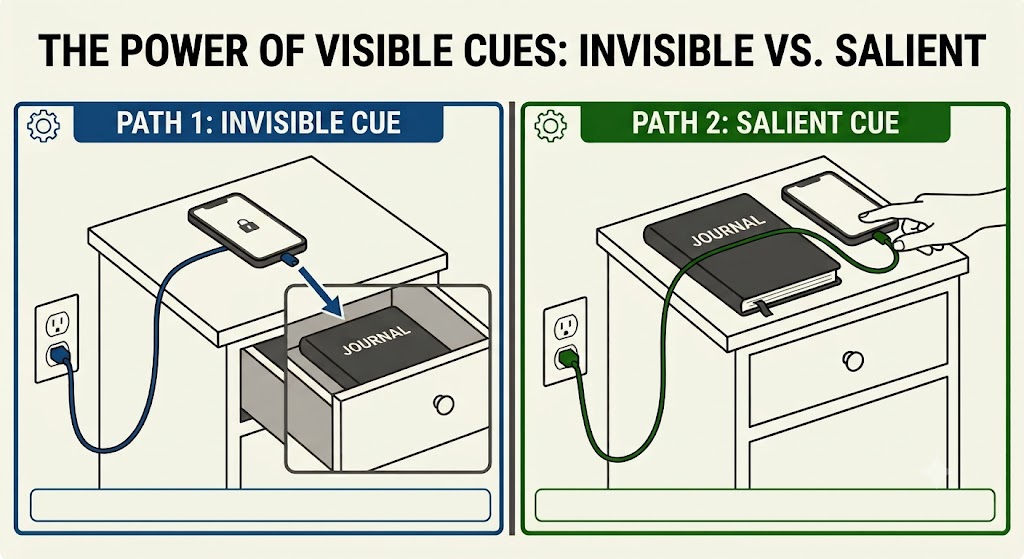
Ultimately, a habit doesn't run on intention; it runs on a moment you can see coming, made physically obvious before you need any willpower. This shift from abstract to physical is what allows your routine to survive the friction of a busy day.
In the upcoming practice, you'll start with a pattern-spotting check to identify well-formed When-Thens versus those with unobservable triggers. You’ll also rewrite a mood-based trigger and apply a placement fix. Before you start, pick one moment from yesterday that happened without fail and write your own When-Then against it.
