Shrinking the Behavior
Welcome to the Course
You've already picked your one target habit. The problem now isn't choosing what to do, it's that your plan almost certainly asks more of you than a bad Tuesday can supply. This course engineers the habit so that starting it costs less than skipping it.
By the end of this course, you'll be able to:
- Shrink your target habit to a version doable in under thirty seconds, even on your worst day
- Anchor that behavior to a specific, observable cue instead of a mood or a time window
- Diagnose vague triggers and rewrite them as concrete situational cues
- Strip the path to the behavior down to two clicks or its physical equivalent
- Stack the habit onto a reliable daily anchor and spot the three ways stacks fail
- Design an immediate micro-celebration and negotiate an accountability contract with real terms
This first unit deals with size, because every other design choice is wasted on a behavior that's too big to start.
Apply the Tiny Habits Recipe
BJ Fogg's Tiny Habits Recipe gives you the whole structure in one line: "After I [existing anchor], I will [tiny behavior doable in under 30 seconds], then I celebrate immediately." Three parts, no optional ones.
Notice what the recipe forces. It won't let you write "I'll read more in the evenings," because there's no anchor and no measurable behavior. It won't let you write "After dinner, I'll read for twenty minutes," because twenty minutes doesn't clear thirty seconds. And it won't let you finish without a celebration, which is the part almost everyone drops.
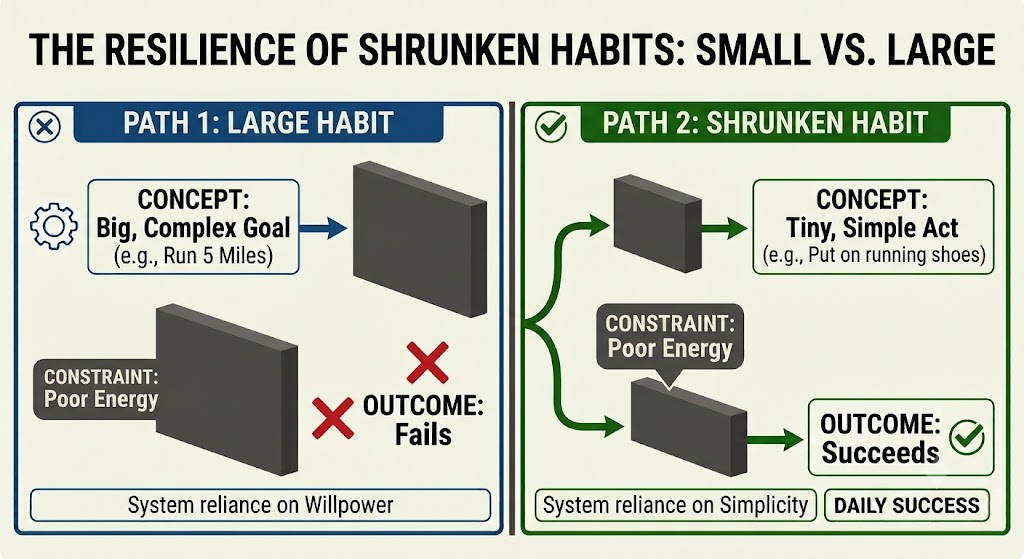
So take your target habit and cut it, not by ten percent but by an order of magnitude. Twenty minutes of yoga becomes one downward dog. Thirty minutes of writing becomes opening the document and typing one sentence. A full workout becomes two push-ups. You're not lowering your ambition. You're lowering the cost of the first repetition, which is the only thing standing between you and a streak.
Test It Against "Too Small to Fail"
Here's the test that does the real work. A shrunken behavior only counts if it's too small to fail: achievable on your busiest, lowest-energy day, not on an average one. Most people shrink to five minutes, feel proud, and stop. Five minutes is still a negotiation, and at 11 p.m. after a fourteen-hour day, you will lose that negotiation.
The way to run the test is to pick a specific bad day from the last month and walk it hour by hour. Not "a busy day" in the abstract. The actual Tuesday.
- Jake: So you've got it down to five minutes of reading after you brush your teeth. Walk me through last Tuesday, hour by hour.
- Chris: Meetings until 7, dinner at 9, dishes, then laid down around 11:40 with my eyes closing.
- Jake: At 11:40, do you open the book?
- Chris: Honestly? No. I'd tell myself I'd double up tomorrow.
- Jake: Then five minutes isn't your habit, it's your good-day habit. What survives 11:40?
- Chris: One page. Maybe one paragraph. That I'd actually do.
Watch what Jake never does: he never questions Chris's discipline. He just asks for the timeline and lets the plan fail on its own evidence. Run the same test on yourself, and if the behavior doesn't survive, cut it again and restate it in full recipe form with the celebration attached.
Design the Worst-Case Version
The version that clears the "too small to fail" test is your minimum viable version, and it needs two things your ambitious version never had. First, a completion standard with no judgment call in it. "One page" is a standard. "A bit of reading" is an invitation to argue with yourself while exhausted. Second, explicit non-goals name the extras you're giving yourself permission to skip on those days without calling the day a miss. If one page is done, the day "counts."
The takeaway is blunt: your habit is only as strong as its worst-day version, so design for that day first and let the good days overshoot on their own.
Next up is a quick fill-in-the-blank check to make sure you can reproduce the recipe from memory and shrink an oversized behavior on demand. Then you'll defend your own shrunken version live, against a coach who will ask you for the timeline of one specific bad day.
