The Marketing Landscape
The Marketing Landscape
In the last unit you defined demand generation by its intent: creating market demand and driving buyer engagement, not collecting contacts. That definition gets sharper once you can see where the discipline sits in the wider marketing organization and why it exists at all. This unit zooms out. You'll trace how marketing's evolution made demand generation a strategic necessity, locate it among adjacent functions, and learn to reframe ambiguous responsibilities into demand and non-demand work.
How Marketing Evolution Made Demand Generation Necessary
Demand generation is not a rebrand of old tactics; it emerged in response to concrete shifts in how buyers behave. Understanding those shifts is what lets you defend the discipline's existence rather than just assert it.
The first shift was the move from interruption to buyer control. For decades, marketing broadcast messages at passive audiences who had few alternatives. Digital channels handed control to buyers, who now complete most of their research independently before ever raising a hand. That created the first necessity: if buyers educate themselves before talking to you, someone has to shape that education and create interest upstream, well before the hand-raise.
The second shift was content saturation. Once every company started publishing, presence stopped being an advantage. The necessity here is engagement, not mere visibility: you have to earn attention with genuinely useful material, not simply exist in the feed.
The third shift was the rise of buying committees and longer, non-linear cycles. A single champion no longer decides; six to ten stakeholders weigh in across months. That made one-shot capture insufficient and created the necessity for sustained engagement across many people and many touches. Each shift points to the same conclusion: capturing existing demand was never going to be enough, so a discipline dedicated to creating and sustaining it became strategically necessary.
Where Demand Generation Fits Among Marketing Functions
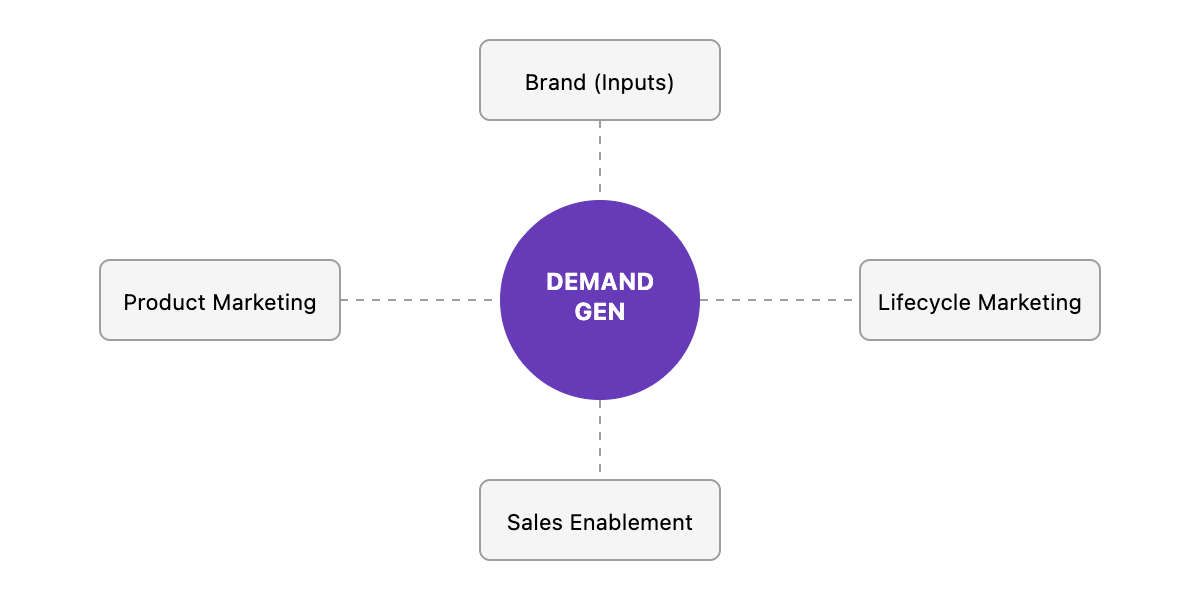 Once you accept why the discipline exists, the next question is where it lives. Picture the marketing ecosystem as a set of specialized functions: brand shapes long-term perception, product marketing owns positioning and messaging, paid media delivers reach through purchased channels, lifecycle nurtures known contacts, and sales enablement equips reps to close. Demand generation is not one more silo beside these; it is the connective function that orchestrates several of them toward a single purpose.
Concretely, demand generation borrows brand's perception, applies product marketing's positioning, uses paid media as a delivery mechanism, and hands engaged buyers to lifecycle and sales. That is exactly why it gets absorbed: because it uses paid media, people call it paid media; because it nurtures interest, people call it lifecycle. The distinction holds on purpose, not tools. Demand generation exists to create and move new demand toward the pipeline, a job none of the adjacent functions owns on its own.
Reframing Unclear Responsibilities as Demand or Non-Demand Work
Because demand generation draws on so many functions, ownership fights are inevitable. The move that resolves them is to stop asking "whose team runs this?" and start asking "which part of this creates demand, and which part serves another function?" Most ambiguous responsibilities are not one thing; they contain a demand-creating portion and a non-demand portion you can separate and assign cleanly.
- Chris: Webinars are product marketing's, right? They show off the product.
- Nova: Part of them, yes. The product deep-dive is enablement, so that's yours. But the session that surfaces a problem the market isn't paying attention to and pulls in new buyers, that's demand creation.
- Chris: So the same webinar can be split.
- Nova: Exactly. Demand gen owns the demand-creating angle and the audience-building; product marketing owns the product content. We just define the handoff between them.
Notice that nobody had to win the whole activity. Decomposing the task by intent gives each function a defensible slice and a clean interface, which is what actually prevents turf disputes.
The takeaway to carry: demand generation is a distinct, connective discipline that marketing's evolution made necessary, and you locate it by intent, not by tool or team. Ahead, you'll first pattern-spot the evolution shifts and the necessity each created, then produce a marketing fit audit you could hand to a VP, and finally take an ambiguous responsibility into a live conversation to split it into demand and non-demand work.
