Creating vs. Capturing Demand
The Demand and Lead Generation Distinction
In the last unit you located demand generation among adjacent functions and learned to split ambiguous work by intent. This unit sharpens the single distinction that gets blurred most often in practice: the difference between creating demand and capturing it. Get this one wrong and you will execute the wrong job with ruthless efficiency. The framework here is deliberately simple, but its consequences run through every campaign decision you make.
Distinguish Creating New Demand From Capturing Existing Demand
The Demand Generation vs. Lead Generation Distinction draws a clean line: demand generation creates demand, while lead generation captures demand that already exists. Creating demand means moving a buyer who does not yet recognize a problem toward seeing it, caring about it, and wanting to solve it. Capturing demand means converting someone who is already looking into a known contact you can route to sales.
The test is the buyer's starting state, not the tactic. A webinar that surfaces a problem the market is ignoring creates demand; a "request a demo" form captures it. Openly published content that shifts how a market thinks creates demand; a gated pricing guide captures the intent of people already shopping. Both are legitimate, and you need both. The error is assuming they are the same job, or that one can substitute for the other.
- Ryan: Our gated eBook pulled 400 form-fills last month. That's demand gen crushing it, right?
- Nova: Depends who filled it out. If they searched "vendor comparison" and downloaded it, you captured demand that already existed.
- Ryan: So it's lead gen wearing a demand gen badge.
- Nova: Pretty much. To actually create demand, that same content would need to reach people who don't yet know the problem is costing them, and it can't do that from behind a gate.
- Ryan: So the gate is fine, it's just doing capture, not creation.
- Nova: Right. And if capture is all we do, we slowly run out of aware buyers to capture.
Notice that the same asset can do either job depending on who it reaches and how it is packaged.
Diagnose the Strategic Misalignment Caused by Conflating the Two
Conflating creation with capture produces a predictable failure pattern, and you can spot it in a pipeline review: form-fill volume is high but qualified opportunities are flat. That gap is the signature of over-capturing a small pool of already-aware buyers while under-investing in creating new ones. You are working the bottom of a shrinking funnel harder and harder.
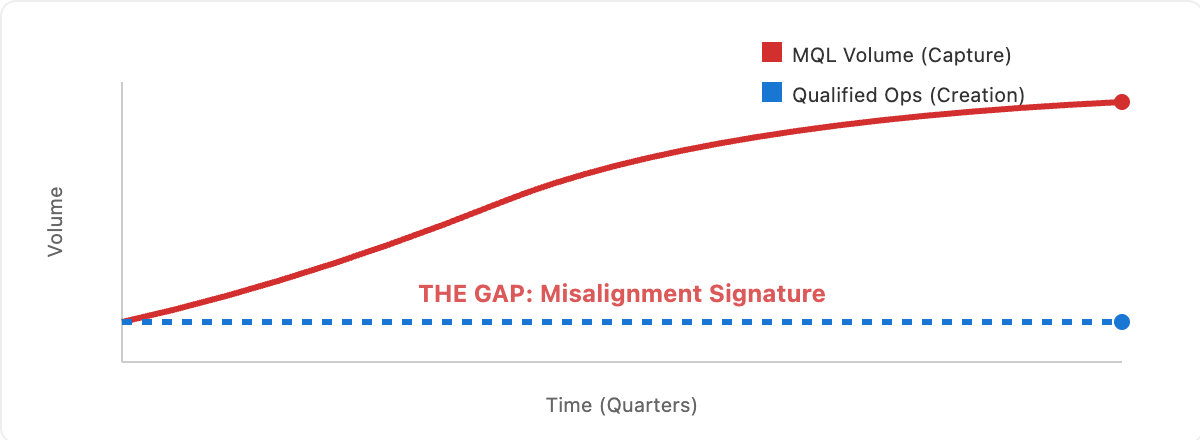
The symptoms cluster. Gating everything locks your best top-funnel education away from the unaware buyers who would benefit from it, so the addressable pool never expands. Treating MQL volume as the headline metric flatters the numbers while masking that you are recycling the same aware audience. And weak market education means nobody is doing the upstream work of turning latent problems into felt ones. Each symptom carries the same consequence: near-term lead counts hold up while future pipeline quietly starves.
Recommend Corrections That Rebalance Demand Creation With Demand Capture
The correction is not to abandon capture, which pays this quarter's bills, but to rebalance toward creation, which fills next quarter's. Start by ungating a portion of your education so it can actually reach unaware buyers and shift how the market thinks. Add genuinely demand-creating content that surfaces the problem before pitching the solution. Then redefine success beyond raw MQL volume, tracking signals like engaged accounts and influenced pipeline that reflect demand being created, not just harvested.
Do this honestly, acknowledging the revenue pressure behind the capture bias. Frame the shift as staged and measurable rather than all-or-nothing: hold most capture intact, reallocate a defined slice to creation, and agree in advance on how you will read the results.
The takeaway to carry: the distinction turns on the buyer's starting state, and conflating the two quietly starves your pipeline even while the lead numbers look healthy. Ahead you will first pattern-spot campaign scenarios as creation, capture, or conflation, then write a diagnosis sharp enough to hand to leadership, and finally defend a rebalanced mix in a live conversation where the revenue pressure pushes back.
