The Demand Generation Charter
The Demand Generation Charter
Across this course you've defined demand generation, located it among adjacent functions, and drawn the line between creating and capturing demand. This closing unit turns all of that into a durable document. A Demand Generation Charter is the artifact that fixes what the discipline owns, where it stops, and how its impact is judged, so the distinctions you've learned survive contact with annual planning and turf negotiations.
Identify the Core Activities That Create Demand and Drive Engagement
Before you can scope a charter, you need to know what genuinely belongs inside it. Demand generation's core activities cluster around two jobs: creating market demand and driving buyer engagement. Creating demand is upstream work: publishing point-of-view content that reframes a problem, running educational webinars that surface a cost the market is ignoring, seeding original research that shifts how buyers think about their situation. Driving engagement is the sustaining work that keeps an activated buyer moving: nurturing interest across channels, orchestrating retargeting that deepens a developing conviction, and hosting community or events that keep your point of view in front of an audience already leaning in.
Notice that both jobs share a signature: they act on the buyer's belief and motivation, not just their contact record. That is the test for whether an activity is core. A gated form that harvests names is capture, not creation. A product spec sheet is enablement. But a webinar that makes an operations leader realize stale reporting is quietly costing them decisions is demand generation doing its actual job.
Define the Scope, Responsibilities, and Boundaries of the Charter
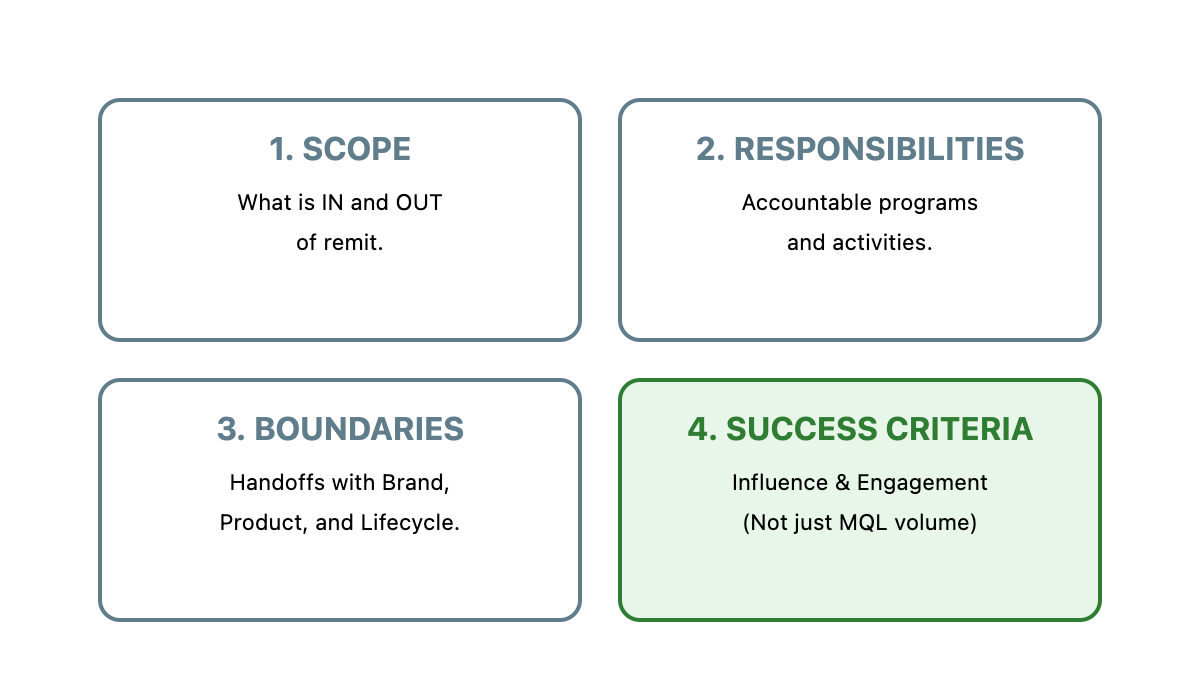
With the core activities identified, the charter gives them structure through four parts. Scope states what is in and out of remit, the single most important section for preventing scope creep. Responsibilities names the specific functions and activities the team owns, translating scope into accountable work. Boundaries and Expectations define the shared interfaces with adjacent teams (brand, product marketing, lifecycle, sales enablement) and set expectations for how handoffs work. Success Criteria define how impact is measured.
The discipline of a good charter lives in what it excludes. If you claim everything, you own nothing defensible. So the charter should explicitly list out-of-scope work: brand owns perception, lifecycle nurtures known contacts post-conversion, sales enablement equips reps, and demand generation hands off to each at a named interface rather than blurring into them. Clean boundaries are what let an executive endorse the function without fearing a land grab.
Design Success Criteria Aligned to the Discipline's Unique Capabilities
The final section is where charters most often fail. Because lead volume is easy to report upward, the temptation is to borrow MQL counts as the headline metric. But measuring demand creation by lead volume misrepresents the discipline, rewarding capture while starving the upstream work you just fought to protect. Success criteria should instead track the discipline's unique capabilities: market awareness, engaged accounts, influenced pipeline, and funnel velocity. These ladder to revenue while actually measuring demand being created.
- Chris: I need something I can put in front of leadership. Why not just report MQLs?
- Nova: Because MQLs only count buyers already looking. If that's our scorecard, we'll optimize for capture and quietly stop creating demand.
- Chris: So how would I report influence instead?
- Nova: Engaged accounts and influenced pipeline. Both tie to revenue, and both show demand we generated rather than harvested.
Watch how the defense connects each metric back to revenue: that ladder is what earns the function its distinct standing.
Everything above stays abstract until you put it to work. First you'll pattern-spot which activities primarily create demand versus drive engagement, then you'll draft a charter outline specific enough to prevent turf disputes, and finally you'll defend your success criteria in a live review where the pull toward lead-volume metrics pushes back. The insight to carry through all three: a charter earns its standing by what it refuses to own and by measuring the demand it creates, not the leads it collects.
