The Demand Generation Discipline
Welcome to the Course
As a Digital Marketing Manager standing up a demand generation function, you're being asked to build something most of your stakeholders can't cleanly define. That ambiguity is a risk: when nobody agrees what demand generation is, your budget gets absorbed into paid media, your work gets confused with lead capture, and your success gets reduced to form-fill counts. This course gives you the definitions, boundaries, and rationale to establish demand generation as its own discipline and defend that standing with executives and peers.
By the end of this course, you'll be able to:
- Define demand generation as the discipline that creates market demand and buyer engagement
- Distinguish creating new demand from capturing existing demand, and diagnose the misalignment that conflating them causes
- Locate demand generation within the broader marketing landscape and reframe ambiguous responsibilities into demand and non-demand work
- Draft a demand generation charter with scope, boundaries, and success criteria aligned to the discipline's unique capabilities
This first unit starts at the foundation: what demand generation actually is, what makes it distinct from adjacent work, and how to translate its purpose into language your team can use to settle scope debates.
What Demand Generation Actually Is
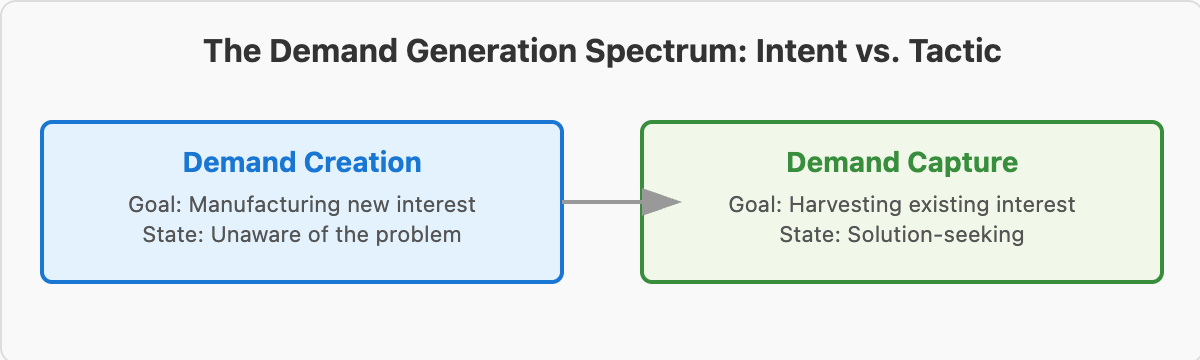
Demand generation is the discipline that creates market demand and drives buyer engagement. Read that definition slowly, because both verbs matter. "Creates market demand" means you are generating interest that did not previously exist: helping buyers recognize a problem they were tolerating, or reframing a priority they hadn't connected to your category. "Drives buyer engagement" means you are building a relationship with those buyers over time, not just intercepting them at the moment they raise their hand.
That is the distinction that trips up most teams. A gated eBook that collects email addresses is not creating demand; it is harvesting people who already went looking. A branded awareness campaign builds recognition, but recognition is not the same as an active buyer who now believes they have a problem worth solving. Demand generation sits upstream of the hand-raise. Its job is to manufacture the interest that everything downstream depends on.
- Chris: Our demand gen numbers look great this quarter. Form fills are up forty percent.
- Nova: Are those new buyers, or people who were already searching for a tool like ours?
- Chris: Mostly bottom-of-funnel search traffic, honestly.
- Nova: Then we captured demand that already existed. We didn't create any. If we stopped, that pool doesn't grow, it just gets picked over faster.
- Chris: So the forty percent isn't really demand gen working. It's demand capture working.
Notice that the metric looked like success but described the wrong activity. That gap between "collecting contacts" and "creating demand" is the single most important idea in this unit.
The Principles That Set It Apart
Once you hold that definition, the boundaries with adjacent functions get sharper. Lead generation captures existing demand: it converts already-aware buyers into named contacts through forms, gates, and offers. Brand shapes perception and long-term associations, but it does not aim to move a specific buyer toward action on a timeline. Lifecycle marketing nurtures contacts you already know, deepening relationships with people already in your database. Each is legitimate and necessary, but none of them creates new market demand.
The clarifying principle is intent, not tactic. The same channel can belong to different disciplines depending on what it is trying to do. A webinar that teaches an audience why a neglected problem is costing them money is demand generation; the registration form on that webinar is lead generation. A retargeting ad that re-engages someone who already visited a pricing page is capture, not creation. When you classify work, ask what the activity is trying to accomplish: is it creating interest that wasn't there, or acting on interest that already exists? That question does more to sort your roadmap than any list of channels ever will.
Turning Purpose into an Operating Statement
Definitions are only useful if your team can quote them under pressure. That's why the last move in this unit is translating demand generation's purpose into a short operating statement: a plain-language anchor that names what the discipline exists to do, what it prioritizes, and how it differs from adjacent work. A good one reads like a decision filter, not a mission-statement platitude. When someone asks "should we own this?", the team should be able to hold the work against the statement and answer in seconds. The failure mode to avoid is drift into lead-capture language, where "generate demand" quietly becomes "hit the MQL number."
The takeaway to carry: demand generation is defined by intent to create interest and engagement, not by the tools it uses or the contacts it collects. A run of practice sits ahead of you. First you'll pattern-spot: a quick self-check sorting realistic activities by whether they create demand or merely capture it. Then you'll teach that distinction to a new teammate live, and finally draft the operating statement your team will actually reference in planning. The definition only earns its keep when you can apply it fast and out loud.
