Contracting Clear Hand Offs
📦 Contracting a Clean Hand Off
You've chosen the task, matched it to the right person, and right-sized the stretch so it challenges without overwhelming. Now comes the moment that makes or breaks all that careful setup: the actual hand off. Done well, the person walks away owning the work, clear on what "good" looks like and how much room they have to act. Done badly, they walk away confused, hovered over, or quietly left to sink.
By the end of this lesson, you will have learned to:
- Tell strategic delegation apart from dumping and abdication.
- Run a kickoff that aligns on all six elements of the Delegation Setup Checklist.
- Write a brief that transfers ownership while keeping detail proportionate to the risk.
🚦 Delegation Is Not Dumping or Disappearing
Three moves can look similar from the outside but feel completely different to the person on the receiving end, so it's worth learning to tell them apart:
| Move | What it looks like | The tell |
|---|---|---|
| Dumping | Offloading a task you don't want, with thin context and no support, often last-minute. | Your motive is clearing your own plate, not growing anyone. |
| Abdication | Handing the work over, saying "it's all yours," then vanishing — no agreed outcome, no check-ins. | You're caught off guard when it drifts, and tempted to blame the person. |
| Strategic delegation | Transferring ownership of meaningful work while you stay on the hook for the outcome. | You share accountability; you never shed it. |
Strategic delegation sits deliberately between the two failures. You transfer ownership of a meaningful piece of work, and here's the part that matters most: you stay on the hook for the outcome even though the other person runs the execution. Delegation shares accountability; it never sheds it. That single idea is what keeps you from drifting into either ditch.
✅ Run the Kickoff Checklist
The way you prevent both dumping and disappearing is a proper kickoff conversation. To keep it complete, run through the Delegation Setup Checklist — six things to align on before the person starts:
- Desired outcome and why it matters — so they aim at a result, not just steps.
- Success criteria — the concrete signs that tell you both the work is finished and good.
- Authority level — how much they can decide on their own.
- Resources and boundaries — what they can use, who they can pull in, where the guardrails sit.
- Check-in points and cadence — agreed up front so a check-in feels expected, not like snooping.
- Deadline.
Authority is the piece managers most often leave fuzzy, and it's the piece that causes the most friction later. It helps to name one of three settings:
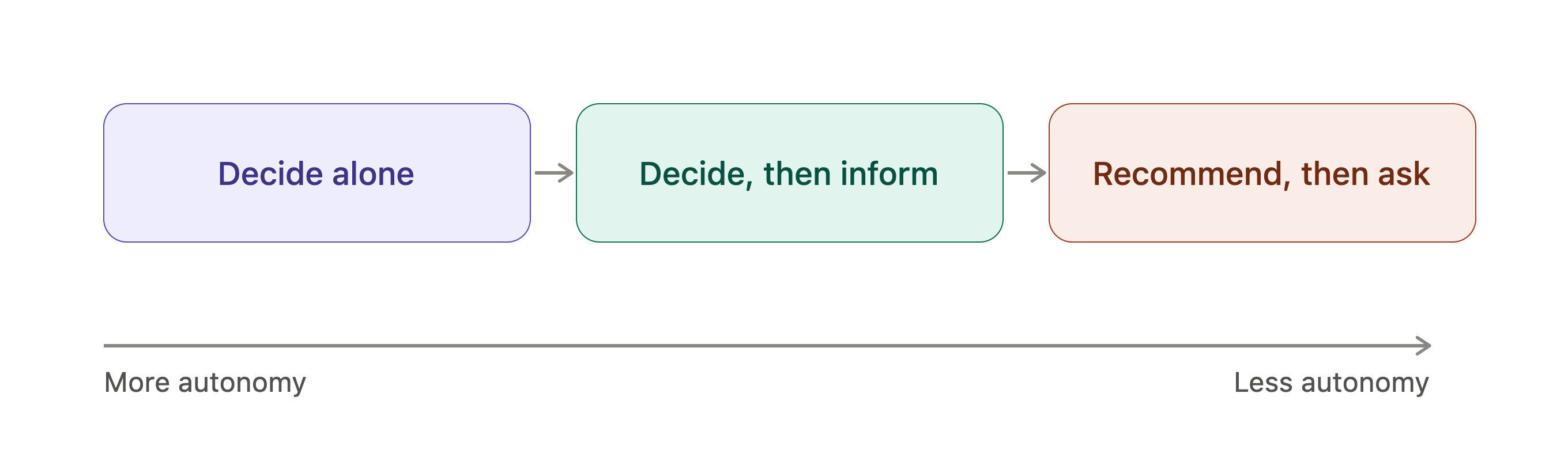
- Decide Alone — they act without asking. Best for routine, low-risk calls where waiting on you would only slow things down and add no value.
- Decide-then-Inform — they act, then tell you afterward. Useful when speed matters but you still need visibility, so a quick note or tracker entry keeps you in the loop without creating a bottleneck.
- Recommend-then-Ask — they bring you a recommendation and wait for a yes before acting. Reserved for high-stakes or irreversible decisions where the outcome changes materially and you need to weigh in first.
Here's a manager, Victoria, making the authority level explicit with Tom before he starts running the onboarding schedule:
- Victoria: You'll own the onboarding schedule end to end, and I want you clear on where your own judgment runs. Say a manager asks to move a session — would you feel comfortable just saying yes to that yourself?
- Tom: I wasn't sure, honestly. I figured I'd check with you each time.
- Victoria: That's a fair instinct. Here's how I'd think about it: for routine reschedules, go ahead and decide on your own, just note it in the tracker. If someone wants to cut a session entirely, bring me a recommendation first, since that changes what new hires actually get.
- Tom: Got it. So small moves are mine, and anything that changes the content comes to you.
- Victoria: Exactly. That way you're not stuck waiting on me for the small stuff, and I'm not surprised by the big stuff.
Notice how the authority conversation named precisely which decisions are Tom's and which route back to Victoria. No guessing, no bottleneck, and no nasty surprises.
✍️ Write a Brief That Transfers Ownership
Once you've talked it through, capture it in a short written brief the person can keep. The brief is simply the checklist written down: outcome and why, success criteria, authority level, resources and boundaries, check-ins, and deadline. Its job is to be a charter they can act from without re-reading your mind every day.
The skill here is matching the depth of the brief to the task's risk and the person's readiness, not padding it out of anxiety. A low-risk task for someone capable needs only a light brief. A high-visibility deliverable warrants more explicit language about authority and check-ins, but it still is not a step-by-step script. Spelling out every move signals distrust and quietly pulls ownership back to you, which defeats the whole point. Be crisp about what's theirs to decide and vague about nothing that matters, but resist narrating the how. Ownership grows in the space you leave for their judgment.
The heart of this lesson is simple: delegation is a deliberate contract that transfers ownership while keeping you accountable, and clarity on the six elements — especially authority — is what separates it from dumping or disappearing. A few practices sit ahead of you now. You'll first sort real hand off examples into delegation, dumping, or abdication to sharpen your eye for the difference, then run a live kickoff conversation using the checklist, and finally draft a brief someone could actually work from. Before then, try this on your next hand off: say out loud which of the three authority levels the person has, and watch how much second-guessing it removes.
